
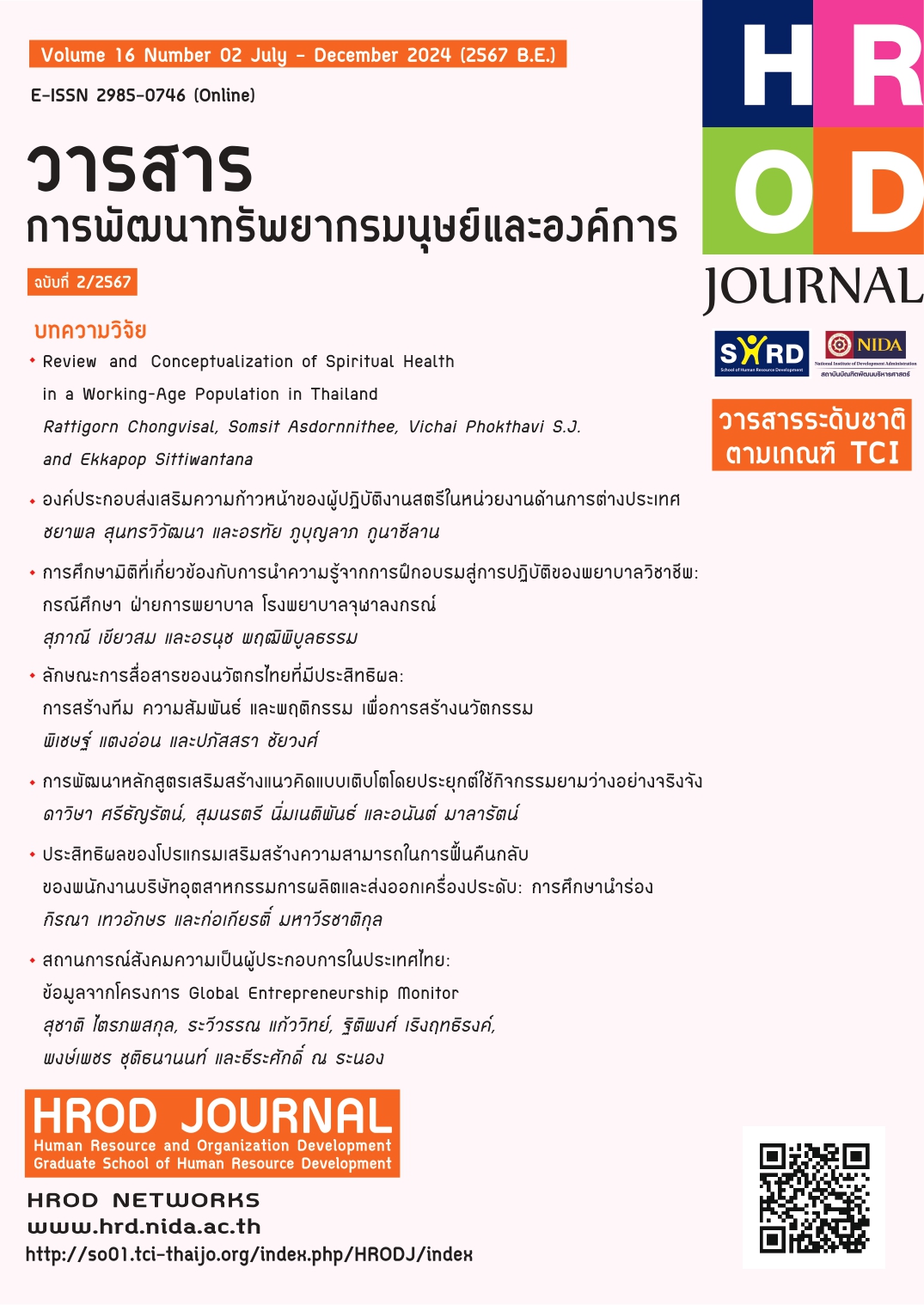
คุณลักษณะการสื่อสารของนวัตกรไทยที่มีประสิทธิผล: การสร้างทีม ความสัมพันธ์ และพฤติกรรม เพื่อการสร้างนวัตกรรม
Article Sidebar
Main Article Content
บทคัดย่อ
การวิจัยนี้มีวัตถุประสงค์เพื่อค้นหาคุณลักษณะการสื่อสารของนวัตกรที่มีประสิทธิผลในทีมสร้างนวัตกรรมของประเทศไทย เป็นการวิจัยเพื่อการสำรวจหรือการวิจัยเชิงบุกเบิกด้วยระเบียบวิธีวิจัยเชิงคุณภาพเป็นหลัก กลุ่มตัวอย่างได้แก่ นวัตกรที่มีประสิทธิผล (มีผลงานอย่างต่อเนื่อง) จำนวน 20 ท่าน สุ่มแบบหลายขั้นตอนร่วมกับการสุ่มแบบเจาะจงจากฐานข้อมูลสิทธิบัตรของกรมทรัพย์สินทางปัญญา ใช้การสัมภาษณ์เจาะลึกเป็นเครื่องมือหลักในการวิจัย วิเคราะห์ข้อมูลจากการสัมภาษณ์ด้วยการวิเคราะห์แก่นสาระ ผลการวิจัยแบ่งได้เป็น 2 ส่วน คือ 1) โครงสร้างความสัมพันธ์: สมาชิกในทีมสร้างนวัตกรรมมักมีความเชี่ยวชาญที่หลากหลายแต่มีทัศนคติและวิธีคิดที่สอดคล้องกัน ทำให้ทำงานร่วมกันได้เป็นอย่างดี สมาชิกแต่ละคนจะได้รับมอบหมายบทบาทแตกต่างกันไปตามความสามารถ ความสัมพันธ์ภายในทีมจะอยู่บนพื้นฐานของการทำงานเป็นหลัก และ 2) พฤติกรรมการสื่อสารกลุ่ม: ทีมสร้างนวัตกรรมเปิดกว้างทางความคิดแต่ยังมีการคิดตามกลุ่มเกิดขึ้นอยู่บ้าง การแสดงความคิดเห็นต้องมีหลักฐานทางวิชาการสนับสนุน สมาชิกทีมสร้างนวัตกรรมมักทำงานร่วมกันเป็นกลุ่มย่อยแบบไม่เป็นทางการ เพราะคล่องตัวและแก้ไขปัญหาได้ทันท่วงที มีการแลกเปลี่ยนข้อมูล/การถ่ายทอดความรู้เป็นพฤติกรรมที่เกิดขึ้นอยู่ตลอด ส่วนการทำงานร่วมกันเป็นกลุ่มใหญ่ จะใช้ตัดสินใจหรือแก้ไขปัญหาร่วมกัน โดยโต้แย้งแสดงเหตุผลเพื่อลดตัวเลือกแล้วผู้นำตัดสินใจอีกครั้ง
Article Details

อนุญาตภายใต้เงื่อนไข Creative Commons Attribution-NonCommercial-NoDerivatives 4.0 International License.
1) เนื้อหาทั้งหมดของบทความที่ลงตีพิมพ์ในวารสารการพัฒนาทรัพยากรมนุษย์และองค์การ เจ้าของผลงานมีการคิด ค้นคว้า ทบทวนวิเคราะห์ สรุป เรียบเรียงและอ้างอิงข้อมูลโดยผู้แต่งเอง กองบรรณาธิการไม่มีส่วนร่วมรับผิดชอบ
2) บทความที่ตีพิมพ์ในวารสารนี้ ต้องไม่เคยได้รับการตีพิมพ์เผยแพร่ที่ใดมาก่อน และไม่อยู่ระหว่างการเสนอเพื่อพิจารณาตีพิมพ์ในวารสารฉบับอื่น หากตรวจพบว่า มีการตีพิมพ์ซ้ำซ้อน ถือเป็นความรับผิดชอบของผู้แต่งแต่เพียงผู้เดียวในการละเมิดลิขสิทธิ์
3) ผลงานที่ได้รับการตีพิมพ์ในวารสารวิชาการ ถือเป็นกรรมสิทธิ์ของวารสารห้ามนำข้อความทั้งหมดหรือบางส่วนไปพิมพ์ซ้ำ เว้นเสียแต่ว่าจะได้รับอนุญาตจากทางกองบรรณาธิการวารสารฯ
เอกสารอ้างอิง
กรมทรัพย์สินทางปัญญา. (2563, 15 มิถุนายน). ระบบสืบค้นข้อมูลสิทธิบัตรออนไลน์. http://patentsearch.ipthailand.go.th
ปภัสสรา ภวภูตานนท์ ณ มหาสารคาม. (2545). การสื่อสารในกระบวนการตัดสินใจของทีมบริหารในองค์กรร่วมทุนระหว่างประเทศไทย-อเมริกันในประเทศไทย [วิทยานิพนธ์นิเทศศาสตรมหาบัณฑิต, จุฬาลงกรณ์มหาวิทยาลัย]. http://doi.org/10.14457/CU.the.2002.545
วิรยา ขุนพรหม. (2543). การสร้างแนวคิดเชิงทฤษฎีที่เกี่ยวกับความสามารถในการสื่อสารระดับกลุ่มในองค์กรไทย [วิทยานิพนธ์นิเทศศาสตรมหาบัณฑิต, จุฬาลงกรณ์มหาวิทยาลัย]. http://doi.org/10.14457/CU.the.2000.342
สำนักงานนวัตกรรมแห่งชาติ. (2563, 15 มิถุนายน). รางวัลนวัตกรรมแห่งชาติ. https://award.nia.or.th
Beckett, R., & Hyland, P. (2009). Effective communication in innovation processes. In K. Becker (Ed.), Enhancing the innovation environment: Proceedings of the 10th international CINet conference (pp. 96-106). CINet. https://eprints.qut.edu.au/27155/
Blasini, B., Dang, R. J., Minshall, T., & Mortara, L. (2017). The role of communicators in innovation clusters. In N. Pfeffermann & J. Gould (Eds.), Strategy and communication for innovation: Integrative perspectives on innovation in the digital economy (pp. 185-203). Springer International Publishing. https://doi.org/10.1007/978-3-319-49542-2_12
Bruhn, M., & Ahlers, G. M. (2017). Integrated communication in the innovation process—An approach to integrated innovation communication. In N. Pfeffermann & J. Gould (Eds.), Strategy and communication for innovation: Integrative perspectives on innovation in the digital economy (pp. 205-225). Springer International Publishing. https://doi.org/10.1007/978-3-319-49542-2_13
Chollathanrattanapong, J. (2022). The effects of transformational leadership on team innovation: The case of private universities in Thailand. Journal of Business Administration The Association of Private Higher Education Institutions of Thailand, 11(1), 91-105. https://so02.tci-thaijo.org/index.php/apheitvu/article/view/254636
Coleman, J. S. (1988). Social capital in the creation of human capital. American Journal of Sociology, 94, S95-S120. http://www.jstor.org/stable/2780243
Eppler, M. J., & McGrath, L. (2017). Pairwise communication for innovation at work. In N. Pfeffermann & J. Gould (Eds.), Strategy and communication for innovation: Integrative perspectives on innovation in the digital economy (pp. 91-111). Springer International Publishing. https://doi.org/10.1007/978-3-319-49542-2_7
Farace, R. V., Monge, P. R., & Russell, H. M. (1977). Communicating and organizing. Addison-Wesley Pub. Co.
Frey, L. R. (Ed.). (2003). Group Communication in Context: Studies of Bona Fide Groups (2nd ed.). Routledge.
Granovetter, M. (1983). The strength of weak ties: A network theory revisited. Sociological Theory, 1, 201-233. https://doi.org/10.2307/202051
Granovetter, M. S. (1973). The strength of weak ties. American Journal of Sociology, 78(6), 1360-1380. https://doi.org/10.1086/225469
Hansen, M. T. (1999). The search-transfer problem: The role of weak ties in sharing knowledge across organization subunits. Administrative Science Quarterly, 44(1), 82-111. https://doi.org/10.2307/2667032
Heider, F. (1958). The psychology of interpersonal relations. John Wiley & Sons Inc. https://doi.org/10.1037/10628-000
Hollingshead, A. B., Wittenbaum, G. M., Paulus, P. B., Hirokawa, R. Y., Ancona, D. G., Peterson, R. S., Jehn, K. A., & Yoon, K. (2005). A look at groups from the functional perspective. In M. S. Poole & A. B. Hollingshead (Eds.), Theories of small groups: Interdisciplinary perspectives (pp. 21-62). SAGE Publications. https://doi.org/10.4135/9781483328935
Infante, D. A., Rancer, A. S., & Womack, D. F. (2003). Building communication theory (4 ed.). Waveland Press.
Kratzer, J., Leenders, R.T.A.J. and Van Engelen, J.M.L. (2005). Informal contacts and performance in innovation teams. International Journal of Manpower, 26(6), 513-528. https://doi.org/10.1108/01437720510625430
Li, D., Wei, Y. D., Miao, C., Wu, Y., & Xiao, W. (2019). Innovation, network capabilities, and sustainable development of regional economies in China. Sustainability, 11(17). https://doi.org/10.3390/su11174770
Monge, P. R., & Contractor, N. S. (2003). Theories of communication networks. Oxford University Press.
Monge, P. R., Cozzens, M. D., & Contractor, N. S. (1992). Communication and motivational predictors of the dynamics of organizational innovation. Organization Science, 3(2), 250-274. https://doi.org/10.1287/orsc.3.2.250
Morgan, G., & Sørensen, J. B. (2014). Unpacking the relationships between conflicts and team innovation: The role of conflict management styles. Management Decision, 52(5), 925–941.
Morgeson, F. P., DeRue, D. S., & Karam, E. P. (2010). Leadership in teams: A functional approach to understanding leadership structures and processes. Journal of Management, 36(1), 5–39. https://doi.org/10.1177/1046496419827376
Nelson, R. E. (1989). The strength of strong ties: Social networks and intergroup conflict in organizations. The Academy of Management Journal, 32(2), 377-401. https://doi.org/10.2307/256367
Özmen, Ö., Yilmaz, L., & Smith, J. (2016). The impact of socio-technical communication styles on the diversity and innovation potential of global science collaboratories. Computational and Mathematical Organization Theory, 22(4), 521-548. https://doi.org/10.1007/s10588-016-9213-5
Putnam, L. L., & Stohl, C. (1990). Bona fide groups: A reconceptualization of groups in context. Communication Studies, 41(3), 248-265. https://doi.org/10.1080/10510979009368307
Rafols, I., & Meyer, M. (2010). Diversity and network coherence as indicators of interdisciplinarity: Case studies in bionanoscience. Scientometrics, 82(2), 263-287. https://doi.org/10.1007/s11192-009-0041-y
Sarker, S. (2017). Knowledge Transfer and Collaboration in Distributed U.S.-Thai Teams. Journal of Computer-Mediated Communication, 10(4). https://doi.org/10.1111/j.1083-6101.2005.tb00278.x
Sherif, M. (1958). Superordinate Goals in the Reduction of Intergroup Conflict. American Journal of Sociology, 63(4), 349-356. https://doi.org/10.1086/222258
Shin, S. J., & Zhou, J. (2003). Transformational leadership, conservation, and creativity: Evidence from Korea. Academy of Management Journal, 46(6), 703–714. https://doi.org/10.2307/30040662
Therawong, S. (2018). Causal relationship model of internal communication innovation in leading organizations of thailand [Doctoral dissertation, National Institute of Development Administration]. https://repository.nida.ac.th/bitstream/handle/662723737/6398/b208129.pdf
Tuckman, B. W., & Jensen, M. A. C. (1977). Stages of small-group development revisited. Group & Organization Studies, 2(4), 419-427. https://doi.org/10.1177/105960117700200404
Van der Voet, J., & Steijn, B. (2020). Team innovation through collaboration: how visionary leadership spurs innovation via team cohesion. Public Management Review, 23(9), 1275–1294. https://doi.org/10.1080/14719037.2020.1743344
Weick, K. (2005). Information Systems Approach to Organizations. In E. Griffin & G. McClish (Eds.), A First Look at Communication Theory (pp. 278-288). McGraw-Hill. https://www.afirstlook.com/docs/infosystems.pdf
