
Development of Chrysanthemum Drying Process for the Sa-Ngo Royal Project Development Center, Chiang Rai Province
Article Sidebar
Main Article Content
Abstract
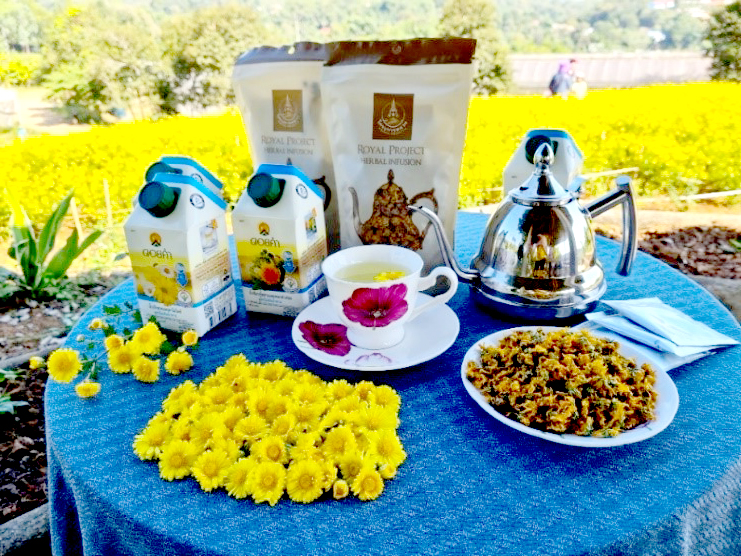
Chrysanthemum flower (Chrysanthemum indicum Linn) cultivation is the main occupation of farmers in the area of Sri Don Mun subdistrict, Chiang Rai province, Thailand. The flowers are harvested and sold to the Sa-Ngo Royal Project Development Center for the drying process. However, the previously-used dryers were unable to dry the flowers in time, resulting in a spoiled product. This research project aims to develop an efficient drying process and drying plants for the Sa-Ngo Royal Project Development Center to comply with the safety standards at the level of community enterprises to support flowers product from the farmers. The result showed that after the improvement of the dryer, the upgraded dryer had a drying rate of 0.127 (gwater/gdry matter)* min, the rate of return (ROR) was 206.61% per year, and the break-even point (BP) of the cost was 6 months. The selling income of fresh chrysanthemums flower increased from 42.50 to 47 baht per kg. As a result, the higher purchasing price of harvested materials had welcomed more farmers to join the program from 10 to 250 families, projecting a total income of over 5.85 million baht in 2020. In conclusion, this subsidy guidance follows the policy of promoting the sustainability of the Royal Project Development Center and strengthens the center as a revenue-generating source for local farmers according to the sufficiency economy philosophy.
Article Details

This work is licensed under a Creative Commons Attribution-NonCommercial-NoDerivatives 4.0 International License.
Area Based Development Research Journal values copyright protection and licensing to safeguard author rights and facilitate the appropriate dissemination of research. Our policies ensure openness, accessibility, and attribution. Authors retain copyright ownership, and articles are published under a Creative Commons Attribution License (CC BY), allowing sharing, adaptation, and proper attribution. Authors have the freedom to publish under the CC BY license, granting broad reuse and distribution permissions. The journal supports posting articles on third-party repositories, adhering to institutional and funding restrictions. Author guidelines detail copyright and licensing requirements, empowering authors with knowledge about their rights and responsibilities. These policies cultivate an environment of collaboration, openness, and responsible sharing, benefiting authors and the research community while honoring intellectual property rights.
References
Arpanutud, P. (2015). Implementation of food safety management system in Thai small and medium food processing enterprises: Institutional and resource dependence perspective. Journal of Public and Private Management, 22(2), 175-203. (in Thai).
Assawarachan, R. (2020). Fundamentals of drying technology in food engineering. Chiangmai: Meajo University. (in Thai).
Boonchan, A., Ratiosom, S., & Parinyasiri, T. (2016). Developing ready-to-eat food manufacturers’ readiness to follow good manufacturing practice regulation in Samut Sakhon. Electronic Journal of Open and Distance Innovative Learning, 6(1), 91-113. (in Thai).
Chaiyaprinan, S. (2011). Engineering design of energy thermal and fluid system. Bangkok: Chulalongkorn University Press. (in Thai).
Charalambous, M., Fryer, P. J., Panayides, S., & Smith, M. (2015). Implementation of food safety management systems in small food businesses in Cyprus. Journal of Food Control, 57, 70-75.
Chokratanachai, W., & Klomjoho, S. (2017). Sustainable development of crispy rice production for commercial food production standards by community participation. Area Based Development Research Journal, 9(1), 8-22. (in Thai).
Srikaeo, K. (2013). Quality management in the food industry. Bangkok: Chulalongkorn University Press. (in Thai).
Suriyakunthorn, P., Jino, P., & Assawarachan, R. (2014). Effect of blanching pretreatment and drying model of chrysanthemum indicum Linn. Thai Society of Agricultural Engineering, 20(2), 43-51. (in Thai).
