
Design and Development of Phii Talok Art Toys from Cultural Capital in Uttaradit Province, Thailand
Article Sidebar
Main Article Content
Abstract
Background: The Phii Talok Parade, a vibrant and distinctive tradition of Tha Pla District, Uttaradit Province, in Northern Thailand serves as a living expression of the community’s cultural identity and history. Despite its cultural significance, the parade remains relatively unknown beyond the local area. This research aimed to design and develop Phii Talok–inspired art toys as a medium for raising public awareness, revitalizing local heritage, and engaging youth in creative cultural preservation. By transforming intangible cultural capital into tangible, contemporary products, the initiative sought to bridge traditional customs with modern consumer appeal, thereby contributing to sustainable community development.
The research engaged key stakeholders from local cultural organizations, government agencies, and educational institutions, alongside 100 upper secondary students from Tha Pla Pracha Uthit School. The process began with a cultural mapping of the Phii Talok tradition, which is held annually in October. The first day features subdistrict-level parades, displays of local products, and participation primarily from residents and neighboring communities. This stage identified the tradition’s cultural elements, audience profile, and opportunities for reinterpretation.
Stakeholders participated in structured brainstorming and SWOT analysis sessions to assess the strengths, weaknesses, opportunities, and challenges of transforming the Phii Talok tradition into creative products. From these discussions, strategies emerged for reimagining the characters as collectible art toys aligned with current consumer trends, particularly the Japanese-inspired kawaii aesthetic. The aim was to maintain cultural authenticity while ensuring contemporary marketability.
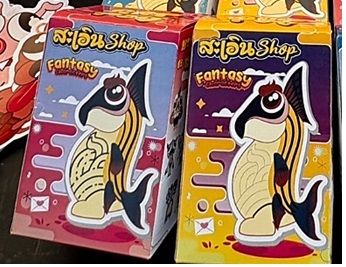
Students were then immersed in a hands-on workshop based on design thinking methodology, moving from empathy and ideation to prototyping and testing. Eleven original Phii Talok characters were conceptualized, each rooted in local ghost lore: Phi Pla Sa-eun (Weird Fish Ghost), Phi Chang (Elephant Ghost), Phi Ped (Duck Ghost), Phi Chao Ra Khe (Crocodile Ghost), Phi Kratai (Rabbit Ghost), Phi Ngu (Snake Ghost), Phi Ling (Monkey Ghost), Phi Khwai (Buffalo Ghost), Phi Kai (Chicken Ghost), Phi Ma (Horse Ghost), and Phi Moo (Pig Ghost). Designs were created using 3D modeling software and fabricated with resin-based 3D printing technology. The completed figures were presented at a local exhibition to assess their cultural and commercial appeal.
Market testing yielded positive responses from local government officials, cultural councils, and the public. The Governor of Uttaradit Province expressed interest in promoting the Phii Talok Art Toys as an official provincial souvenir, while the Tha Pla Cultural Council committed to supporting commercialization efforts. Initial sales were conducted through online platforms such as Line and Facebook, with pre-orders managed by ten community-based distributors. The pilot production run was deliberately limited, reflecting art toy market norms, resulting in the sale of 100 units. Each unit generated a profit margin of 250 Baht, averaging 2,500 Baht per distributor. Demand quickly outpaced supply, leading to 20 additional requests from prospective distributors.
Beyond economic impact, the project generated significant social and cultural benefits. It fostered intergenerational collaboration, with students, artisans, and elders co-creating designs rooted in local narratives. The school integrated the project into its curriculum, blending cultural studies with art, design, and entrepreneurship education. This model ensured continuity by engaging new cohorts of students each year, reinforcing the cultural relevance of the Phii Talok tradition. The initiative also demonstrated the potential for economic diversification through creative tourism. Prior to the project, no official souvenirs were available during the Phii Talok Parade. The introduction of culturally themed art toys not only created a new revenue stream but also rebranded the festival as a contemporary cultural attraction. Community members gained skills in product marketing, storytelling, and online sales, expanding both local and regional reach.
From a sustainability perspective, the project’s success depended on maintaining production quality, managing limited-edition releases, and developing related merchandise such as T-shirts, tote bags, and plush dolls. Strengthening the production process and training additional community members were identified as priorities to meet growing demand. Furthermore, the integration of cultural product development into school programs ensured that youth participation—and thus cultural transmission—would continue over time. In the broader context of community development, the Phii Talok Art Toy Project exemplifies how intangible heritage can be revitalized through participatory design and creative industry strategies. The collaboration between government, local organizations, educational institutions, and community members created a shared sense of ownership and agency. By converting cultural capital into marketable goods without compromising authenticity, the project strengthened both local identity and economic resilience.
Conclusion: The transformation of the Phii Talok Parade into a source of inspiration for contemporary art toys illustrates a model for sustainable heritage-based product innovation. The approach simultaneously preserves and reinterprets tradition, engages youth in cultural stewardship, generates community income, and enhances the visibility of a unique local custom on a wider stage. Through strategic collaboration, creative design, and market-oriented thinking, the Phii Talok tradition has evolved from a local festivity into a catalyst for cultural pride, tourism development, and economic sustainability.
Article Details

This work is licensed under a Creative Commons Attribution-NonCommercial-NoDerivatives 4.0 International License.
Area Based Development Research Journal values copyright protection and licensing to safeguard author rights and facilitate the appropriate dissemination of research. Our policies ensure openness, accessibility, and attribution. Authors retain copyright ownership, and articles are published under a Creative Commons Attribution License (CC BY), allowing sharing, adaptation, and proper attribution. Authors have the freedom to publish under the CC BY license, granting broad reuse and distribution permissions. The journal supports posting articles on third-party repositories, adhering to institutional and funding restrictions. Author guidelines detail copyright and licensing requirements, empowering authors with knowledge about their rights and responsibilities. These policies cultivate an environment of collaboration, openness, and responsible sharing, benefiting authors and the research community while honoring intellectual property rights.
References
Chaiyakote, P., & Chantarasombat, C. (2018). The guideline development of the community participatory for the development learning resources in the schools under the Secondary Educational Service Area Office 20. Journal of Educational Administration and Supervision, 9(1), 145-158. (in Thai).
Chunlasin, S. (2010). Development of a community participatory model using local wisdom for educational management based on the sufficiency economy philosophy in basic education institutions: An application of the AIC process. Suranaree Journal of Social Science, 4(2), 17-31. (in Thai).
Darbhalakshana, C. (2017). Development of a project-based learning model using SCAMPER technique with cloud service to enhance lower creative thinking of lower level secondary school students. (Master’s thesis). Faculty of Education, Chulalongkorn University. (in Thai).
Fan, J. X., & Vanitwatthananuwat, C. (2020). The design of art toy that combines the emotion and feeling of childhood with interaction. Journal of Humanities and Social Sciences Review, 22(2), 121-133. (in Thai).
Ghuge, G. D. (2023). 3D modeling: A review. International Journal of Advanced Research in Science, Communication and Technology, 3(3), 614-623.
Israsena na Ayudhya, P., & Treerattanapan, C. (2017). Design thinking: Learning by doing. Retrieved April 2, 2024, from: http://resource.tcdc.or.th/ebook/Design.Thingking.Learning.by.Doing.pdf. (in Thai).
Kaewkamon, K., Thaotong, N., Rosruen, S., Pechchan, A., Ratanasupa, A., & Phutiariyawat, J. P. (2021). Manipulation of cultural capital for sustainable community development. Journal of Humanities and Social Sciences Nakhon Pathom Rajabhat University, 11(1), 75-91. (in Thai).
Kantipat, P., Pengchai, T., & Khongyuen, C. (2023). The art toy design inspired by Phra Buddhabat Bua Bok Temple arch patterns in Udon Thani Province. Journal of Asia Arts and Design, 4(2), 93-112. (in Thai).
Karnchanapayap, G. (2018). The study of form to produce art toy sculpture. (Research report). Pathumthani: Rangsit University. (in Thai).
Komolvanij, T. (2021). Development of “S.C.A.M.P.E.R” cards game for innovative thinking. Burapha Arts Journal, 24(2), 89-107. (in Thai).
Kuntjara, A. P. (2022). Art toy as a tool for engaging the global public on the city of Surabaya. Creative Industries Journal, 15(2), 146-159. DOI: https://doi.org/10.1080/17510694.2021.1912536
Liemmanee, W. (2015). 3D printing technology from a mathematical perspective. Proceedings of the 2nd National Academic Conference, Research and Development Institute, Kamphaeng Phet Rajabhat University, (pp. 186-199). Retrieved April 18, 2025, from: https://research.kpru.ac.th/sac/ fileconference/24722018-05-04.pdf. (in Thai).
Office of the National Economic and Social Development Council, Office of the Prime Minister. (2022). The 13th National Economic and Social Development Plan (2023–2027). Royal Thai Government Gazette. Retrieved March 14, 2025, from: http://www.ratchakitcha.soc.go.th/DATA/PDF/2565/E/258/T_0001.PDF. (in Thai).
Phrakhrusrisutasopon (Ngoen Chanta), & Phrakhrusiripariyatyanusath. (2024). An Analytical Study of Buddhadhamma Principles in “Phi Talok’S Ceremonial Tradition” of Thai Yuan, Thapla District, Uttaradit Province. Journal of Buddhist Studies, 15(1), 51-67. (in Thai).
Poksupphiboon, A., & Srikanlayanabuth, A. (2020). The guidelines for designing kawaii local characters and mascots. Institute of Culture and Arts Journal, 22(1), 153-165. (in Thai).
Pratumaneechai, K., Thangthong, P., Pukdum, J., & Kongcharoen, S. (2023). Knowledge integration of design thinking principles with entrepreneurs to create local wisdom products in the Koh Lad E Than community of Sam Phran district, Nakhon Pathom Province. Research Community and Social Development Journal, 17(4), 137-149. (in Thai).
Puanperm, S. (2017). Culture industry and the diversity of Kawaii culture: Characters: Hello Kitty and Kumamon. JSN Journal Special Edition, 7(3), 103-122. (in Thai).
Punyasri, P., & Akakut, T. (2024). Development of community products toward sustainable commercialization using participatory action research technique. Journal of Roi Kaensarn Academi, 9(10), 1971-1984. (in Thai).
Siripinyokij, M. (2010). The role of 3D modeling technology in the creative design process in contemporary Thailand. (Master’ s thesis) Faculty of Fine and Applied Arts, Bangkok University. (in Thai).
Somthawinpongsai, C., Chanwichian, J., Hirunburana, W., Vongurai, P., Tripaiboon, C., & Sangern, T. (2022). Cultural capital management for design brand of the community enterprise group, Phu Khao Thong Sub-District, Phra Nakhon Si Ayutthaya Province. Rajapark Journal, 16(46), 465-476. (in Thai).
Suwanthada, P., & Sikka, S. (2018). Community product design and development applying the cultural capital and wisdom : In the upper northeastern region. Art and Architecture Journal Naresuan University, 9(2), 137-155. (in Thai).
Tuekkhaow, P., Jamjuree, D., & Poonsuwan, S. (2021). Development of community-based learning model for promoting secondary school students’ capability of creative use of cultural capital. Arts of Management Journal, 5(3), 718-732. (in Thai).
Uttaradit Provincial Statistical Office. (2024). Uttaradit Provincial Statistical Report: 2024. Retrieved February 9, 2025, from: https://uttaradit.nso.go.th/images/Thiwanon/Report/Report-Uttaradit/Report-Uttaradit2567.pdf
