
Managing Farmer’s Way Tourism in the Klong Pho Canal-Side Community, Phra Nakhon Si Ayutthaya Province, Thailand
Article Sidebar
Main Article Content
Abstract
Background: The Klong Pho Canal-Side Community, situated in Bang Pa-in District, Phra Nakhon Si Ayutthaya Province, Thailand, faces pressing challenges related to environmental degradation and socio-economic transformation. Rapid industrial estate expansion, urban sprawl, and extractive activities such as sand and clay pit operations have led to water pollution, brackish conditions, and salinization. These changes have rendered water unsuitable for consumption and agricultural use, resulting in a decline in rice cultivation areas and waning interest in farming among the younger generation. In response, this research sought to revitalize the community through the development of farmer’s way tourism, leveraging local capital to sustain the traditional agricultural lifestyle while promoting socio-economic resilience.
The study involved 55 key informants—including community leaders, local scholars, homeowners, farmers, agricultural groups, and network partners—and 400 tourists from Phra Nakhon Si Ayutthaya Province.
The research followed a five-step process:
1) Identity Search – The team employed participatory tools such as community mapping, seasonal and cultural calendars, and an inventory of community capital to design tourism activities rooted in the local identity. This process emphasized the importance of identifying distinctive cultural and agricultural assets that could differentiate the community as a tourist destination.
2) Human Development – Capacity-building initiatives were conducted to train residents as community storytellers, fostering skills in tourism management, service provision, communication, and environmental conservation. Study tours to other successful farmer’s way tourism sites were organized to provide practical benchmarks for adaptation.
3) Community Development – An assessment of four subdistricts—Ban Krot, Khung Lan, Taling Chan, and Sam Reuan—was undertaken to evaluate tourism readiness. Improvements were made to infrastructure such as signboards, learning resource labels, reception areas, and public sanitation facilities. Efforts were made to align tourism standards with sustainable tourism principles, balancing development with preservation of natural and cultural heritage.
4) Working Mechanism Creation – A core group and working committees were established to oversee tourism initiatives, coordinate with local agencies, and ensure equitable benefit sharing among community members.
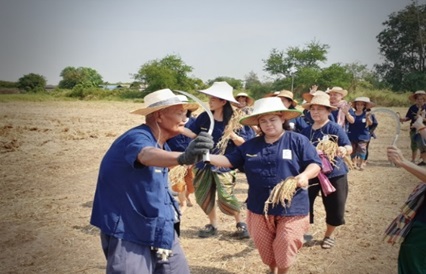
5) Marketing Promotion – The community collaboratively organized farmer-style tourism programs, integrating agricultural experiences, cultural heritage, and local cuisine. Marketing strategies considered tourist behavior and service marketing mix factors influencing visitation decisions.
Findings indicate that the Klong Pho Canal-Side Community successfully established a living museum to showcase its diverse wisdom and traditions. This initiative enhanced local awareness of cultural and environmental values, fostered pride in heritage, and encouraged active participation in conservation. Environmental resources, rice-farming traditions, and culinary practices were revived and transmitted to younger generations and visitors through experiential activities. Fair income distribution mechanisms were implemented, along with partnerships involving governmental, private, and civil society actors.
The project’s impacts are multidimensional:
1) Tourism Development – By mapping and understanding five categories of community capital, the community identified unique features that differentiated its tourism offering. This process strengthened a sense of ownership and laid a foundation for sustainable tourism governance.
2) Knowledge Enhancement – Tourism knowledge dissemination created local tourism experts who could manage visitor experiences effectively while safeguarding resources.
3) Community Infrastructure – The installation of facilities such as clear wayfinding signage, learning station labels, and accessible restrooms improved the visitor experience and met sustainable tourism standards.
4) Culture and Environment – Environmental resources, traditions, and local wisdom—particularly those linked to rice cultivation—were restored and integrated into tourism activities, fostering both conservation and cultural pride.
5) Management and Governance – The formation of core management groups enabled effective resource allocation, equitable income distribution, and cooperative agreements with external stakeholders.
6) Awareness Building – Internal campaigns increased community engagement in tourism, while external marketing attracted continuous visitation and strengthened the community’s image.
7) Economic Impact – Local wisdom was transformed into tourism products and services, generating supplementary income and stimulating a circular economy. Tourism activities were also incorporated into new tour packages marketed by local travel companies to both Thai and international visitors.
8) Social Impact – Tourism prompted social cohesion through professional and storytelling groups, while also reinforcing traditional festivals, rituals, and agricultural practices such as Lo Krathong moonlight bathing, local boat races, and rice harvesting ceremonies.
From a broader perspective, the project contributed to sustainable development across four dimensions:
1) Environmental – Restoration and preservation of natural resources and ecosystems.
2) Social and Cultural – Reinforcement of community pride, identity, and intercultural exchange.
3) Economic – Creation of income-generating opportunities and value-added local products.
4) Political and Governance – Strengthened collaboration among local administrations, tourism authorities, and private operators.
Challenges remain in managing tourism amid urban expansion and environmental change, particularly in maintaining water quality and integrating tourism development with the preservation of traditional lifestyles. Future Development Plan (3–5 years) includes:
1) Enhancing community capacity in tourism management through clearly defined governance structures, skill development in hosting, interpretation, marketing, and intergenerational knowledge transfer.
2) Diversifying and upgrading products and services, developing a unified brand, and expanding markets through external partnerships.
3) Establishing sustainable resource and environmental management mechanisms, including community regulations and a tourism development fund.
4) Building cooperative networks with government agencies, private sector entities, and educational institutions, as well as creating linkages with nearby tourist attractions for integrated route development.
Conclusion: The Klong Pho Canal-Side Community’s transformation illustrates how rural communities can leverage local capital, foster inclusive governance, and integrate sustainable tourism to address environmental and socio-economic challenges. The success of this initiative lies in its holistic approach—combining identity preservation, capacity building, infrastructure improvement, cultural revitalization, equitable benefit-sharing, and collaborative marketing—which together ensure the long-term viability of farmer’s way tourism and the community’s resilience in the face of change.
Article Details

This work is licensed under a Creative Commons Attribution-NonCommercial-NoDerivatives 4.0 International License.
Area Based Development Research Journal values copyright protection and licensing to safeguard author rights and facilitate the appropriate dissemination of research. Our policies ensure openness, accessibility, and attribution. Authors retain copyright ownership, and articles are published under a Creative Commons Attribution License (CC BY), allowing sharing, adaptation, and proper attribution. Authors have the freedom to publish under the CC BY license, granting broad reuse and distribution permissions. The journal supports posting articles on third-party repositories, adhering to institutional and funding restrictions. Author guidelines detail copyright and licensing requirements, empowering authors with knowledge about their rights and responsibilities. These policies cultivate an environment of collaboration, openness, and responsible sharing, benefiting authors and the research community while honoring intellectual property rights.
References
Ayutthaya Provincial Public Relations Office. (2019). Farmers in Bang Pa-in and Bang Sai Districts Lodge Complaint with the Governor. Retrieved June 15, 2025, from: https://ww2.ayutthaya.go.th/news/detail/7149. (in Thai).
Boosaparerk, N., & Putphun, P. (2022). Guidelines for management of community capital consistent with the 20-year national strategy at Bueng Cham-O Sub-district, Nong Suea District, Pathum Thani Province. Panyapiwat Journal, 14(1), 158-171. (in Thai).
Butprom, A., & Sanedee, P. (2024). Factors of Thai tourists affecting workcation’s travel in Khlong San District, Bangkok. Journal of Humanities and Social Sciences Prince of Songkla University, 20(2), 130-147. (in Thai).
Chaisaengpratheep, N. (2014). The formats and operation process of agro-tourism. Veridian E-Journal, Silpakorn University (Humanities, Social Sciences, and Arts), 7(3), 310-321. (in Thai).
Chaiyakhet, W., Thongpoon, K., Thongsanoer, N., Somwatee, S., & Pasasuk, W. (2020). The evaluation of Wang Ang community potential to develop farmer tourism, Nakhon Si Thammarat Province. Suratthani Rajabhat Journal, 8(2), 42-72. (in Thai).
Chenchitsin, N., & Euajarusphan, A. (2023). Perspectives of a future approach to agrotourism in Thailand. Suratthani Rajabhat Journal, 10(1), 1-20. (in Thai).
Choibamroong, T. (2014). Agricultural resources research for sustainable agro-tourism: A case study of Surat Thani, Thailand. NIDA Development Journal, 54(3), 202-220. (in Thai).
Chupanya, T., & Kingtakran, N. (2023). The development of creative cultural tourism activity in Suan Dusit and relevant area. Tamnak Journal Suan Sunandha Rajabhat University, 1(2), 24-37. (in Thai).
Department of Foreign Trade, Ministry of Commerce. (2025). The Ministry of commerce summarizes rice export figures for 2024. Retrieved March 17, 2025, from: https://www.dft.go.th/th. (in Thai).
Duangjaidee, W. (2024). Conceptual framework for developing a community capital-based school-level curriculum framework for implementation in school curriculum development. Journal of Information and Learning, 35(3), 143-153. (in Thai).
Intakhan, P., Pratuangboriboon, N., Khamsan, W., Limpaiboon, J., Bunvut, S., Suwannaraj, S., …, & Srivichai, K. (2023). Creative cultural tourism for health by communities, Koh Kha District, Lampang Province. Area Based Development Research Journal, 15(1), 56-71. (in Thai).
Jaima, S., & Pathomsirikul, Y. (2016). Marketing factors associated with customer loyalty in service business. Executive Journal, 36(1), 37-47. (in Thai).
Jarenpanit, T., Sangyoka, S., & Chimjan, O. (2021). Enhancing the potential of creative community-based tourism of Nakhon Chum Subdistrict, Phitsanulok Province. Area Based Development Research Journal, 13(5), 373-388. (in Thai).
Khamkerd, T., Chaiyo, P., Sangiemsilp, P., Therawat, J., Rueangrit, U., & Chuayphen, P. (2020). Development of community agricultural tourism by multilateral organization in Wang-Yang Community, Suphan Buri Province. Area Based Development Research Journal, 12(6), 432-450. (in Thai).
Klangnurak, H., & Jaroenwisan, K. (2023). Phuket’s potential for wellness tourism. Journal of Management Science Research, Surindra Rajabhat University, 7(1), 182-192. (in Thai).
Krainara, C. (2015). Sustainable competitiveness development of rice commodity and rice farmers in Central Region of Thailand. Retrieved November 16, 2024, from: https://www.botlc.or.th. (in Thai).
Kumthakruea, J., Chinsongkram, N., Uthongsap, K., Wingwon, B., Huang, X., Zhao, X., & Wang, S. W. (2025). Management of natural resource capital for enhance community based tourism in stimulating the grassroots economy of the Ban Pang Ma-O Community in Wang Ngoen Subdistrict, Mae Tha District, Lampang Province. URU Journal of Integrated Sciences for Development, 15(1), URU-J.ISD 280150. (in Thai).
Leelakitpaisarn, Y., Chaovanapricha, K., Chuanchomb, J., Srinathiyawasina, T., Sriyothina, S., Wichasin, P., & Traiphong, P. (2024). Increasing agro-ecotourism potential as a learning resource in Suphan Buri Province. Arts of Management Journal, 8(1), 401-417. (in Thai).
Lekdee, C., Rattanasermpong, M., & Prasops, W. (2023). Farmer’s way of life in the era of Thailand 4.0 of the farmers of Tlung Lek Subdistrict, Khok Samrong District, Lopburi Province. Three-Science Journal, 9(1), 1-11. (in Thai).
Lovelock, C., & Wirtz, J. (2011). Services marketing: People, technology, strategy (7th edition). Pearson Education.
Maraphot, K., & Somboon, T. (2023). The development of agro-tourism routes to promote tourism in Phanom Sarakham District, Chachoengsao Province. Interdisciplinary Social Sciences and Communication Journal, 6(4), 210-233. (in Thai).
Matichononline. (2019). Over 3,500 Rai of seasonal rice fields in Bang Pa-in District have completely dried up. Retrieved July 7, 2025, from: https: www.matichon.co.th/region/news_1767491. (in Thai).
Ministry of Agriculture and Cooperatives. (2021). Guidelines for suitable agricultural promotion based on Phra Nakhon Si Ayutthaya Province (Agricultural Map Database). Retrieved June 15, 2025, from: https: www.ldd.go.th/agri-map/data/ayu. (in Thai).
Nawatnatee, T., & Kongdit, S. (2021). Tourist behavior towards the interpretation of agro-ecotourism in Sam Ruean Community, Phra Nakhon Si Ayutthaya Province, Thailand. Review of International Geographical Education Online, 11(10), 754–758. (in Thai).
Onlamai, W. (2022). Guidelines for the development of responsible tourism at Ban Si Than Community, Khon Kaen Province. Journal of Business Administration and Social Sciences Ramkhamhaeng University, 5(2), 42-56. (in Thai).
Phimsuwan, P., Samran-in, C., Salulrat, T., Prueksa, R., & Chuapung, B. (2018). Ecolodge management with community participation of Sam Ruan Community, Phra Nakorn Sri Ayutthaya Province. Area Based Development Research Journal, 10(1), 33-43. (in Thai).
Phoondee, Y. (2022). Monitoring of water quality by using phytoplankton as a biological index in Khlong Pho, Sam Ruean Sub-district, Bang Pa-In District, Phra Nakhon Si Ayutthaya Province. Science, Technology, and Social Sciences Procedia, 2022(4), rspg057. (in Thai).
Prungcharurn, P., & Angasinha, C. (2024). Thai farmers’ practices and organic farmer’s awareness in Thailand. Journal of Dhamma for Life, 30(4), 344-358. (in Thai).
Rafiq, M., & Ahmed, P. K. (1995). Using the 7Ps as a generic marketing mix: An exploratory survey of UK and European marketing academics. Marketing intelligence & Planning, 13(9), 4-15.
Rakbumrung, W., Promyoo, T., & Chanda, K. (2022). The influence of quality standards of agritourism and tourist attraction management affecting the sustainability of agritourism. SAU Journal of Social Sciences & Humanities, 6(1), 91-109. (in Thai).
Rakngen, A., Dejopas, K., Meesiri, A., & Posanakul, P. (2020). Eco-agricultural tourism of Thepo village, Sam Ruean Subdistrict, Bang Pa-in District, Phra Nakhon Si Ayutthaya. Journal of Humanities and Social Sciences, 8(2), 145-161. (in Thai).
Reanrat, N., Rengkounkway, M., & Mekarkakorn, T. (2019). The agro tourism service readiness of the farmer learning center at Ban Hom Chuen Ladlumkaew District, Pathumthani Province. Journal of Sports Science and Health, 20(1), 126-141. (in Thai).
Sriget, U., & Ngernklay, P. (2021). Community-based tourism management in Eastern Thailand. Western University Research Journal of Humanities and Social Science, 7(1), 250-262. (in Thai).
Sriyothin, S., Leelakitpaisarn, Y., Wichasin, P., Huanchom, J., Sriparsertsuk, A., Srinathiyawasin, T., & Sriyothin, B. (2024). Agrotourism: Driving tourism and hospitality industry through learning resources in the community to increase sustainable income. Panyapiwat Journal, 16(3), 313-333. (in Thai).
Sorthong, K., Katekao, V., Chirinang, P., & Mankan, W. (2024). Thai tourism strategy 2023-2027 and ecotourism. Journal of MCU Nakhondhat, 11(2), 12-20. (in Thai).
Thai Rice Foundation Under Royal Patronage. (2025). Types of rice. Retrieved July 7, 2024, from: http://www.thairice.ort. (in Thai).
Trade Policy and Strategy Office. (2025). The NESDC (National Economic and Social Development Council) is monitoring trends in the Thai tourism sector for opportunities to drive long-term economic growth. Retrieved November 16, 2024, from: http://www.tpso.go.th. (in Thai).
Treeaekanukul, L., (2014). Social and culture capital and the life of ancient city promotion in Nan Province. Area Based Development Research Journal, 6(3), 93-106. (in Thai).
Thodthankhun, T., Suksai, S., Malinin, W., Phanmool, J., & Phechburi, N. (2020). The study of quality of life and Identity of Sam Ruen Sub-district Community Bang Pa-In District Phra Nakhon Si Ayutthaya Province. Journal of Liberal Art of Rajamangala University of Technology Suvarnabhumi, 2(1), 307-320. (in Thai).
Wongwirach, K., Janasak, S., Mookam, T., & Luanyai, N. (2024). Economic opportunities for communities through community-based tourism in Huamuang Subdistrict community, Muang Pan, Lampang Thailand. Area Based Development Research Journal, 16(3), 256-272. (in Thai).
