
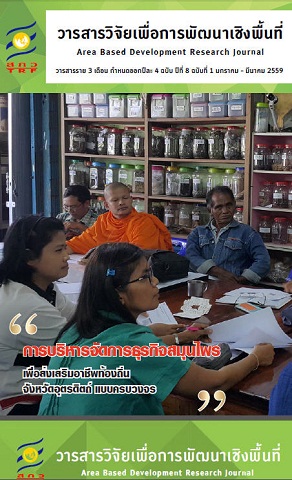
การบริหารจัดการธุรกิจสมุนไพร เพื่อส่งเสริมอาชีพท้องถิ่น จังหวัดอุตรดิตถ์ แบบครบวงจร
Article Sidebar
Main Article Content
Abstract
บทคัดย่อไม่สมบูรณ์
Herb Business Management for boosting the local occupation in Uttaradit Province
The research aimed to study the following: 1) the context and potential of herbal entrepreneurs, 2) the biodiversity of herbal wisdom concept, 3) the herbal data base design and development, 4) the worthiness of an investment and competitiveness of the economic concept and 5) the product processing development for herb. Quantitative surveys and qualitative methods were employed in this study. The target groups composed of the community, private and public sectors.
The result from SWOT analysis found that Uttaradit Province had strengths in the following aspects. the regular knowledge-sharing among Thai traditional medicine practitioners, the existing of Thai traditional medical network, legal and standard firms, and a large herbal grinder firm in the lower northern area and the only regional association of Thai traditional medicine. Weaknesses were the following: lack of serious promotion of the herbal production and lack of in-depth herbal recipes. On the opportunities, it had many potential herbalists. Threats were lack of interactions between the networks of agriculturists, merchandises, Thai traditional medicines and entrepreneurs in order to share the data, knowledge, herbal cultivations and cost approximation. The discussion in the community forum indicated that local herbal medicines were the most participatory group from Lablae district. Most medical certificates and recipes came from Tha-pla district. The recipes from Thai traditional medical wisdom contained 344 formulas from Pi-chai district, Tha-pla and Lablae district,respectively. The result on the herbal data base design and development showed that the data base could go on by using the search engine of Google.com and URL http://industrial.uru.ac.th/herb/index.php. The data base included the information of herbal agriculturists, Thai traditional medicines, herbs and 25 processing products. The worthiness of an investment and competitiveness of the economic concept was in moderate level to a good level with the break even period between 7-9 years; while, the pay-back period was 15 years. Promotion on processing product development and product design presented 5 entrepreneurs of 10 products with joint activities such as labeling, packaging and site visit at Trad province. Thus, it increased their products’ value 42.85 percent for a maximum 100 percent. The path analysis and market link indicated that the firms’ group planted herbs in order to use on their own, be a retail trade and wholesale; moreover, they purchased herbs from Laos through Phu-Doo International Point of Entry, Ban-Khok district, Uttaradit Province. In addition, big herbal firms of Industrial pharmaceutical factories, including J.S.P pharmaceutical manufactory (Thailand) Co.,Ltd. and COX pharmaceutical manufactory (Thailand) Co.,Ltd. had made market links with local entrepreneurs in Uttaradit Province.
Article Details
Area Based Development Research Journal values copyright protection and licensing to safeguard author rights and facilitate the appropriate dissemination of research. Our policies ensure openness, accessibility, and attribution. Authors retain copyright ownership, and articles are published under a Creative Commons Attribution License (CC BY), allowing sharing, adaptation, and proper attribution. Authors have the freedom to publish under the CC BY license, granting broad reuse and distribution permissions. The journal supports posting articles on third-party repositories, adhering to institutional and funding restrictions. Author guidelines detail copyright and licensing requirements, empowering authors with knowledge about their rights and responsibilities. These policies cultivate an environment of collaboration, openness, and responsible sharing, benefiting authors and the research community while honoring intellectual property rights.
