
The Learning Process of Hand-Woven Silk Design and Product for Silk Tourist Village, Buriram Province
Article Sidebar
Main Article Content
Abstract
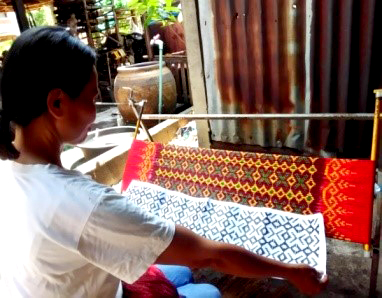
Buriram Province is a hub for sericulture wisdom, and is recognized for Mudmee silk quality products. Considering the consumers’ diverse needs, the community is urged to develop their hand-woven Ikat or Mudmee silk products to meet the demands, which involve seeking preferred motifs, colours and fabrics. This project provides knowledge on Mudmee motif design techniques and colour design by optical estimation and changing the hue by neutral-warp threads. A target group of 30 weavers from 5 silk tourist villages were selected for training, which was provided in the form of workshop. The results showed that all groups were able to integrate newly acquired knowledge with the local wisdom and produced 40 prototypes. Through marketing process, it is noted that the customer’s purchase is influenced by colour variation and novelty, and trendy patterns. In conclusion, the village sustains the knowledge and continues improving their products.
Article Details

This work is licensed under a Creative Commons Attribution-NonCommercial-NoDerivatives 4.0 International License.
Area Based Development Research Journal values copyright protection and licensing to safeguard author rights and facilitate the appropriate dissemination of research. Our policies ensure openness, accessibility, and attribution. Authors retain copyright ownership, and articles are published under a Creative Commons Attribution License (CC BY), allowing sharing, adaptation, and proper attribution. Authors have the freedom to publish under the CC BY license, granting broad reuse and distribution permissions. The journal supports posting articles on third-party repositories, adhering to institutional and funding restrictions. Author guidelines detail copyright and licensing requirements, empowering authors with knowledge about their rights and responsibilities. These policies cultivate an environment of collaboration, openness, and responsible sharing, benefiting authors and the research community while honoring intellectual property rights.
References
Chidtavong, L., Winckler, M., Georg Bock, H., & Ellwanger-Mohr, M. (2016). Digitizing traditional Lao textile to modern weave technique. Chinese Business Review, 15(11), 547-555.
Department of Industrial Promotion. (2003). The Mudmee in a new perspective. Bangkok: Process colour design & printing. (in Thai).
Lekka, L., & Dascalopoulos, S. (2008). Motif and symmetry characteristics of the ornamentation on traditional Greek woven textiles from the area of the aegean. Fibers & Textiles in Eastern Europe, 16(3), 64-68.
Panthung, P. (2019a). Participatory development of textile product of Ban Phu Thong community, Sukhothai province. Area Based Development Research Journal, 11(4), 331-345. (in Thai).
Panthung, P. (2019b). The process to create a pattern of Mud Mee woven fabric with the participation of Ban Muang Hom woven handicraft group, Phitsanulok province. Area Based Development Research Journal, 11(5), 405-421. (in Thai).
Phakdeesuwan, S. (2010). Pattern design for MudMee silk fabrics of Maha Sarakham. Chophayom Journal, 21, 17-35. (in Thai).
Prajonsant, S. (2016a). The design of Mud-mee silk from graphic pattern of Khmer sanctuary plan in the lower Northeastern part, Thailand. Silpakorn University Journal of Social Sciences, Humanities, and Arts, 16(3), 115-132.
Prajonsant, S. (2016b). Development of Mudmee silk products for tourism in Buriram, Thailand: the effects of warp yarns’ colours on Mudmee silk (Research report). Buriram: Buriram Rajabhat University. (in Thai).
Prajonsant, S. (2017a). Ikat designed by optical mixture colours (Research report). Buriram: Buriram Rajabhat University. (in Thai).
Prajonsant, S. (2017b). The Ikat designed by the value of colour changing of neutral colour warp yarn (Research report). Buriram:Buriram Rajabhat University. (in Thai).
Prayakprakhon, M. (2017). Design and development of Hol pattern to contemporary design. The Proceeding of National Academic Conference Home proud III. Khon Kaen: Khonkaen University, 39-42. (in Thai).
Priscilla, A. R., & Welter, L. (1999). Symmetry analysis of embroideries on Greek women’s chemises. Clothing and Textiles Research, 17(1), 176-190.
Ruchudkul, M. (2006). The behavior of tourists for buying silk products of OTOP in Nakhonratchasima province (Research report). Nakhonratchasima: Nakhon Ratchasima University. (in Thai).
Sikka, S. (2011). Creating unique patterns of Isan local. Journal of Industrial Technology Ubonratchathanee Rajabhat University, 1(2), 119-132. (in Thai).
The Foundation for the Promotion of Supplementary Occupations and Related Techniques under the Royal Patronage of Her Majesty the Queen. (2013). The new mudmee motif that has chosen. Bangkok: plan sara.
The Queen Sirikit Sericulture Center Chiang Mai. (2012). Guidelines for the silk production and silk product design to meet the needs of consumers in Thailand. Retrieved March 28, 2015, from: http://www.qsds.go.th/. (in Thai).
Yangh, K., & Rongrong, C. (2016). Patterns on the embroidered textiles unearthed from the Silk Road II: Geometrical Pattern. Asian Social Science, 12(1), 191-198.
