
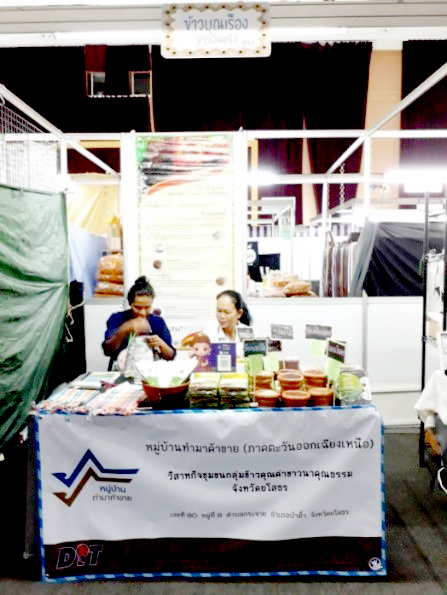
การพัฒนาศักยภาพการประกอบธุรกิจหมู่บ้านทำมาค้าขาย วิสาหกิจชุมชนกลุ่มข้าวคุณค่า ชาวนาคุณธรรม จังหวัดยโสธร
Article Sidebar
Main Article Content
บทคัดย่อ
งานวิจัยนี้มีวัตถุประสงค์เพื่อวิเคราะห์สถานภาพการดำเนินงานและรูปแบบการจัดทำวิสาหกิจชุมชน และพัฒนาศักยภาพการประกอบธุรกิจของวิสาหกิจชุมชนกลุ่มข้าวคุณค่า ชาวนาคุณธรรม จังหวัดยโสธร ให้สามารถดำเนินธุรกิจได้อย่างเข้มแข็ง ยั่งยืน และสามารถแข่งขันทางการค้าได้ การดำเนินการวิจัยเน้นการมีส่วนร่วมระหว่างนักวิจัย ผู้นำชุมชนและสมาชิกของวิสาหกิจฯ เพื่อให้เกิดการถ่ายทอดและแลกเปลี่ยนความรู้ระหว่างกัน โดยการวิเคราะห์ จุดแข็ง จุดอ่อน โอกาส และอุปสรรค ร่วมกับการวิเคราะห์โมเดลธุรกิจ เสนอแนะกลยุทธ์และปัจจัยสำคัญในการประกอบธุรกิจ จัดอบรมให้ความรู้ในการประกอบธุรกิจและการศึกษาดูงาน พร้อมทั้งพัฒนาผลิตภัณฑ์ และขยายช่องทางการจำหน่ายสินค้าทั้งทางออนไลน์และออฟไลน์ ทำให้สมาชิกของวิสาหกิจ ฯ ได้รับการพัฒนาทักษะการดำเนินธุรกิจและศักยภาพการแข่งขันทางธุรกิจ ผลวิจัยมีดังนี้ 1) ผลิตภัณฑ์ได้รับการพัฒนา มีช่องทางการจำหน่ายและสื่อที่ใช้ในการประชาสัมพันธ์เพิ่มขึ้น ทำให้มีลูกค้าและรายได้มากขึ้น 2) สมาชิกของวิสาหกิจ ฯ มีความรู้และเห็นความสำคัญของการตลาดออนไลน์เพื่อเพิ่มยอดขาย 3) รูปแบบการจัดทำบัญชีเป็นระบบและตรวจสอบได้ และสะดวกในการวางแผนการผลิตและการตลาด และ 4) โรงสีได้รับการพัฒนาตามมาตรฐาน ทำให้สามารถแปรรูปข้าวเปลือกเป็นข้าวสารที่มีคุณภาพ เป็นการเพิ่มรายได้ของวิสาหกิจ ฯ
Article Details

อนุญาตภายใต้เงื่อนไข Creative Commons Attribution-NonCommercial-NoDerivatives 4.0 International License.
Area Based Development Research Journal values copyright protection and licensing to safeguard author rights and facilitate the appropriate dissemination of research. Our policies ensure openness, accessibility, and attribution. Authors retain copyright ownership, and articles are published under a Creative Commons Attribution License (CC BY), allowing sharing, adaptation, and proper attribution. Authors have the freedom to publish under the CC BY license, granting broad reuse and distribution permissions. The journal supports posting articles on third-party repositories, adhering to institutional and funding restrictions. Author guidelines detail copyright and licensing requirements, empowering authors with knowledge about their rights and responsibilities. These policies cultivate an environment of collaboration, openness, and responsible sharing, benefiting authors and the research community while honoring intellectual property rights.
เอกสารอ้างอิง
Boonrattanakittibhumi, C. (2014). Capacity entrepreneur of community enterprises in Thailand. Journal of Social Academic, 7(3), 103-117. (in Thai).
Chaimuang, N. (2015). Development of community enterprise management to sustainable self-reliance. Payap University Journal, 25(1), 15-39. (in Thai).
Chuea-Insoong, M., Klaiklang, R., & Nimkoetphol, S. (2019). Tung Thong organic rice group community enterprise management accomplishment toward decreasing their expenses (expenditure) in U-thong district, Suphan Buri province. FEU Academic Review, 13(1), 69-85. (in Thai).
Department of Agricultural Extension. (2005). Community enterprise promotion act, B.E. 2548. Bangkok: Office of the Community Enterprise Promotion Board Secretariat. (in Thai).
Department of Industrial Promotion. (2009). Management system standards for community enterprise. Retrieved March 20, 2019, from http://library.dip.go.th. (in Thai).
Department of Internal Trade. (2018). Study report of forms and guidelines for trading village. Retrieved August 8, 2019, from https://www.dit.go.th/Content.aspx?m=101&c=23603. (in Thai).
Kasornbua, T. (2015). Strategies to increase market competition potential for new entrepreneurs (baskets type) in the ASEAN market. Case study of Ban Bang Pluang rice farmers communities enterprises, Tambon Bang Pluang, Ampher Ban Sang, Prachinburi province. Journal of Humanities and Social Sciences, Burapha University, 23(41), 225-247. (in Thai).
Nuanpradit, S. (2018). The development of the bookkeeping and product and service costing systems for Sangyod rice community enterprise: A case study of Baan Khao Klang, Khuan Khanun district, Pattalung province. Journal of Management Sciences, 35(2), 27-54. (in Thai).
Office of the National Economics and Social Development Council. (2019). National economic and social development plan no. 12. Bangkok: Office of the Prime Minister. (in Thai).
Osterwalder, A. & Pigneur, Y. (2010). Business model generation: A handbook for visionaries, game changers, and challengers. New Jersey: John Wiley & Sons.
Patrawart, J., Senthong, W., Yothasmutr, S., Sriurai, S., Singharerk, W., Rattanakeit, C., ... Chalothorn, N. (2006). Complete research report on cooperative movement development project in 36 provinces. Retrieved August 13, 2019, from https://elibrary.trf.or.th. (in Thai).
Pradit, K. (2018). The development of distribution channels of rice products through the electronic-commerce system for Bor-Khor’s housewife’s group, the community enterprise in Takbai district, Narathiwat province. The Journal of Social Communication Innovation, 6(2), 152-164. (in Thai).
Pongpit, S. (2007). Community enterprise: Mechanisms of local economy. Bangkok: Edison Press Products Co Ltd. (in Thai).
Promsaka Na Sakolnakorn, T. & Sungkharat, U. (2014). Development guidelines for small and micro community enterprises in Songkhla lake basin. Journal of Humanities and Social Sciences, 10(1), 97-122. (in Thai).
Thisawet, R., Somboon, S., & Ngeoywijit, S. (2017). The strategies for development organic rice production system following selfsufficiency economy philosophy of the Ton-Kla enterprise of Amnat Charoen Groups. Journal of Humanities and Social Sciences, Ubon Ratchathani Rajabhat University, 8(Speical), 106-121. (in Thai).
Yasothon Provincial Agricultural Extension Office. (2018). Chawna Khunatham Community Enterprise. Retrieved August 8, 2019, from http://www.organicyasothon.com/. (in Thai).
