
การสร้างมูลค่าพืชอัตลักษณ์ชาติพันธุ์มอญ ชุมชนมอญบ้านเสากระโดง จังหวัดพระนครศรีอยุธยา
Article Sidebar
Main Article Content
บทคัดย่อ
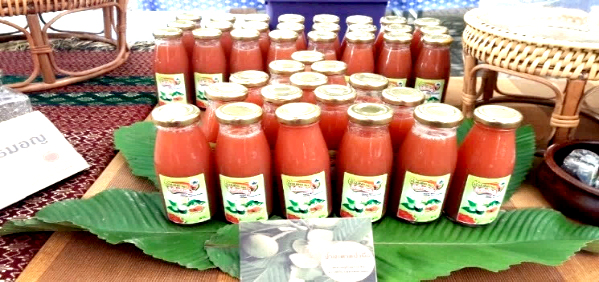
งานวิจัยนี้มีวัตถุประสงค์เพื่อสร้างมูลค่ามะตาดและกระเจี๊ยบแดง ซึ่งเป็นพืชท้องถิ่นที่มีรสเปรี้ยวและมีเมือกและเป็นวัตถุดิบของอาหารชาติพันธุ์มอญ ด้วยกระบวนการวิจัยแบบมีส่วนร่วมกับคนในชุมชนมอญบ้านเสากระโดง อำเภอบางปะอิน จังหวัดพระนครศรีอยุธยา จำนวน 32 คน มีการดำเนินการดังนี้ 1) การพัฒนาผลิตภัณฑ์อาหารจากพืชท้องถิ่นของชุมชน โดยการพัฒนาสูตร ศึกษากระบวนการผลิต คุณภาพ การเปลี่ยนแปลงคุณภาพในระหว่างการเก็บรักษา และต้นทุนการผลิต 2) การถ่ายทอดองค์ความรู้และการคืนข้อมูล และ 3) การทดลองตลาดกับกลุ่มผู้บริโภคทั่วไปและนักท่องเที่ยว ผลิตภัณฑ์อาหารที่เป็นเอกลักษณ์ของชุมชน ได้แก่ น้ำมะตาดน้ำผึ้งซึ่งได้รับการยอมรับด้านลักษณะปรากฏและสี ผลิตภัณฑ์มีฤทธิ์ต้านอนุมูลอิสระและปริมาณฟีนอลิก และชารามัญซึ่งประกอบด้วยชามะตาด ชาใบกระเจี๊ยบ ชาดอกกระเจี๊ยบ และชาดอกพิกุล ซึ่งได้รับการยอมรับจากผู้บริโภคและอุดมด้วยสารต้านอนุมูลอิสระ น้ำมะตาดน้ำผึ้งและชารามัญสามารถเก็บรักษาได้นานกว่า 3 เดือนที่อุณหภูมิห้อง ผลจากการดำเนินงานทำให้ชุมชนตระหนักถึงคุณค่าและความสำคัญของพืชอัตลักษณ์ชาติพันธุ์มอญในท้องถิ่นของตนเอง มีการปลูกมะตาดและกระเจี๊ยบแดงมากขึ้นเพื่อนำไปแปรรูปสร้างมูลค่าเพิ่มและเป็นผู้ผลิตวัตถุดิบในท้องถิ่น เกิดการรวมกลุ่มในการแปรรูปและจำหน่ายผลิตภัณฑ์ที่สามารถสร้างอาชีพและรายได้ให้กับชุมชนกว่า 8,000 บาทต่อเดือน และส่งเสริมการท่องเที่ยวชุมชนได้
Article Details

อนุญาตภายใต้เงื่อนไข Creative Commons Attribution-NonCommercial-NoDerivatives 4.0 International License.
Area Based Development Research Journal values copyright protection and licensing to safeguard author rights and facilitate the appropriate dissemination of research. Our policies ensure openness, accessibility, and attribution. Authors retain copyright ownership, and articles are published under a Creative Commons Attribution License (CC BY), allowing sharing, adaptation, and proper attribution. Authors have the freedom to publish under the CC BY license, granting broad reuse and distribution permissions. The journal supports posting articles on third-party repositories, adhering to institutional and funding restrictions. Author guidelines detail copyright and licensing requirements, empowering authors with knowledge about their rights and responsibilities. These policies cultivate an environment of collaboration, openness, and responsible sharing, benefiting authors and the research community while honoring intellectual property rights.
เอกสารอ้างอิง
Ampansirirat, A., & Wongchaiya, P. (2017). The participatory action research: Key features and application in community. Journal of Humanities and Social Sciences Mahasarakham University, 36(6), 192–202. (in Thai).
Amritveer, B., Junaid, N., Neha, B., & Amol, S. P. (2016). A review update on Dillenia indica F. Elongata (Miq). Miq. Journal of Drug Delivery & Therapeutics, 6, 62-70.
AOAC. (1988). Official methods of analysis of AOAC international. Yeast and molds counts in foods. Dry rehydratable film method, petrifilm method. Gaithersburg Md, USA: AOAC International.
AOAC. (1994a). Official methods of analysis of AOAC international. Aerobic plate count in foods, dry rehydratable film method, petrifilm method. Gaithersburg, USA: AOAC International.
AOAC. (1994b). Official methods of analysis of AOAC international. Coliform and Escherichia coli count in foods, dry rehydratable film method. Gaithersburg, USA: AOAC International.
AOAC. (2003). Official methods of analysis of AOAC international. Enumeration of Staphylococcus aureus in selected types of processed and prepared foods, petrifilm method. Gaithersburg, USA: AOAC International.
Banchun, O. (2014). Beside Mon meal. Bangkok: Matichon. (in Thai)
Begum, S., Acharya, J., Banerjee, A., & De, B. (2015). Chemical composition and in-vitro study for analysis of potential neuroprotective and antidiabetic activity in Mimusops elengi L. International Journal of Pharmacognosy and Phytochemical Research, 7(4), 701-706.
Beuchat, L. R., Komitopoulou, E., Beckers, H., Betts, R. P., Bourdichon, F., Fanning, S., ..., & Kuile, B. H. T. (2013). Low–water activity foods: increased concern as vehicles of foodborne pathogens. Journal of Food Protection, 76(1), 150-172.
Bhattacharjee, S. K. (2000). Handbook of aromatic plants. India: Jaipur.
Chalaluck, P. (2005). Participatory action research. Journal of Western Rajabhat Universities, 1(1), 17-23. (in Thai)
Chandrasiri, V., Soontornnarurungsi, S., & Kanthanon, N. (2008). Preservation of Ma-tad fruits: the concept of local food conservation. Journal of Nutrition Association of Thailand, 43(2), 22-28. (in Thai)
Charoenphun, N., & Phaephiromrat, C. (2018). Development of seasoning powder product from longan. Thai Journal of Science and Technology, 26(4), 631-640. (in Thai)
Da-Costa-Rocha, I., Bonnlaender, B., Sievers, H., Pischel, I., & Heinrich, M. (2014). Hibiscus sabdariffa L.-A phytochemical and pharmacological review. Food Chemistry, 165, 424–443.
Gami, B., Pathak, S., & Parabia, M. (2012). Ethnobotanical, phytochemical and pharmacological review of Mimusops elengi Linn. Asian Pacific Journal of Tropical Biomedicine, 2(9), 743-748.
Gemede, H. F., Ratta, N., Haki, G. D., Woldegiorgis, A. Z., & Beyene, F. (2015). Nutritional quality and health benefits of “Okra” (Abelmoschus esculentus): a review. International Journal of Nutrition and Food Sciences, 4(2), 208-215.
Ketthet, B. (2015). Local inheritance. Mahasarakham: Kakayia Publisher. (in Thai)
Komarathat, D. (2008). Cost accounting (12th ed.). Bangkok: Chulalongkorn University Publishing. (in Thai)
Kviecinski, M. R., David, I. M. R., Fernandes, F. S., Correa, M. D., Clarinda, M. M., Freitas, A. F., …, & Pedrosa, R. C. (2017). Healing effect of Dillenia indica fruit extracts standardized to betulinic acid on ultraviolet radiation-induced psoriasis-like wounds in rats. Pharmaceutical Biology, 55, 641-648.
Lim, Y. Y., Lim, T. T., & Tee, J. J. (2007). Antioxidant properties of several tropical fruits: a comparative study. Food Chemistry, 103(3),1003-1008.
Manok, S., & Limcharoen, P. (2015). Investigating antioxidant activity by DPPH, ABTS and FRAP assay and total phenolic compounds of herbal extracts in Ya-Hom Thepphachit. Advanced Science, 15(1), 106-117. (in Thai)Ministry of Public Health. (2000). The notification of Ministry of Public Health No. 193. Production processes, production, equipments, and food storage. Retrieved June 10, 2020, from http://food.fda.moph.go.th/law/data/announ_moph/V.English/No.239-44%20
%20Amendment%20(No.%20193)%202543.pdf. (in Thai)
Petchaboon, C. (2018). Food in merit-making ceremonies of Thai-Mon descendants and Mon workers: a case study on food of Sao Kradong Mon community, Bang Pa-in district, Phra Nakhon Si Ayutthaya province. Journal of Liberal Arts, Prince of Songkla University, 10(2), 35-57. (in Thai)
Ramasoota, P. (1997). Participatory action research. Bangkok: Mahidol University, ASEAN Institute for Health Development. (in Thai)
Srichayet, P. (2019). Principles of food processing to extend product’s shelf life. Food Journal, 49(1), 12-19. (in Thai)
Srihangao, L. (2018). Financial benet-costs analysis for potatoes process of Chedi Mae-Krua agriculturist housewives group in Mae Faek Mai district, Sansai, Chiang Mai province. FEU Academic Review, 12(1), 219-234. (in Thai)
Thai Industrial Standards Institute. (2013). Dried roselle for infusion TCPS 1460/2556. Thai Community Product Standard, Ministry of Industry, Thailand. (in Thai)
Thai Industrial Standards Institute. (2015). Concentrated passion fruit juice TCPS 853/2558. Thai Community Product Standard, Ministry of Industry, Thailand. (in Thai)
Wiseansart, A., Pensuk, V., Nimala, N., Pariyajarn, S., Suriya, A., & Vilavong, S. (2014). Costs and prices of swine’s processed products of farmers in Koklam and Sang Aram villages under the Royal Project Pidthong Langphra, Kudmakfai sub-district, Nongwuaso district, Udon Thani province. Prawarun Agricultural Journal, 11(2), 149-158. (in Thai)
Wongpratheep, N. (2010). The development of herbs paste of rice flour product. Area Based Development Research Journal, 2(5), 63-70. (in Thai)
Wu, L. C., Hsu, H. W., Chen, Y. C., Chiu, C. C., Lin, Y. I., & Ho, J. A. A. (2006). Antioxidant and antiproliferative activities of red pitaya. Food Chemistry, 95(2), 319-327.
