
แนวทางการจัดการความรู้นวัตกรรมกระบวนการเกษตรเพื่อสุขภาวะของผู้สูงอายุ โรงเรียนผู้สูงอายุตำบลไกรนอก จังหวัดสุโขทัย
Article Sidebar
Main Article Content
บทคัดย่อ
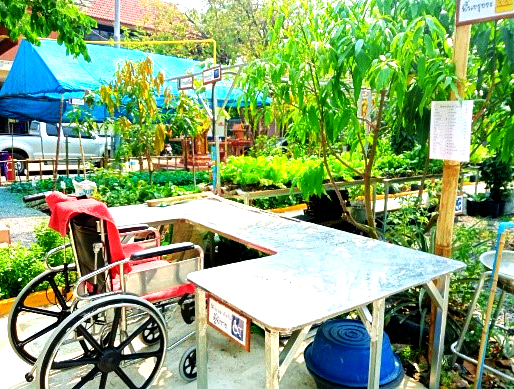
ผู้สูงอายุในตำบลไกรนอก จังหวัดสุโขทัย ประสบปัญหาสารเคมีกำจัดศัตรูพืชในเลือดเกินค่ามาตรฐาน ไม่สามารถเข้าถึงอาหารที่ปลอดภัยและมีข้อจำกัดทางร่างกายทำให้ไม่สามารถทำการเกษตรได้ งานวิจัยนี้จึงพัฒนาแนวทางการจัดการความรู้เพื่อค้นหานวัตกรรมกระบวนการเกษตรที่ส่งเสริมสุขภาวะที่ดีของผู้สูงอายุ โรงเรียนผู้สูงอายุตำบลไกรนอก ผ่านการวิจัยเชิงปฏิบัติการแบบมีส่วนร่วมตามกรอบการจัดการความรู้ SECI ประกอบด้วย 4 ขั้นตอน ดังนี้ 1) การแลกเปลี่ยนข้อมูลและความรู้ เป็นการค้นหาภาคีเครือข่าย ค้นหาความต้องการและเทคโนโลยีที่เหมาะสม 2) จัดระบบและบูรณาการความรู้ ด้วยการพัฒนาคู่มือ หลักสูตร แปลงสาธิตนวัตกรรม และวิทยากรประจำแหล่งเรียนรู้ 3) ปรับใช้ความรู้ เชื่อมโยงและขยายผล เป็นการพัฒนาศักยภาพของผู้สูงอายุด้วยหลักสูตรและสิ่งสนับสนุนการเรียนรู้ที่พัฒนา 4) วัดและประเมินผลการจัดการความรู้ ซึ่งพบว่าผู้สูงอายุเกิดแรงบันดาลใจในการทำเกษตรปลอดภัย เรียนรู้และเข้าใจด้านการผลิต การตลาดและสามารถแบ่งปันองค์ความรู้กับผู้สูงอายุในตำบลใกล้เคียง ผลลัพธ์เชิงสุขภาวะพบว่า ผู้สูงอายุประเมินสุขภาวะของตนเองระดับมากที่สุดในทุกมิติ ได้แก่ ร่างกาย จิตใจ สังคม และสติปัญญา และผู้สูงอายุปลูกผักเพิ่มขึ้นร้อยละ 17.58 สามารถลดรายจ่ายในครัวเรือนได้เฉลี่ย 812.20 บาท/เดือน/ครัวเรือน และยังไม่มีผลผลิตสำหรับจำหน่าย ผลการถอดบทเรียนสะท้อนว่าผู้สูงอายุสามารถเข้าถึงอาหารปลอดภัยได้มากขึ้น ได้เรียนรู้การทำงานที่เหมาะสมกับสภาพร่างกายของตนเอง รู้วิธีการพัฒนามาตรฐานการปฏิบัติทางการเกษตรที่ดีสำหรับพืช (GAP) การแลกเปลี่ยนเรียนรู้ร่วมกัน การผ่อนคลายความเครียดและรู้สึกภาคภูมิใจที่ผลิตอาหารปลอดภัยแก่ชุมชนและสังคม
Article Details

อนุญาตภายใต้เงื่อนไข Creative Commons Attribution-NonCommercial-NoDerivatives 4.0 International License.
Area Based Development Research Journal values copyright protection and licensing to safeguard author rights and facilitate the appropriate dissemination of research. Our policies ensure openness, accessibility, and attribution. Authors retain copyright ownership, and articles are published under a Creative Commons Attribution License (CC BY), allowing sharing, adaptation, and proper attribution. Authors have the freedom to publish under the CC BY license, granting broad reuse and distribution permissions. The journal supports posting articles on third-party repositories, adhering to institutional and funding restrictions. Author guidelines detail copyright and licensing requirements, empowering authors with knowledge about their rights and responsibilities. These policies cultivate an environment of collaboration, openness, and responsible sharing, benefiting authors and the research community while honoring intellectual property rights.
เอกสารอ้างอิง
Centre for Excellence in Universal Design. (2020). The 7 Principles. Retrieved July 5, 2020, from: http://universaldesign.ie/What-is-Universal-Design/The-7-Principles/.
Chutapruttikorn, R. (2018). UD home: Architectural learning integration through social service project. Journal of Environmental Design, 5(2), 83-99. (in Thai).
Chumtakhob, D. (2020). Sufficiency economy: An alternative survival strategy for the COVID-19 pandemic. Journal of Multidisciplinary Academic Research and Development, 2(3), 11-22. (in Thai).
IAASTD. (2009). Agriculture at crossroads - Global report. Retrieved July 7, 2020, from: https://wedocs.unepr.org/handle/20.500.11822/9569.
Ikujiro, N., & Takeuchi, H. (1995). The knowledge creating company: How Japanese companies create the dynamics of innovation. New York: Oxford University Press.
Inthaphan, C. (2018). Guidelines for social innovation for the elderly using social capital in the area of local administrative organizations in Ubon Ratchathani province. (Research report). Faculty of Political Science, Ubon Ratchathani University. (in Thai).
Jarutat, J., & Sansanaweerakul, C. (2015). Universal design: Concept of design for all. Real Estate Information Center Journal by GH Bank, 21(80), 40-47. (in Thai).
Jitsuchon, S. (2019). Thailand’s sufficiency economy philosophy as an alternative path to sustainable development. European Journal of Sustainable Development, 8(2), 191-200.
Kadir, A., & Jamaludin, M. (2013). Sustainable life and social development through universally designed environment. Asian Journal of Environment-Behaviour Studies, 3(9), 1-10.
Kasikorn Research Center. (2021). Are Thai ready for hyper aging society?. Retrieved August 15, 2021, from: https://kasikornresearch.com/th/analysis/k-social-media/Pages/Aging-society-FB-30-04-21.aspx.
Krinok Subdistrict Administrative Organization. (2019). Annual report of Krinok subdistrict administrative organization. Sukhothai:Krinok Subdistrict Administrative Organization. (in Thai).
National Bureau of Agricultural Commodity and Food Standards. (2009). Good agricultural practices for food crop: Thai Agricultural Standard TAS 9001-2009. Bangkok: National Bureau of Agricultural Commodity and Food Standards. (in Thai).
Noulsri, A. (2019). Aging society and labor agriculture sector of Thailand. Retrieved September 16, 2019, from: http://wiki.ocsc.go.th/_media/514.pdf. (in Thai).
Office of the National Economic and Social Development Council, (n.d.). What is the sufficiency economy philosophy?. Retrieved June 25, 2020, from: https://www.nesdc.go.th/ewt_w3c/ewt_dl_link.php?filename=suffic ienteconomy&nid=9202. (in Thai).
Praisin, A., Wannakayont, A., & Ruangreung, L. (2020). House design for elderly and mobility disable based on universal design concept. Journal of MCU Nakhondhat, 7(11), 299-313. (in Thai).
Poungngam, K. (2015). Local innovation of local government organization. Bangkok: Kematham (in Thai).
Rice, J., & Rice, B. (2002). The applicability of the SECI model to multi-organisational endeavours: An integrative review. International Journal of Organizational Behaviour, 9(8), 671-682.
Sirikesorn, L. (2021). Development of safe green produce grower group of smallholder farmers in Phranakorn Si Ayutthaya, Bang Ban, and Bang Pahan districts, Phra Nakhon Si Ayutthaya province. Area Based Development Research Journal, 13(4), 234-250. (in Thai).
Sriko, T. (2021). Model of curriculum and elderly teaching learning management in innovation creativity era (Romsamohvittaya School) Mueang district, Phitsanulok. Journal of Legal Entity Management and Local Innovation, 7(9), 207-220. (in Thai).
Tamdee, D., Suwanaprapisa, T., & Senaratra, W. (2013). Knowledge management and knowledge creation for healthy community in Lower- Northern Thailand. Nursing Journal, 40(4), 100-113. (in Thai).
Wutthirong, P. (2010). Innovation and Thailand’s competitiveness: The next step towards creative economy. Chulalongkorn Review, 22(86), 43-67. (in Thai).
