
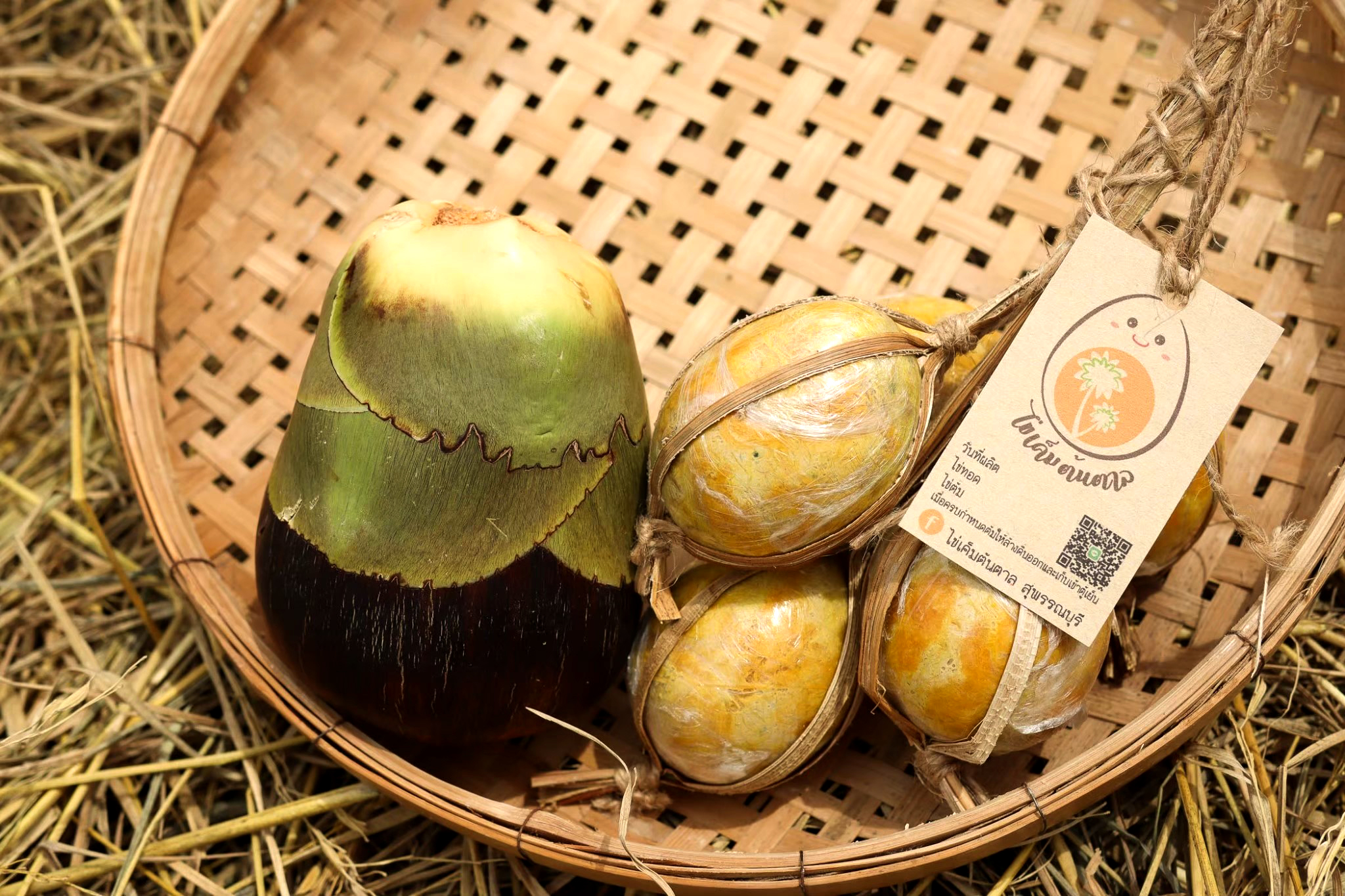
Guidelines for Value-Added Creation of Toddy Palm Salted Egg as a Tourism Product of Iodine Herb Salted Egg Community Enterprise, Suphanburi Province
Article Sidebar
Main Article Content
Abstract
The Iodine Salted Egg Community Enterprise, Ton Tan subdistrict, Song Phi Nong district, Suphanburi province, had encountered a problem of linking their products to souvenirs for local tourism because it was a common product that lacked the representation of local identity. Thus, the objective of this research was to develop the guidelines for adding value to the iodine salted egg to suit tourism purposes and promote the local identity. Participatory research and development approach was pursued with the members of the community enterprise, community leaders, conservational, and community tourism networks. The process was jointly conducted in the three following steps: 1) to develop the guidelines to create value for the herbal salted eggs with iodine and promote the local identity tourism product, 2) to test the market for the tourism product that promotes local identity and to assess the satisfaction of its consumers, 3) to conduct an after-action review from the community participation process. The result of development revealed that the community enterprise’s sales increased by an average of 23,131 baht per month (62.30%), while sales volumes in all products increased by 723 units per month (59.12%) and generated a total net profit of 7,604 baht per month (82.62%). The community has learned the process of creating value and connecting to tourism activities that lead to a concrete scheme for local toddy palm conservation.
Article Details

This work is licensed under a Creative Commons Attribution-NonCommercial-NoDerivatives 4.0 International License.
Area Based Development Research Journal values copyright protection and licensing to safeguard author rights and facilitate the appropriate dissemination of research. Our policies ensure openness, accessibility, and attribution. Authors retain copyright ownership, and articles are published under a Creative Commons Attribution License (CC BY), allowing sharing, adaptation, and proper attribution. Authors have the freedom to publish under the CC BY license, granting broad reuse and distribution permissions. The journal supports posting articles on third-party repositories, adhering to institutional and funding restrictions. Author guidelines detail copyright and licensing requirements, empowering authors with knowledge about their rights and responsibilities. These policies cultivate an environment of collaboration, openness, and responsible sharing, benefiting authors and the research community while honoring intellectual property rights.
References
Chanachaiphuwapat, S. (2019). Packaging, logo, and communication strategy planning for Bang Bo’s plaslid in Samut Prakan province. Area Based Development Research Journal, 11(3), 250-269. (in Thai).
Charanyanon, T., Panaphon, W., Wanasitthichaiwat, W., Ngamphakdi, R., Panchinda, N., Inthong, W., & Srion, N. (2006). Study of rearing management and the cost of raising the field ducks in the central and eastern zones. Bangkok: The Agricultural Cooperative Society of Thailand Co., Ltd. (in Thai).
Chesamae, A., & Gadmeang, Y. (2021). The development of packaging and branding for community products to link the cultural tourism of the Puranawas community, Thawi Watthana district, Bangkok. Journal of Humanities and Social Sciences Thonburi University, 15(2), 79-90. (in Thai).
Chitkati, P., Meepripruk, M., Funkhiaw, A., Buadee, N., Ussasarn, K., Anurakwattan, O. ..., & Tonboon, N. (2021). Development of community–based tourism products of Ban Thong Kung, Kamphaeng Phet province. Area Based Development Research Journal, 13(2), 120-134. (in Thai).
Cohen, E. (1979). Rethinking the sociology of tourism. Annals of Tourism Research, 6(1), 18-35.
Daldanise, G. (2020). From place-branding to community-branding: A collaborative decision-making process for cultural heritage
enhancement. Sustainability, 12(24), 10399.
Department of Health, Ministry of Public Health. (1992). Nutritional value of Thai food. Nonthaburi: Printing House. (in Thai)
Gilmore, F. (2002). A country – can it be repositioned? Spain – the success story of country branding. Journal of Brand Management,
(4–5), 281–293.
Janchai, D. (2004). Marketing strategy: Big fish eat small fish. Bangkok: SE-Educations. (in Thai)
Kahn, K., Barczak, G., Nicholas, J., Ledwith, A., & Perks H. (2012). An examination of new product development best practice.
Journal of Product Innovation Management, 29(2), 180-192.
Kasemsook, P. (2017). Social network analysis of free-range layer duck production in central and western part of Thailand.
(Master’s thesis). Kasetsart University, Department of Veterinary Public Health. (in Thai).
Khamkerd, T., Rueangrit, U., Sangiemsilp, P., Therawat, J., & Markjan, C. (2020). Community-based tourism management
model on the foundations of sustainable community lifestyles of Tontan subdistrict, Songphinong district, Suphanburi province.
(Research report). Rajamangala University of Technology Suvarnabhumi. (in Thai).
Koranantakul, P. C. (2002). The double identity of anthropologists in their hometown. Insiders: Field experiences of Thai anthropologists.
Bangkok: Sirindhorn Anthropology Center. (in Thai).
Kotler, P. (2003). Marketing management (5th edition). New Jersey: Pearson Education, Inc.
Kurznack, L., Schoenmaker, D., & Schramade, W. (2021). A model of long-term value creation. Retrieved April 20, 2021, from:
https://www.rsm.nl/fileadmin/Images_NEW/Erasmus_Platform_for_Sustainable_ValueCreation/A_ Model_of_Long_Term_Value_Creation.pdf.
Liaotrakul, V., Kromsri, K., & Nakwong, P. (2018). Effect of spray-dried toddy palm powder on quality of toddy palm cake.
(Research report). Rajamangala University of Technology Suvarnabhumi. (in Thai).
Liaotrakul, W., Liaotrakul, W., & Hongthongsuk, T. (2021). Effect of extraction temperature and concentration on the quality of
pandan juice. (Research report). Rajamangala University of Technology Suvarnabhumi. (in Thai).
Pauwels, K. (2004). How dynamic consumer response, competitor response, company support and company inertia shape longterm marketing effectiveness. Marketing Science, 23(4), 596-610.
Phasang, P., Ngaenwongnai, N., & Sukpirom, R. (2017). The study of value creation of native woven fabrics in Nan province case
study: Baan Hia community enterprises group, Sila Laeng sub-district, Pua district, Nan province. (Research report). Nan
Community College. (in Thai).
Ramitanon, C. (2007). Cultural identity and change. Chiang Mai: Chiang Mai University, Faculty of Social Sciences. (in Thai).
Rimanoczy, I. (2017). Big bang being: Developing the sustainability mindset. Abingdon, UK: Routledge.
Serirat, S. (1999). Principles of marketing. Bangkok: Phetjaratsang Hangthurakit Press. (in Thai).
Srinukoon, K., & Maraphot, K. (2021). Agricultural product development for agricultural tourism Ban Khlong Khuean community,
Chachoengsao province. Area Based Development Research Journal, 13(1), 31-43. (in Thai).
Srirat, P. (2021). Local food value-added creation for tour program in Lan Saka district, Nakhon Si Thammarat province. Area
Based Development Research Journal, 13(2), 106-119. (in Thai).
Tansakul, P., & Chuaykarn, N. (2021). Development of creative products from Nipa palm forest resources to promote tourism of
Khanab Nak community, Nakorn Si Thammarat province. Area Based Development Research Journal, 13(1), 44-60. (in Thai).
Techakana, J. (2019). Rebranding Thailand through the phenomenon of the dark cave and the 13 wild boars. Journal of MCU
Peace Studies, 7(6), 1547 – 1560.
Thwaites, K., & Simkins, I. (2007). Experiential landscape: An approach to people, place and space. London: Routledge.
Wijemanne. R., Rajapaksha N. Priyadarshani, M., & Jansz, R. (2006). Variations in carotenoid profiles of pulp morphological fruit
types of palmyrah from Kalpitiya. Vidyodaya Journal of Science, 13, 33-39.
