
การพัฒนาธนาคารภูมิปัญญาบ้านแม่สูนน้อยอย่างมีส่วนร่วม อำเภอฝาง จังหวัดเชียงใหม่
Article Sidebar
Main Article Content
บทคัดย่อ
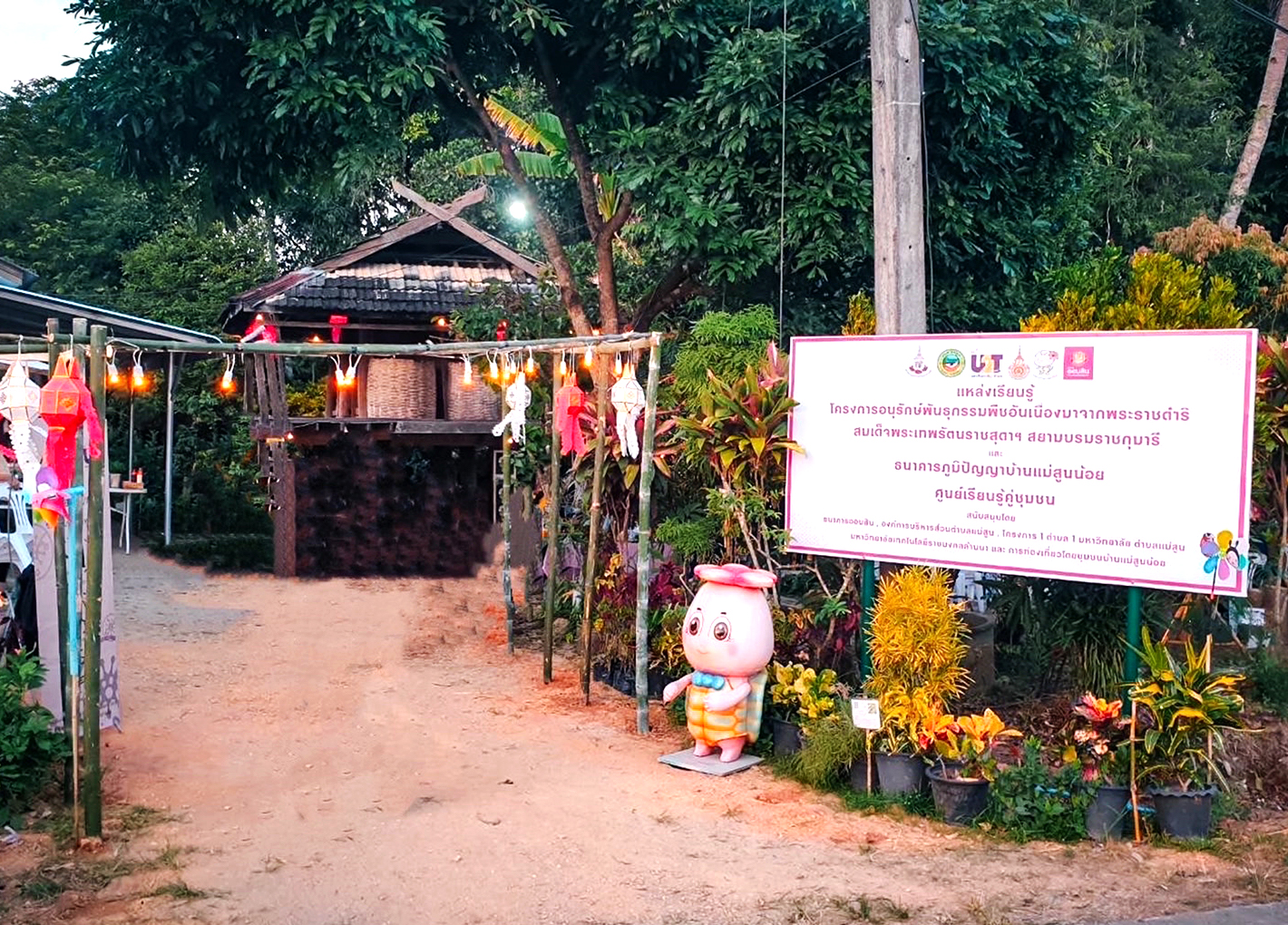
บ้านแม่สูนน้อย อำเภอฝาง จังหวัดเชียงใหม่ มีกลุ่มผู้ว่างงานฉับพลันและกลุ่มผู้มีรายได้น้อย ที่มีรายได้ไม่เพียงพอในการยังชีพขั้นพื้นฐาน ซึ่งเป็นผลจากสถานการณ์การแพร่ระบาดของไวรัสโคโรนา (COVID-19) ทำให้มีการบุกรุกผืนป่าเบญจพรรณ และป่าสนเพื่อทำมาหากินเพิ่มมากขึ้น งานบริการวิชาการนี้มีวัตถุประสงค์เพื่อยกระดับความรู้ความสามารถในการประกอบอาชีพตามความถนัดและศักยภาพของชุมชน เพิ่มทักษะใหม่ที่จำเป็น เสริมทักษะใหม่ในบริบทใหม่ และพัฒนาทักษะอาชีพรายบุคคล ด้วยกระบวนการดังนี้ 1) การกำหนดปัญหาที่แท้จริง 2) การสร้างสัมมาชีพชุมชน 3) การออกแบบพื้นที่แหล่งภูมิปัญญาชุมชนอย่างมีส่วนร่วม 4) การดำเนินการปรับปรุงพื้นที่อย่างมีส่วนร่วม 5) กำหนดมาตรการและแนวทางการใช้ประโยชน์ และ 6) การส่งมอบพื้นที่สู่ชุมชนบ้านแม่สูนน้อย ส่งผลให้กลุ่มผู้ว่างงานฉับพลันมีอาชีพใหม่จำนวน 27 คน ลดลงจาก 78 คน เป็น 51 คน กลุ่มผู้มีรายได้น้อย 7 กลุ่ม รวมตัวจำหน่ายสินค้า ณ ธนาคารภูมิปัญญาบ้านแม่สูนน้อย และมีปราชญ์ชุมชนเพิ่มขึ้น 3 คน จากการเปลี่ยนแปลงพื้นที่ในชุมชนและกิจกรรมที่เป็นรูปธรรม ทำให้คนในชุมชนมีรายได้ เกิดการรับรู้คุณค่าทั้งตัวบุคคลในชุมชน สถาปัตยกรรม ทรัพยากรป่าไม้ ต้นน้ำ และนำไปสู่การเปลี่ยนแปลงในระดับกลุ่มต่อไป
Article Details

อนุญาตภายใต้เงื่อนไข Creative Commons Attribution-NonCommercial-NoDerivatives 4.0 International License.
Area Based Development Research Journal values copyright protection and licensing to safeguard author rights and facilitate the appropriate dissemination of research. Our policies ensure openness, accessibility, and attribution. Authors retain copyright ownership, and articles are published under a Creative Commons Attribution License (CC BY), allowing sharing, adaptation, and proper attribution. Authors have the freedom to publish under the CC BY license, granting broad reuse and distribution permissions. The journal supports posting articles on third-party repositories, adhering to institutional and funding restrictions. Author guidelines detail copyright and licensing requirements, empowering authors with knowledge about their rights and responsibilities. These policies cultivate an environment of collaboration, openness, and responsible sharing, benefiting authors and the research community while honoring intellectual property rights.
เอกสารอ้างอิง
Carbon Market. (n.d.). Circular economy. Retrieved August 20, 2022, from: http://carbonmarket.tgo.or.th/index.php?lang=TH&-mod=Y2VfaXM=. (in Thai).
Chunlasin, S. (2010). Development of a community participatory model using local wisdom for educational management based on the sufficiency economy philosophy in basic education institutions: An application of the aic process. Suranaree Journal of Social Science, 4(2), 17-31. (in Thai).
CIO World Magazine. (2021). Strategies for creating careers for the community. Retrieved October 28, 2022, from: http://www.cioworldmagazine.com/dr-kriengsak-chareonwongsak-strategies-creating-local-careers/. (in Thai).
Department of Environmental Quality Promotion. (1997). Solid waste management system. Bangkok: Promotion and Publication Division for Department of Environmental Quality Promotion.
Ganjanapan, A. (2000). Conservation of natural resources: Paradigm and policy. Bangkok: The Thailand Research Fund. (in Thai).
Government Savings Bank. (2020). Wisdom bank. Retrieved August 16, 2022, from: https://shorturl.asia/OBeL8. (in Thai).
Jensantikul, N. (2020). Labor in the coronary epidemic situation (COVID-19): Government measures and effects. Journal of Multidisciplinary in Humanities and Social Sciences, 3(3), 601-612. (in Thai).
Kesanuch, S., Nundaeng, C., Attasan, S. P., Pompai, J., & Warudee, K. (2021). The assessing potential and needs of the community supporting the special economic zone in Nong Khai province. Journal of Liberal Art of Rajamangala University of Technology Suvarnabhumi, 3(1), 13-26. (in Thai).
Mahawong, S. (2006). Spatial development of commercial fruit gardening in Mae Sun sub-district, Fang district, Chaing Mai province. (Research report). Chiang Mai: Graduate school of Chiang Mai University.
Ministry of Higher Education, Science Research and Innovation. (2020). The integrative sub-district economic and social development project (University to Tambon). Retrieved August 16, 2022, from: https://op.chandra.ac.th/plan/images/pdf/Manual%20Mhesi%20U2T%202564.pdf. (in Thai).
Ministry of Natural Resources and Environment. (2019). Community Biobank. Retrieved August 16, 2022, from:http://newweb.mnre.go.th/th/news/detail/32242. (in Thai).
National Higher Education, Science, Research and Innovation Policy Council. (2021). U2T: University to Tambon. Retrieved August 16, 2022, from: https://www.nxpo.or.th/th/8089/. (in Thai).
Norkham, R., Khunthongwong, S., & Boonsong, P. (2019). The development of coexistence of communities and forests in conservation forest areas. Udon Thani Rajabhat University Academic Journal, 7(2), 1-20. (in Thai).
Office of the National Economics and Social Development Council. (2020). Plans for the revival of the economy and society from the results of the COVID-19 and projects under the limit of 4 hundred billion baht according to the royal decree loan 1 trillion baht. Retrieved Octorber 28, 2022, from: https://shorturl.asia/Vocaf. (in Thai).
Parnpechra, S. (2009). Problems in the use of natural resources affecting community way of life and culture. (Research report). Bangkok: Dhurakij Pundit University. (in Thai).
Phansiri, P. (2016). Teaching documents for community development: Faculty of Humanities and Social Sciences, Nakhon Pathom Rajabhat University. Retrieved August 20, 2022, from: https://shorturl.asia/lah7p. (in Thai).
Ponsri, S. (2004). Theory and principle of community development (5th edition). Bangkok: Odeon Store.
Putjorn, P., Veranavin, L., Kheovichai, K., & Unaromlert, T. (2013). Participatory action research in community-based tourism management for sustainable community development at Salakkhok, Trat province. Journal of Liberal Arts, Prince of Songkla University, 5(2), 102-117. (in Thai).
Ratchathawan, R., Kaewkrajok, T., Jongkatekit, W., Phromkaew, P., Sumdangsan, D., & Thonglert, D. (2018). The community participation process in well-being development. Journal of Southern Technology, 11(1), 231-238. (in Thai).
Royal Forest Department. (n.d.). RFD action plan 5 years 2561-2565 Ministry of Natural Resources and Environment. Retrieved August 18, 2022, from: http://forestinfo.forest.go.th/Content/file/RFD_ActionPlan5year_2561-2565%20fn.pdf
Sanguannam. C. (2002). Theory and practice of educational administration. Bangkok: Book Point. (in Thai).
Sanrattana, U. (2011). Need assessment for curriculum and instruction development. Journal of Education Khon Kaen University, 34(1-2), 9-20. (in Thai).
Setkij, W. (2020). Sustainable development in the context of national development. Burapha Journal of Political Economy, 8(1), 81-106. (in Thai).
Singhaler, R., & Jongwutiwes, N. (2018). A model of community development for sustainable self-sufficiency: A case study Dondang village, Kantharawichai district, Maha Sarakham province. Journal of Technology Management Rajabhat Maha Sarakham University, 5(1), 133-144. (in Thai).
Sinthipong, U. (2015). Local community and the participation in the management of natural resources for sustainable use. Executive Journal, 35(1), 104-113. (in Thai).
Songkhla District Community Development Office. (2019). Creating a vocational group in a community vocational village. Retrieved September 19, 2022, from: https://district.cdd.go.th/muang-songkhla/services/. (in Thai).
Subdistrict Administrative Organization of Mae Soon. (2019). General and basic information of local government organizations. Retrieved August 17, 2022, from: http://www.maesoon.go.th/default/index.php/data. (in Thai).
Subdistrict Administrative Organization of Mae Soon. (2021). Local development plan. Retrieved August 17, 2022, from: http://www.maesoon.go.th/default/index.php/planpattana. (in Thai).
Sukhothai Thammathirat Open University. (2015). Feasibility study. Retrieved July 5, 2022, from: https://www.stou.ac.th/stouon-line/lom/data/sec/Lom14/02.html. (in Thai).
Thiangkamon, N. (2009). Environment and development. Bangkok: Chulalongkorn University.
The Chaipatana Foundation. (2017). Concepts and theories about the development and conservation of natural resources and the environment. Retrieved August 20, 2022, from: https://www.chaipat.or.th/concept-and-theory-development/develop-ment-and-conservation-of-natural-resources.html. (in Thai).
Topanurakkun, U., & Paiwithayasiritham, C. (2016). A participatory action research in conserving and passing on Thai Songdam’s cloth weaving wisdom. Silpakorn Educational Research Journal, 8(2), 162-175. (in Thai).
Tubtim, P. (2020). Strategies for collaboration in sustainable environmental management. Journal of MCU Nakhondhat, 7(12), 451-464. (in Thai).
Wiratchai, N., & Wongwanich, S. (2002). A synthesis of needs assessment techniques used in students’ these of Faculty of Education, Chulalongkorn University. Journal of Research Methodology, 15(2), 255-277. (in Thai).
Yokjinda, W. (2014). Public participation in community development of Thung Krang village, Tumbon Thap Sai, Amphoe Pong Nam Ron, Chanthaburi province. Bangkok: Public and Private Management, Graduate School of Public Administration. (in Thai).
