
การพัฒนารูปแบบผลิตภัณฑ์แม่ตุ่มจิ้นซ่ำพริกเพื่อส่งเสริมรายได้ในชุมชนไทลื้อ จังหวัดพะเยา
Article Sidebar
Main Article Content
บทคัดย่อ
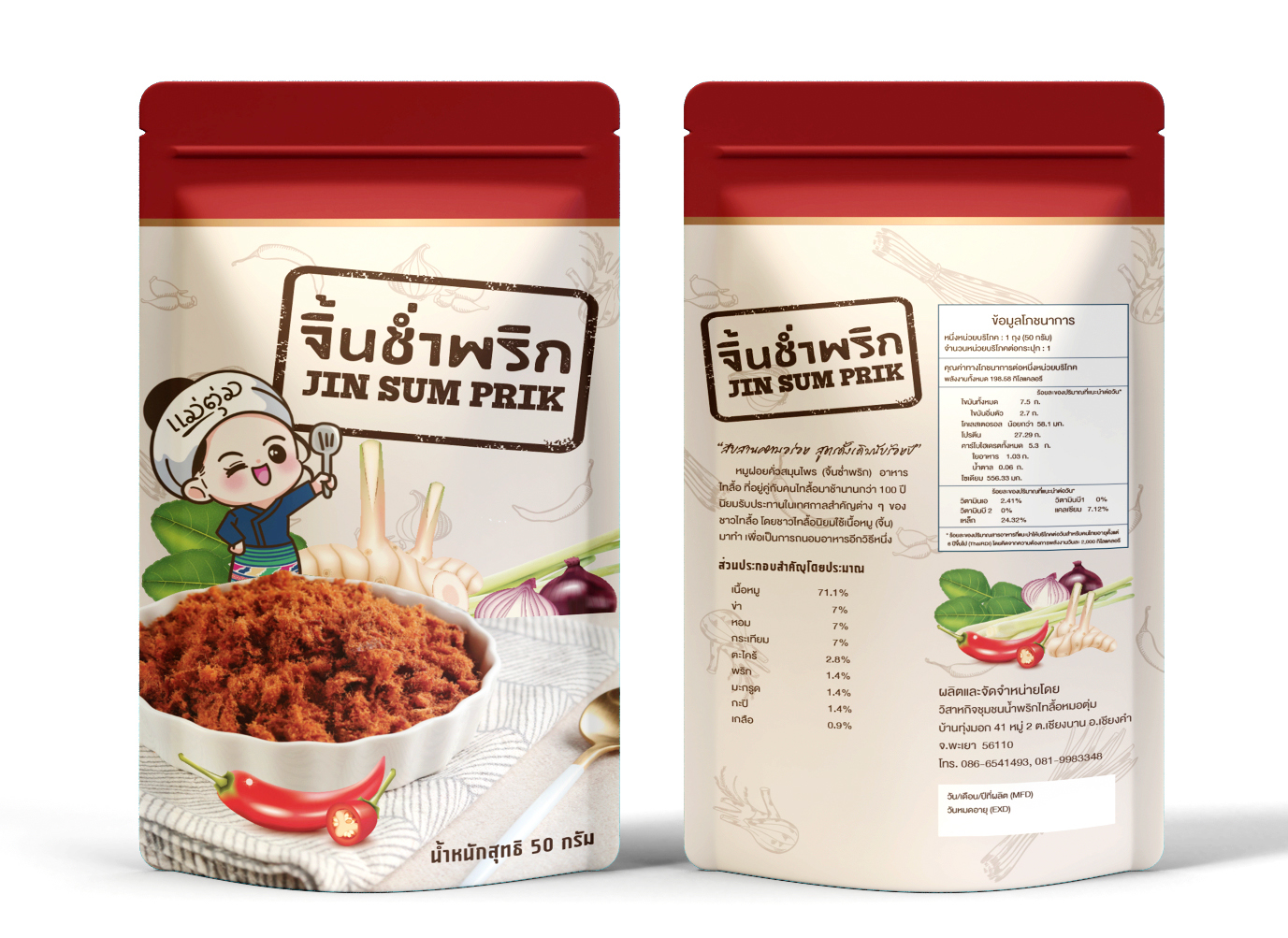
จิ้นซ่ำพริกเป็นอาหารพื้นบ้านของชุมชนไทลื้อ อำเภอเชียงคำ จังหวัดพะเยา ซึ่งเกิดจากภูมิปัญญาบรรพบุรุษในการถนอมอาหารโดยนำเนื้อหมูมาแปรรูปและผสมกับสมุนไพรท้องถิ่น และเป็นอาหารเชิงวัฒนธรรมที่สุ่มเสี่ยงต่อการสูญหาย ผลิตภัณฑ์แม่ตุ่มจิ้นซ่ำพริกในชุมชนไทลื้อประสบปัญหาการพัฒนารูปแบบผลิตภัณฑ์ที่เหมาะสมและตรงกับความต้องการของตลาด งานวิจัยนี้เป็นการวิจัยเชิงปฏิบัติการแบบมีส่วนร่วมซึ่งมีกระบวนการ ดังนี้ 1) การวิเคราะห์ศักยภาพของผลิตภัณฑ์และกลุ่มลูกค้าเป้าหมาย 2) การพัฒนาบรรจุภัณฑ์และสร้างเส้นทางการจำหน่าย และ 3) การทดสอบตลาด ทำให้มีผลิตภัณฑ์ที่ออกแบบใหม่ภายใต้เรื่องราวของจิ้นซ่ำพริก และการออกแบบสติ๊กเกอร์เป็นรูปผู้หญิงมวยผม โพกผม และแต่งกายด้วยชุดวัฒนธรรมไทลื้อ ในมือชูตะหลิว เพื่อสื่อความหมายถึงอาหารของชาวไทลื้อ และปรับเปลี่ยนบรรจุภัณฑ์เป็นถุงซิปล็อคที่ระบุส่วนประกอบและคุณค่าทางโภชนาการ การพัฒนาบรรจุภัณฑ์ต้นแบบ 3 ขนาดคือ 25 กรัม ราคาจำหน่ายซองละ 20 บาท ขนาด 30 กรัม ซองละ 35 บาท 3 ซอง 100 บาท และ ขนาด 50 กรัม ซองละ 50 บาท และช่องทางการตลาดโดยฝากขายที่ร้านขายของฝาก ส่งผลให้กลุ่มลูกค้าจดจำผลิตภัณฑ์ในบรรจุภัณฑ์ใหม่ และมียอดขายเฉลี่ยเพิ่มขึ้นจากเดือนละ 2,000 บาท เป็น 4,431.81 บาท
Article Details

อนุญาตภายใต้เงื่อนไข Creative Commons Attribution-NonCommercial-NoDerivatives 4.0 International License.
Area Based Development Research Journal values copyright protection and licensing to safeguard author rights and facilitate the appropriate dissemination of research. Our policies ensure openness, accessibility, and attribution. Authors retain copyright ownership, and articles are published under a Creative Commons Attribution License (CC BY), allowing sharing, adaptation, and proper attribution. Authors have the freedom to publish under the CC BY license, granting broad reuse and distribution permissions. The journal supports posting articles on third-party repositories, adhering to institutional and funding restrictions. Author guidelines detail copyright and licensing requirements, empowering authors with knowledge about their rights and responsibilities. These policies cultivate an environment of collaboration, openness, and responsible sharing, benefiting authors and the research community while honoring intellectual property rights.
เอกสารอ้างอิง
Altay, B. C., Okumuş, A., & Adıgüzel Mercangöz, B. (2022). An intelligent approach for analyzing the impacts of the COVID-19 pandemic on marketing mix elements (7Ps) of the on-demand grocery delivery service. Complex & Intelligent Systems, 8(1), 129-140.
Ampansirirat, A. & Wongchaiya, P. (2017). The participatory action research: Key features and application in community. Journal of Humanities and Social Sciences Mahasarakham University, 36(6), 192-202. (in Thai).
Berman, B. (1996). Marketing Channels. New York: John Wiley & Sons. Bond, A., Palerm, J., & Haigh, P. (2004). Public participation in EIA of nuclear power plant decommissioning projects: A case study analysis. Environmental Impact Assessment Review, 24(6), 617-641.
Creighton, J. L. (2005). The public participation handbook: Making better decisions through citizen involvement. USA: John Wiley & Sons.
Cohen, J. M. & Uphoff, N. T. (1980). Rural development Participation: Concept and measures for project development committee center for international studies. USA: Cornell University.
Designated Areas for Sustainable Tourism Administration (Public Organization). (2018). Chiang Kham Tai Lue cultural tourist community. Retrieved December 6, 2022, from: https://cbtthailand.dasta.or.th/webapp/community/content/43/.
Dahlstrom, M. F. (2014). Using narratives and storytelling to communicate science with nonexpert audiences. Proceedings of the National Academy of Sciences of The United States Of America, 111(Suppl. 4), 13614–13620.
Green, S. J., Grorud-Colvert, K., & Mannix, H. (2018). Uniting science and stories: Perspectives on the value of storytelling for communicating science. Ottawa: Canadian Science Publishing.
Kaewthep, K. (2006). Characteristics and research for area-based. Chiang Mai: Wanida press. (in Thai).
Kitiburt, W. (2007). Development Thai Leau community products, Doi Saket district, Chiang Mai. (Research report). Chiang Mai: Chiang Mai Rajabhat University. (in Thai).
Martinez-Conde, S., & Macknik, S. L. (2017). Opinion: Finding the plot in science storytelling in hopes of enhancing science communication. Proceedings of the National Academy of Sciences, 114, 8127–8129.
Phayao Labor Office. (2022). Enhancing, protect, and quality of life of non-worker in Phayao provice. Retrieved March 6, 2022, from: https://phayao.mol.go.th/labor_statistics. (in Thai).
Piyachan, P., Pattaranukrom, P., Samukkethu, S., & Kamonsirisakul, H. (2020). System and mechanisms development to drive Community Based Research (CBR) in Bangkok. Romphruek Journal of Krirk University, 38(1), 51-66. (in Thai).
Prommanee, P. (2011). Storytelling technique. Retrieved January 6, 2022, from: https://www.gotoknow.org/ posts/456068. (in Thai).
Robiady, N. D., Windasari, N. A., & Nita, A. (2021). Customer engagement in online social crowdfunding: The influence of storytelling technique on donation performance. International Journal of Research in Marketing, 38(2), 492-500.
Rosenbloom, B. (1999). Marketing channels: A management view. Forth Wort: The Dryden Press.
Rowe, G., & Frewer, L. J. (2005). A typology of public engagement mechanisms. Science, Technology, & Human Values, 30(2), 251-290.
The Princess Maha Chakri Sirindhorn Anthropology Centre (public organization). (2022). Ethnic community: Chiang Kham Tai Lue (Chiang Kham district, Phayao province). Retrieved December 6, 2022, from: https://www.sac.or.th/databases/ethnic-groups/ethnicGroups/97. (in Thai).
Yanprateap, T. (2007). Non-fiction writing. 12th Edition. Bangkok: Ramkhamhang University Press. (in Thai).
