
การแก้ปัญหาความยากจนด้วยโมเดลแก้จน “ฟื้นฟูเศรษฐกิจ หล่อเลี้ยงชีวิตด้วยไผ่” อำเภอท่าลี่ จังหวัดเลย
Article Sidebar
Main Article Content
บทคัดย่อ
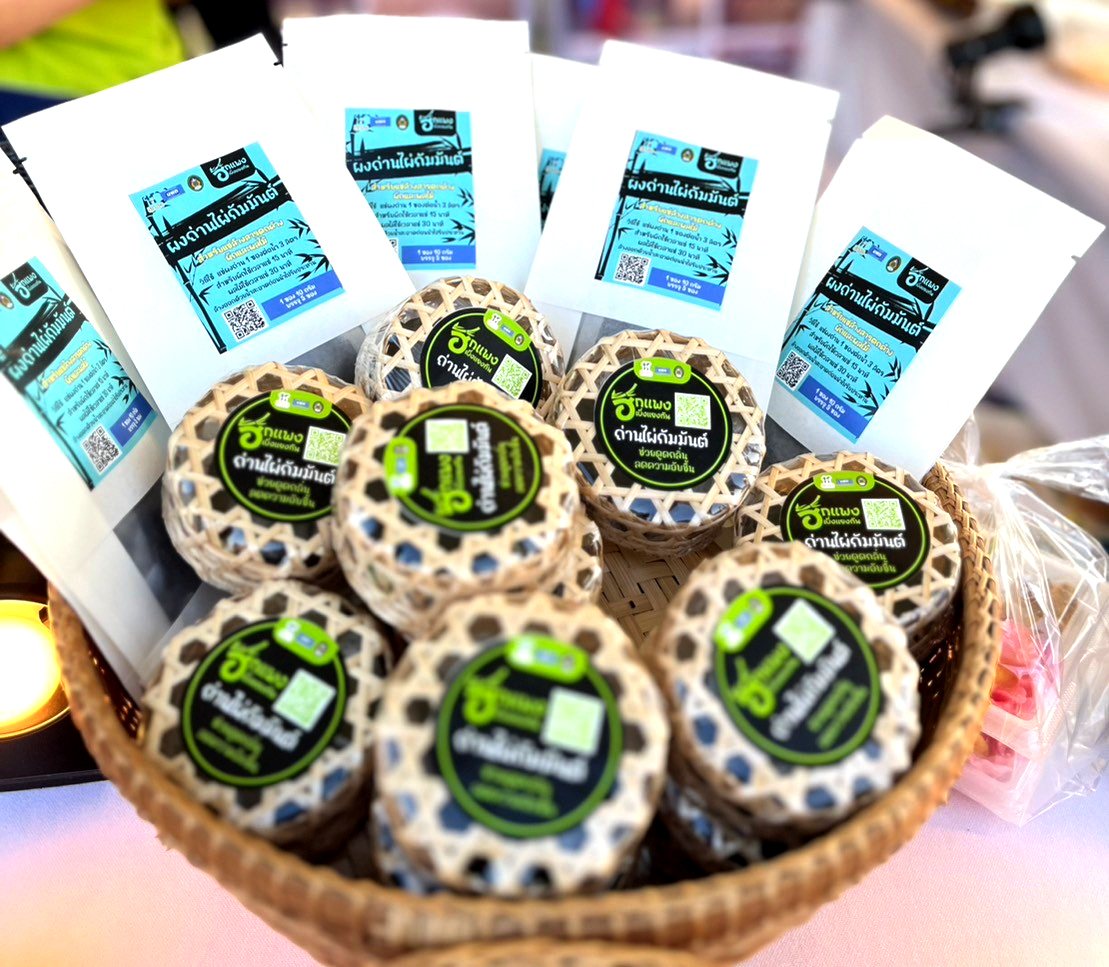
ครัวเรือนยากจนในอำเภอท่าลี่ จังหวัดเลย จำนวน 112 ครัวเรือน มีรายได้หลักจากไผ่และหน่อไม้ มีรายได้เฉลี่ย 36,055.36 บาท/ปี/ครัวเรือน ปัญหาหลักของครัวเรือนยากจนคือ ไม่สามารถควบคุมปริมาณผลผลิตไผ่ในพื้นที่ การผลิตหน่อไม้แปรรูปไม่มีคุณภาพ ไม่มีบรรจุภัณฑ์และตราสินค้า การจำหน่ายแบบต่างคนต่างขาย และผลิตภัณฑ์จักสานไม่ไผ่ไม่มีรูปแบบที่ทันสมัย งานวิจัยนี้จึงพัฒนาโมเดลแก้จน “ฟื้นฟูเศรษฐกิจ หล่อเลี้ยงชีวิตด้วยไผ่” ซึ่งประกอบด้วย 3 โมเดลย่อย ได้แก่ โมเดลแก้จนด้วย “หน่อไม้” โมเดลแก้จนด้วย “ถ่าน” และ โมเดลแก้จนด้วย “ผลิตภัณฑ์จักสาน” ซึ่งมีการดำเนินการ ดังนี้ 1) การเชื่อมโยงคนจนเข้าสู่ห่วงโซ่คุณค่าด้วยแนวคิด “ชุมชนช่วยชุมชน คนแข็งแรงช่วยคนอ่อนแอ” 2) การพัฒนากระบวนการจัดการแปลงไผ่ กระบวนการผลิตและการแปรรูปผลิตภัณฑ์หน่อไม้ ถ่านกัมมันต์ และจักสาน ซึ่งประกอบด้วย กระบวนการจัดการแปลงไผ่ และกระบวนการผลิตและการแปรรูปผลิตภัณฑ์หน่อไม้ ถ่านกัมมันต์ และจักสาน และ 3) การเชื่อมโยงเครือข่ายทางการตลาดและขยายช่องทางการจัดจำหน่าย ส่งผลให้มีการยกระดับผลิตภัณฑ์ไผ่และหน่อไม้ดังนี้ 1) หน่อไม้ต้มพาสเจอไรซ์ ทำให้มีกำไรเพิ่มขึ้นร้อยละ 222 2) หน่อไม้ดองอนามัย ทำให้มีกำไรเพิ่มขึ้นร้อยละ 69 3) หน่อไม้อบแห้งพาสเจอไรซ์ ทำให้มีกำไรเพิ่มขึ้นร้อยละ 657 4) การยกระดับผลิตภัณฑ์จักสาน ทำให้มีกำไรเพิ่มขึ้นร้อยละ 375 5) การยกระดับการเผาถ่านมะขามเป็นผลิตภัณฑ์ถ่านกัมมันต์ ทำให้มีกำไรเพิ่มขึ้นร้อยละ 29 และ 6) การปรับเปลี่ยนรูปแบบการดูแลรักษาป่าไผ่แบบธรรมชาติ เป็นการบริหารจัดการแปลงปลูกและระบบการจ่ายน้ำสวนไผ่ ทำให้มีกำไรเพิ่มขึ้นร้อยละ 36 ครัวเรือนยากจนมีรายได้ตลอดห่วงโซ่อุปทานตั้งแต่ต้นน้ำ กลุ่มผู้ปลูก กลางน้ำ กลุ่มผู้แปรรูป และปลายน้ำ กลุ่มผู้รับสินค้าไปจัดจำหน่าย และเป็นการแก้ปัญหาความยากจนได้อย่างต่อเนื่องและยั่งยืน
Article Details

อนุญาตภายใต้เงื่อนไข Creative Commons Attribution-NonCommercial-NoDerivatives 4.0 International License.
Area Based Development Research Journal values copyright protection and licensing to safeguard author rights and facilitate the appropriate dissemination of research. Our policies ensure openness, accessibility, and attribution. Authors retain copyright ownership, and articles are published under a Creative Commons Attribution License (CC BY), allowing sharing, adaptation, and proper attribution. Authors have the freedom to publish under the CC BY license, granting broad reuse and distribution permissions. The journal supports posting articles on third-party repositories, adhering to institutional and funding restrictions. Author guidelines detail copyright and licensing requirements, empowering authors with knowledge about their rights and responsibilities. These policies cultivate an environment of collaboration, openness, and responsible sharing, benefiting authors and the research community while honoring intellectual property rights.
เอกสารอ้างอิง
De Bells, M. P. (2017). Bamboo propagation handbook. Loei: Loei Rajabhat University. (in Thai).
Department of Forestry. (2019). Summary of the establishment of community forests according to forest types. Retrieved January 10, 2023, from: https://forestinfo.forest.go.th/fCom_Regis.aspx. (in Thai).
Jairtalawanich, S. (2021). Design and development a sliced bamboo-shoots cutter. Kasem Bundit Engineering Journal, 11(3), 38-55. (in Thai).
Kiatsongchai, S., Pruksa, S., Maliton, W., Petkanjanapong, P., Soisuwan, K., Inthawong, R., & Yothee, A. (2021). Research for precise poverty alleviation in Loei province. (Research report). Loei Rajabhat University. (in Thai).
Kotler, P., & Keller, K. L. (2016). Marketing management. (15th edition). Edinburgh: Pearson.
Noiprom, N., Wilaikaew, A., & Kulutnam, T. (2019). Dong Sam Kha community forest: Economic values of Nam Kam village, Tha Li district, Loei province. Research and Development Journal, 14(50), 1-12. (in Thai).
Office of Strategy Management Upper Northeast Provincial Cluster 1. (2018). Development plan for Upper Northern Provinces (2018- 2022). Retrieved January 10, 2023, from: http://old.industry.go.th/loei/index.php/5-2561-2565/22323-5-2561-2565/file. (in Thai).
Office of the National Economic and Social Development Council. (2018). National strategy. Retrieved January 10, 2023, from: http://nscr.nesdc.go.th/ns/. (in Thai).
Office of the National Economic and Social Development Council. (2022). Order of appointment of provincial sufficiency economy and sustainable development center. Retrieved October 14, 2023, from: https://opendata.nesdc.go.th/dataset/pelcd42. (in Thai).
Pakeechay, K., & Charoenphun, N. (2021). Bamboo shoot-processed food and the possibility of commercial production. Journal of Science and Technology, 29(5), 865-879. (in Thai).
Phuangchik, T. (2015). Activated carbon from bamboo: Does the market have a high demand?. Journal of Science and Technology, 23(6), 945-954. (in Thai).
Program Management Unit on Area Based Development. (2021). Research and innovations in poverty alleviation: precision and efficacy. (Research report). Office of National Higher Education Science Research and Innovation Policy Council. (in Thai).
Sukjai, K., Kalsirisilp, R., & Langapin, J. (2021). Design and development of bamboo craft splitting and slicing machine. Srinakharinwirot University Engineering Journal, 16(1), 71-81. (in Thai).
Tekhanmag, K., & Thampramaun, P. (2020). Wickers product development to the creative economy of Ban Pakklongbangkapieng, Huaphai sub-district, Muang district, Singburi province. NRRU Community Research Journal, 14(2), 44-56. (in Thai).
Thai People Map and Analytics Platform, (2021). Poverty household numbers. Retrieved April 5, 2022, from: https://www.tpmap.in.th/2564/42. (in Thai).
Thailand Environment Institute. (2021). Bamboo value chain analysis in Thailand. Retrieved June 22, 2022, from: https://tei.or.th/file/library/2021-bamboo_50.pdf. (in Thai).
Thailand United Nation. (2022). Sustainable development goals. Retrieved January 10, 2023, from: https://thailand.un.org/th/sdgs.(in Thai).
Withurathansan, T., Saratusananun, N., & Buttapala, K. (2007). The development of quality products of boiled bamboo shoots packed in bags by the professional group of Ban Ahi community, Tha Li district, Loei province. (Research report). Loei Rajabhat University, Faculty of Science and Technology. (in Thai).
