
ห่วงโซ่คุณค่าการผลิตรังไหมอีรี่สู่นวัตกรรมผลิตภัณฑ์จากดักแด้ไหมอีรี่ ตำบลทัพเสด็จ จังหวัดสระแก้ว
Article Sidebar
Main Article Content
บทคัดย่อ
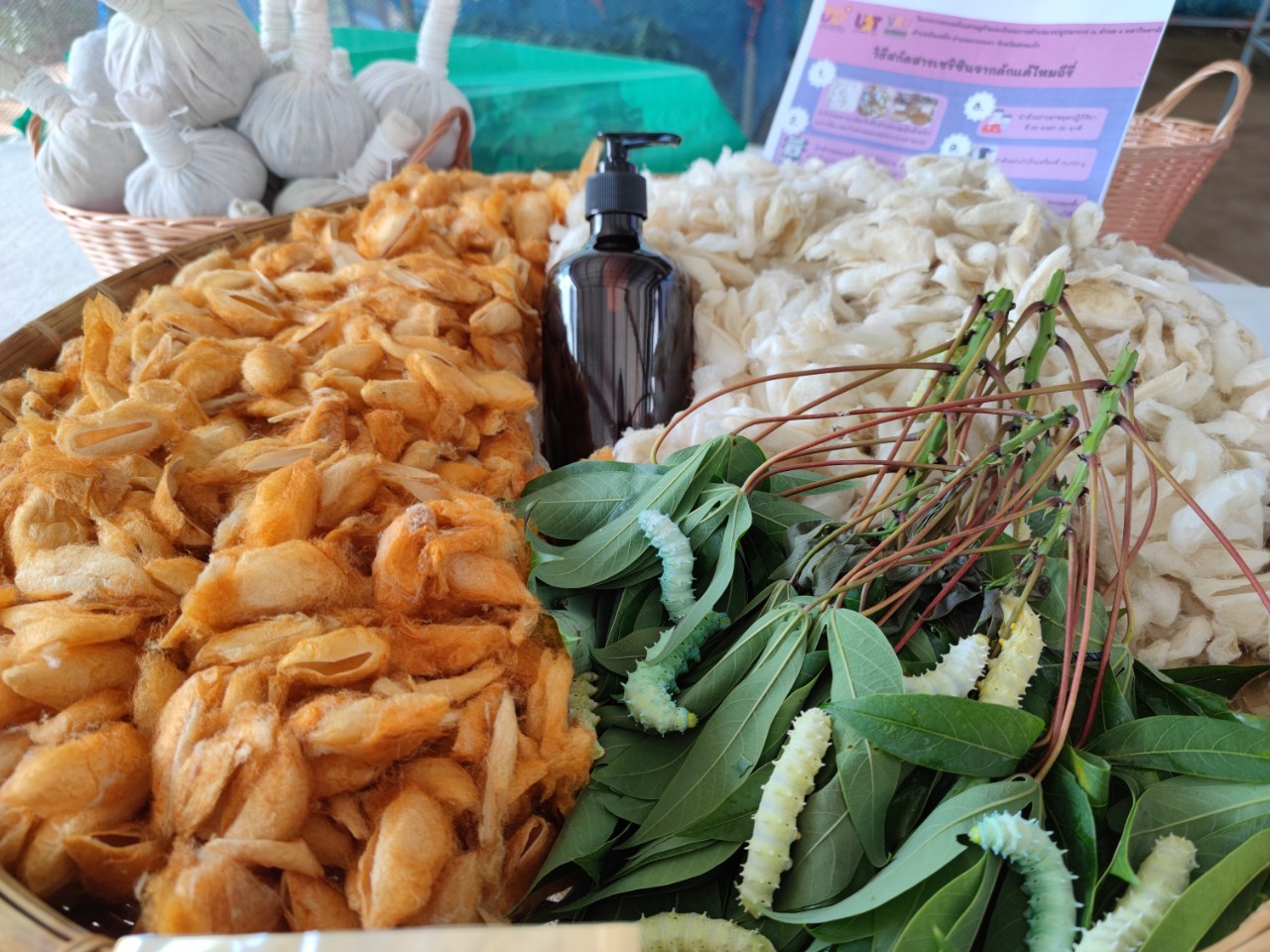
ตำบลทัพเสด็จ อำเภอตาพระยา จังหวัดสระแก้ว เป็นชุมชนชายแดนที่มีอาชีพหลักด้านเกษตรกรรม และเลี้ยงไหมอีรี่เป็นอาชีพเสริมหลังจากว่างเว้นจากการทำการเกษตร เกษตรกรผู้เลี้ยงไหมอีรี่ใน 4 หมู่บ้าน ผลิตรังไหมอีรี่สดเฉลี่ยรอบละ 20-30 กิโลกรัม แต่รังไหมอีรี่มีขนาดเล็กไม่ได้คุณภาพ และขาดแคลนไข่ไหมอีรี่จึงทำให้เกษตรกรผลิตได้ในปริมาณน้อยและไม่ต่อเนื่อง และไม่สามารถจำหน่ายดักแด้ไหมอีรี่ กระบวนการประกอบด้วยขั้นตอนดังนี้ 1) การจัดกลุ่มอย่างยั่งยืน โดยการจัดเวทีระดมความคิดเห็นของตัวแทนคนในชุมชน ผู้นำชุมชน พัฒนาชุมชนอำเภอตาพระยา เพื่อรับฟังปัญหาและความต้องการของชุมชน และร่วมกันจัดทำแผนการพัฒนายกระดับคุณภาพชีวิตชุมชนตำบลทัพเสด็จและวางกรอบในการพัฒนา 2) การจัดการกระบวนการผลิตตลอดห่วงโซ่อุปทาน การวางแผนพัฒนาศักยภาพการเลี้ยงไหมอีรี่แบบครบวงจร 3) การเรียนรู้ และการพัฒนาผลิตภัณฑ์ชุมชน ด้วยการแปรรูปผลิตภัณฑ์จากดักแด้ไหมอีรี่โดยการประยุกต์ความรู้ด้านเทคโนโลยีการแปรรูปอาหารในการแก้ไขปัญหาของชุมชน ดังนี้ บะหมี่อบแห้งดักแด้ไหมอีรี่ ผงโรยข้าว และช็อคโกแลตดักแด้ และ การทำปุ๋ยน้ำอินทรีย์จากมูลไหมอีรี่และปุ๋ยไม่พลิกกลับกอง การพัฒนาบรรจุภัณฑ์และออกแบบบรรจุภัณฑ์ และการขอจดจัดตั้งกลุ่มวิสาหกิจชุมชน 4) การตลาดและส่งเสริมการสร้างเครือข่ายชุมชน โดยการประสานงานเชื่อมโยงการตลาดจำหน่ายรังไหมอีรี่ร่วมกับศูนย์ส่งเสริมหม่อนไหมจังหวัดสระแก้ว เพื่อจัดหาบริษัทรับซื้อรังไหม การถ่ายทอดองค์ความรู้ด้านการสร้างแบรนด์สินค้า การใช้ช่องทางอีคอมเมิร์ซ รวมถึงหาช่องทางและโอกาสในการเข้าร่วมงานแสดงสินค้าต่างๆของภาครัฐ มีการจำหน่ายผลิตภัณฑ์ทั้งรูปแบบออนไลน์ และออฟไลน์ เพื่อเพิ่มยอดขาย และ 5) ภาคีเครือข่ายร่วมกับชุมชนคอยช่วยเหลือ ติดตาม สนับสนุน และให้คำแนะนำ เพื่อการพัฒนาชุมชนอย่างยั่งยืน ส่งผลให้ชุมชนเกิดการเปลี่ยนแปลงด้านองค์ความรู้การเลี้ยงไหมอีรี่แบบครบวงจร ตั้งแต่ต้นน้ำ กลางน้ำและปลายน้ำ และกระบวนการผลิตเพื่อเพิ่มมูลค่าดักแด้ไหมอีรี่ผ่านการบูรณาการความร่วมมือระหว่างชุมชนและภาคีเครือข่ายในการถ่ายทอดองค์ความรู้ สร้างนวัตกรรม การสร้างรายได้ และการสร้างความยั่งยืนในชุมชน ทำให้มีนวัตกรชุมชนด้านการเลี้ยงไหมอีรี่ที่มีองค์ความรู้และสามารถถ่ายทอดองค์ความรู้การเลี้ยงไหม ทำให้สามารถผลิตรังไหมอีรี่ เกรด A ตามเกณฑ์มาตรฐานของบริษัทเอกชน และนวัตกรชุมชนใช้องค์ความรู้ในการผสมพันธุ์ไหมอีรี่ที่มีรังไหมสีทอง และได้รับการขึ้นทะเบียน ไหมมันสำปะหลังสระแก้ว สายพันธุ์ไหมของกรมหม่อนไหม นอกจากนี้ยังมีนวัตกรชุมชนด้านการแปรรูปผลิตภัณฑ์จากดักแด้ไหมอีรี่ที่สามารถถ่ายทอดองค์ความรู้ นำไปสู่การจัดตั้งกลุ่มวิสาหกิจชุมชนผู้เลี้ยงไหมอีรี่และแปรรูปผลิตภัณฑ์จากไหมอีรี่ตำบลทัพเสด็จ ชุมชนมีรายได้เพิ่มเฉลี่ยครัวเรือน 5,000-6,000 บาทต่อเดือน เพิ่มขึ้นร้อยละ 25-50 มีการจัดตั้งศูนย์เรียนรู้การเลี้ยงไหมอีรี่ตำบลทัพเสด็จเพื่อเป็นแหล่งเรียนรู้อาชีพ และนำไปสู่การพัฒนาคุณภาพชีวิตและความมั่นคงทางเศรษฐกิจในชุมชนอย่างยั่งยืน
Article Details

อนุญาตภายใต้เงื่อนไข Creative Commons Attribution-NonCommercial-NoDerivatives 4.0 International License.
Area Based Development Research Journal values copyright protection and licensing to safeguard author rights and facilitate the appropriate dissemination of research. Our policies ensure openness, accessibility, and attribution. Authors retain copyright ownership, and articles are published under a Creative Commons Attribution License (CC BY), allowing sharing, adaptation, and proper attribution. Authors have the freedom to publish under the CC BY license, granting broad reuse and distribution permissions. The journal supports posting articles on third-party repositories, adhering to institutional and funding restrictions. Author guidelines detail copyright and licensing requirements, empowering authors with knowledge about their rights and responsibilities. These policies cultivate an environment of collaboration, openness, and responsible sharing, benefiting authors and the research community while honoring intellectual property rights.
เอกสารอ้างอิง
Akai, H. (2002). Development and contribution of the international society for wild silk moths. International Journal of Silkmoth & Silk, 7, 1-10.
Attathom, T., Kunhasut, V., & Areekul, S. (1992). Rearing of eri silkworm by different host plants. In Proceedings of the 30th Kasetsart University Annual Conference: Plants (pp. 291-300). Ministry of Science, Technology and Energy, Kasetsart University, Bangkok. (in Thai).
Attathom, T. (2011). Eri silk: A new type of silk that eats cassava leaves. Retrieved January 12, 2025, from https://www.goto-know.org/posts/441496. (in Thai).
Attathom, T. (n.d.). Raising Eri silkworms as a new alternative career. Department of Entomology, Faculty of Agriculture, Kasetsart University, Kamphaeng Saen Campus, Nakhon Pathom (in Thai).
Attathom, T., Saksirirat, S., Phatthanasetthanon, W., & Phromchana, N. (2002). Production cost analysis of Eri silkworm for the development toward industrialization. (Research report). Thailand Science Research and Innovation. (in Thai).
Food Intelligence Center. (2023). Insect protein alternative food for sustainability. Retrieved January 12, 2025, from https://fic.nfi.or.th/upload/market_overview/pdf385.pdf. (in Thai).
Intira, L., Nanthachai, N., & Palida, T. (2023). Effect of Eri silkworm pupa powder on quality changes of brownies. Phranakhon Rajabhat Research Journal (Science and Technology), 18(1), 69-83. (in Thai).
Jaifong, C., Seerasarn, N., & Puttamuk, T. (2022). Extension of cassava mosaic disease management in Taphraya District, Sakaeo Province. Journal of Roi Kaensarn Academi, 7(10), 67-81. (in Thai).
Jarimopas, B., Areekul, P., Saksoong, P., Attathom, T., & Areekul, S. (1993). Eri silk rearing for economic development of North-Eastern Thailand. Kasetsart University Research and Development Institute. Bangkok. (in Thai).
Khamchuenwong, N. (2020). Guidelines for enhancing the potential of Eri silk farmers. Retrieved January 12, 2025, from https://researchcafe.tsri.or.th/guidelines-to-promote-the-industrial-potential-of-eri-farmers/ (in Thai).
Matichon Online. (2019). Rain shadow area of Ta Phraya District, Sa Kaeo Province is dry, while many other provinces are hit by storms. Retrieved January 12, 2025, from https://www.matichon.co.th/region/news_1655607 (in Thai).
Mishra, N., Hazarika, N. C., Narain, K., & Mahanta, J. (2003). Nutritive value of non-mulberry and mulberry silkworm pupae and consumption pattern in Assam, India. Journal of Nutrition Research, 23, 1303-1311.
Office of Agricultural Economics. (2023). Office of Agricultural Economics visits the area to monitor the situation of cassava and sugarcane for the year 2023/24. Retrieved January 12, 2025, from: https://www.oae.go.th. (in Thai).
Orranee, S., Worawit, M., Wanaporn, T., Suthira, P., Tipanee, S., Saowanee, A., ..., & Seepai, A. (2022). Replacement of fishmeal by Eri silkworm (Samia ricini) or Thai crossbreed (J108 × Nhaglai) silkworm in goldfish (Carassius auratus) diet on growth performance, pigmentation, and health status index. King Mongkut’s Agricultural Journal, 40(3), 260-271. (in Thai).
Phromboon, A., Saksung, S., & Phatrakon, T. (2007). Cyanide residue and lecithin content from Eri silkworms. (Research Report). Department of Biochemistry, Kasetsart University. (in Thai).
Pimpasalee, S., Hemathulin, S., Ittarat, R., Klaoliang, K., Wonrawongsomkam, K., Dokkang, S., & Phomtu, P. (2022). Development of a prototype method for extraction of proteins from eri silkworms for health food products developing Eri silkworm cocoon and pupae processing. Retrieved January 12, 2025, from https://qsds.go.th/newosrd/wp-content/uploads/sites/115/2022/07/silk-2565-9.pdf (in Thai).
Saennamwong, K., Sukritanont, Y., Nopsenee, P., Wilai, S., Raksang, W., Junpoon, S., ..., & Suttachana, S. (2006). The research and development project of Eri silk in the Northeast. (Research Report). Department of Agriculture. (in Thai).
Sakunphun, S., Uppapong, K., Junkawee, T., Palas, P., & Roonreangjai, R. (2024). Enhancing community economy through a new value chain of red tilapia in Lum Nam Nan, Uttaradit Province, Thailand. Area Based Development Research Journal, 16(4), 329-345. (in Thai).
Sarkar, D. C. (1988). Eri culture in India. Central Silk Board, Ministry of Textiles, Government of India. Grafo Printers.
Sirimungkararat, S., Saksirirat, W., Nopparat, T., & Narkdang, T. (2010). Eri textile development for registration to Thai community product standard (TCPS). International Journal of Silkmoth & Silk, 14, 39-48.
Sirimungkararat, S. (2012). Eri silkworm products and current status of wild silkmoths in Thailand. The 7th International Conference on Wild Silkmoth and Silk: Southeast Asian Silk, Mahasarakham, Thailand, November 22-24, 2012.
Sirimungkararat, S. (2013). Eri silk: An economic insect worth watching. Retrieved January 12, 2025, from https://www.stou.ac.th/study/sumrit/10-58/page2-10-58.html (in Thai).
Sirimongkararat, S., Saksirirat, W., Wongsorn, D., & Maskhao, S. (2013). Use of castor commercial line for increasing yield of Eri silkworm. Khon Kaen Agriculture Journal, 41(Suppl. 1), 185-191. (in Thai).
Suthira, P. (2020). Research approaches for adding value to Eri silkworm pupae. Retrieved January 12, 2025, from https://qsds.go.th/newosrd/wp-content/uploads/sites/115/2020 /12/Eri-Silkworm.pdf. (in Thai).
Suttisan, P., Sukrichaya, H., Roongrat, I., Khanittha, K., Kanokwan, W., Suttikai, D., & Phianphon, P. (2022). Development of a prototype method for extraction of proteins from Eri silkworms for health food products: Developing Eri silkworm cocoon and pupae processing. Retrieved January 16, 2025, from https://qsds.go.th/newosrd/wp-content/uploads/sites/115/ 2022/07/silk-2565-9.pdf. (in Thai).
The Support Arts and Crafts International Centre of Thailand (SACICT). (2023). Eri silk handicrafts. Retrieved January 12, 2025, from https://sacit.or.th/uploads/items/attachments/956936879f66f5cf4ffbf3aefffd56ca/_d9c828d53e9a176bb883c0ee-1d35378a.pdf. (in Thai).
Valaya Alongkorn Rajabhat University under the Royal Patronage. (2018). Raising Eri silkworms (man thor yod). Retrieved January 12, 2025, from https://ppi.psu.ac.th/project/1487. (in Thai).
Wongtong, S., Areekul, P., Onlamoon, A., & Tragoolgarn, S. (1980). Research on wild silkworm cultivation in the highlands of northern Thailand. (Research Report), Highland Agriculture Project 1976-1980, Bangkok. (in Thai).
