
The Study and the Development of Ban Suan Nok Kwak’s Logo for Packaging Design of Spicy Santol Salad Product in Prachin Buri Province
Article Sidebar
Main Article Content
Abstract
This research aimed to 1) study data of Ban Suan Nok Kwak and spicy santol salad product, 2) develop Ban Suan Nok Kwak’s logo for packaging design of spicy santol salad product in Prachin Buri Province, and 3 ) assess customer satisfaction toward packaging design of spicy santol salad product in Prachin Buri Province. The research instruments included 1) the interview form for the farm owner, 2 ) the questionnaire about logo pattern selection, 3 ) the satisfaction assessment form toward logo design, 4) the questionnaire about label pattern selection, and 5) the satisfaction assessment form toward packaging design.
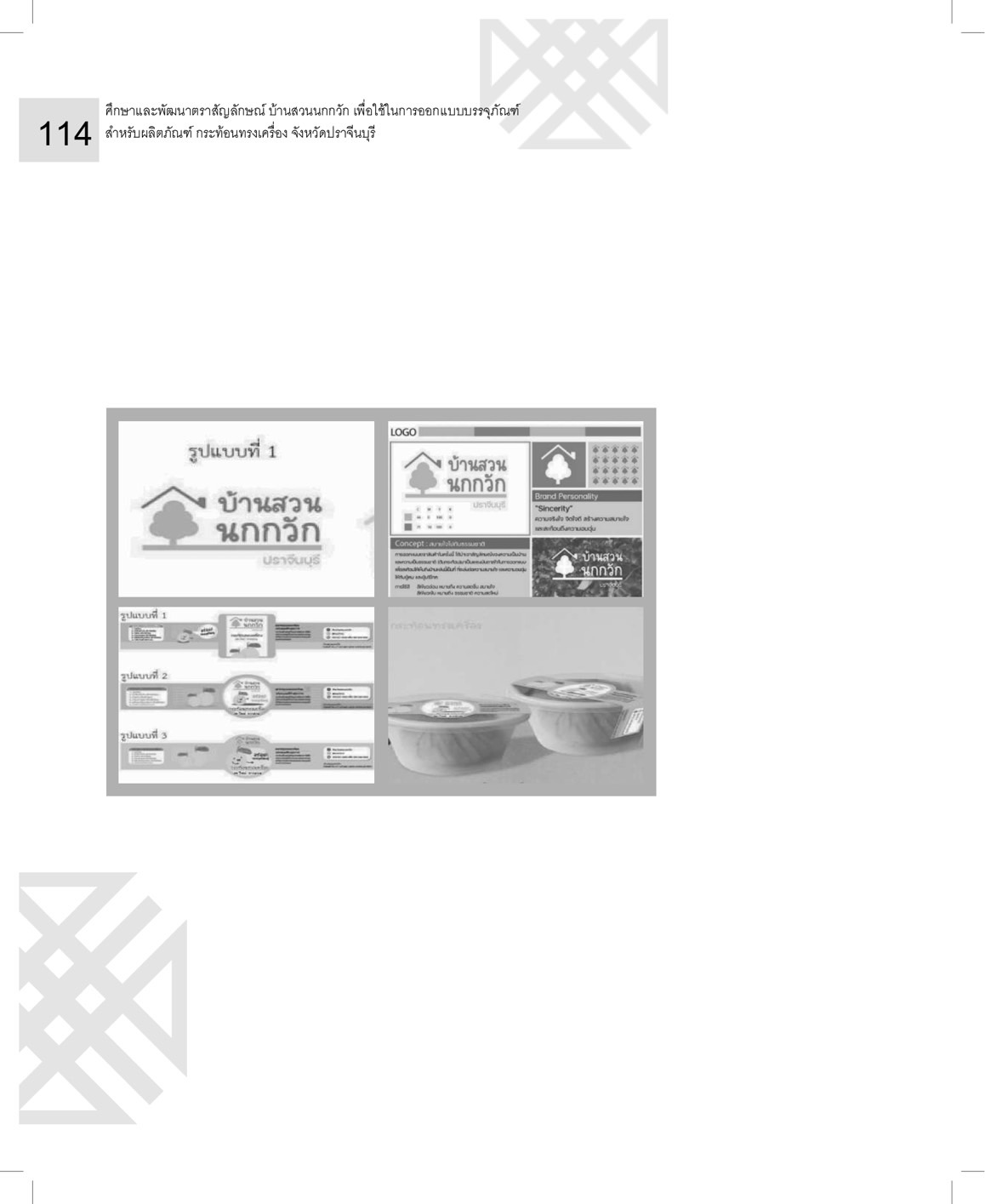
According to the results, the process can be described as follows. 1) For the results of the studied data of Ban Suan Nok Kwak by the interview with the farm owner, it was found that he would like the researcher to design new patterns of logo, packaging, and label with modern looks and suitable for the product. 2) For Ban Suan Nok Kwak’s logo design, it was found that Pattern 1 had the highest score, representing “Very suitable” (=4.16, S.D.=0.73). Combination form was used as the logo design technique. To clarify, letters, image, or graphics were applied and combined for design. Green was the selected color based on monochrome technique, i.e., using a single color or the only one prominent color, but with different shades. “Sincerity” was brand personality, representing kindness and comfort; and reflected warmth. After the new logo pattern was obtained (The selected pattern), satisfaction toward logo design in 100 consumers was assessed. It was found that the rated score represented “Very suitable” (
=4.03, S.D.=0.63). 3) For structural packaging design, 500 ml lidded plastic food containers were selected. These PP containers were semirigid plastic packaging, widely used in general. 4) For label design, it was found that Pattern 2 had the highest score, representing “Very suitable” (
=4.08, S.D.=0.84). 5) And for satisfaction assessment in 100 consumers, it was found that the rated score represented “Very suitable” (
=3.91, S.D.=0.50).
Article Details

This work is licensed under a Creative Commons Attribution-NonCommercial-NoDerivatives 4.0 International License.
The original manuscript published in the Burapha Arts Journal, Faculty of Fine and Applied Arts, Burapha University, is the property of Burapha University. No part of this text may be reproduced in whole or in part without written permission from the university.
References
ชัยรัตน์ อัศวางกูร. (2550). ออกแบบให้โดนใจ คู่มือการออกแบบบรรจุภัณฑ์สำหรับผู้ประกอบการและ นักออกแบบ. พิมพ์ครั้งที่ 3. กรุงเทพฯ: ทั้งฮั่วซินการพิมพ์.
แผนพัฒนาจังหวัดปราจีนบุรี. (2559). แผนพัฒนาจังหวัดปราจีนบุรี พ.ศ. 2561 – พ.ศ. 2564.
พงษ์ศักดิ์ ไชยทิพย์. (2547). เทคนิคการออกแบบงานกราฟิก. กรุงเทพฯ : ซีเอ็ดยูเคชั่น.
มยุรี ภาคลำเจียก. (2558). รอบรู้บรรจุภัณฑ์. พิมพ์ครั้งที่ 1. กรุงเทพฯ: จินดาสาส์นการพิมพ์.
มยุรี ภาคลำเจียก. (2556). บรรจุภัณฑ์สินค้าอุปโภคบริโภค. กรุงเทพฯ : โรงพิมพ์หยี่เฮง.
มยุรี ภาคลำเจียก. (2560). คู่มือบรรจุภัณฑ์มาตรฐาน สำหรับผู้ประกอบการเครื่องสำอาง SME. กรุงเทพฯ : จินดาสาส์นการพิมพ์.
สกนธ์ ภู่งามดี. (2554). การออกแบบสื่อสิ่งพิมพ์ เพื่อผลิตงานโฆษณา. กรุงเทพฯ: นเรศการพิมพ์.
สุภาภรณ์ ธีระจันทร์. (2559). การบรรจุภัณฑ์. กรุงเทพฯ : สุภัชนิญค์ พริ้นติ้ง กรุ๊ป.
สุมาลี ทองรุ่งโรจน์. (2555). Packaging Design ออกแบบบรรจุภัณฑ์. พิมพ์ครั้งที่ 1. กรุงเทพฯ:วาดศิลป์.
อารยะ ศรีกัลยาณบุตร. (2550). การออกแบบสิ่งพิมพ์. กรุงเทพฯ: วิสคอมเซ็นเตอร์.
