The development of orange dyeing from Bixa Orellana and Filagen textiles innovation with the Intellectual Wisdom from Tai Lue textiles.
Article Sidebar
Main Article Content
Abstract
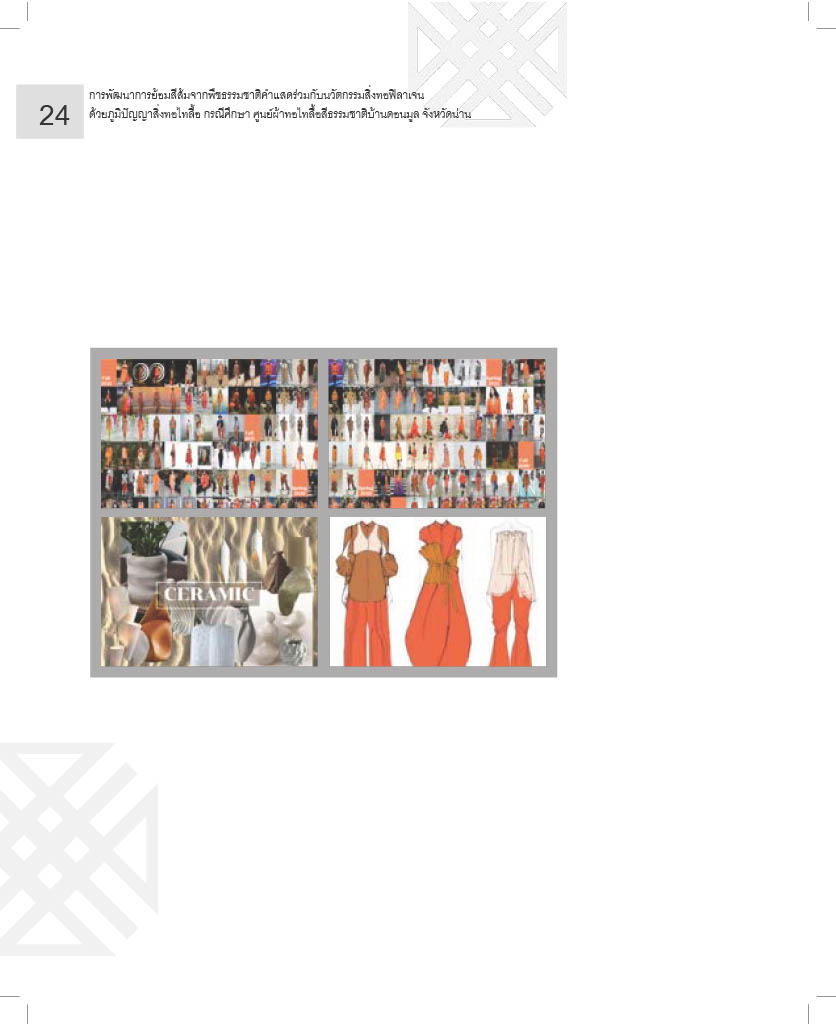
This research article is an experimental study focusing on the development of the guidelines of Bixa Orellana's orange pigment through a cultural capital and innovation of Filagen textiles in line with international fashion trends. 1) Secondary data research 1.1) Study the popularity of orange color in fashion trends 1.2) Study the natural dyeing method from the Tai Lue cultural capital 1.3) Study the Filagen textile innovation 2) The study included fieldwork to gather primary data on the process of natural dyeing methods from Bixa Orellana and experimental development of Filagen textile innovations through the Tai Lue cultural approach by local experts at the Ban Don Moon Tai Lue Textile Center in Nan Province. 3) Data analysis 4) Three important data were obtained from the research of the innovation of Bixa Orellana's orange pigment and Filagen fabric textiles, which was studied through cultural methods, and the international fashion trends. 4.1) The natural dyeing method using Bixa Orellana seeds found that changes in the mordant result in shifts in the saturation and tint of the orange level. 4.2 By mixing Bixa Orellana with other plants using heat dyeing process, the change of mordant will affect the change of Hue and Saturation of the orange level. 4.3) Filagen Textile Innovation can be dyed with Bixa Orellana, a process derived from the cultural knowledge of Tai Lue textiles.
Article Details

This work is licensed under a Creative Commons Attribution-NonCommercial-NoDerivatives 4.0 International License.
The original manuscript published in the Burapha Arts Journal, Faculty of Fine and Applied Arts, Burapha University, is the property of Burapha University. No part of this text may be reproduced in whole or in part without written permission from the university.
References
พัดชา อุทิศวรรณกุล. (2561). แฟชั่นและผลิตภัณฑ์ไลฟ์สไตล์จากทุนวัฒนธรรมสิ่งทอ จังหวัดน่าน. กรุงเทพฯ : คณะศิลปกรรมศาสตร์ จุฬาลงกรณ์มหาวิทยาลัย.
พัดชา อุทิศวรรณกุล. (2565). Fashion And Merchandise การจัดการบริหารสินค้าแฟชั่น (ฉบับปรับปรุง). กรุงเทพฯ : คณะศิลปกรรมศาสตร์ จุฬาลงกรณ์มหาวิทยาลัย.
Gerardo Bandera. (2022) HOW THE FASHION INDUSTRY POLLUTES OUR WATER.Retrieved October 30,2022,from https://www.fairplanet.org/story/how-the-fashion-
industry
Jenny Bell (2021). THE BEAUTY AND BENEFITS OF NATURAL DYES. Retrieved November,3,2022,from https://ecosophy.co.uk/journal/2021/10/28/the-beauty-and-
benefits
Jenny Clark. (2022). Colour Evolution SS 24. Retrieved October 19,2022,from https://www.wgsn.com/fashion/article/93490
Jenny Clark & Clare Smith. (2022) Colour of the Year 2024: Apricot Crush. Retrieved October 19,2022,from https://www.wgsn.com/fashion/article/93642
Morton, J. F. (1960). Can Annatto (Bixa Orellana L.) an Old Source of Food Color. Meet New Needs for Safe Dye?. Vol. 73. pp. 301-308. Proceedings of the Florida State Horticultural Society.
เกษมสุข เพ่งพินิจ, ผู้จัดการฝ่ายการตลาดและการขาย. บริษัท จี อี พี สปินนิ่ง จำกัด. สัมภาษณ์วันที่ 11 สิงหาคม 2565.
ศุภมาศ วงศ์ไทย. ศูนย์ผ้าทอไทลื้อสีธรรมชาติบ้านดอนมูล. สัมภาษณ์วันที่ 24 ตุลาคม 2565.
