Mong-korn-lai-kanok : Creative Research of Crossing Culture Art Dali-Sukhothai
Article Sidebar
Main Article Content
Abstract
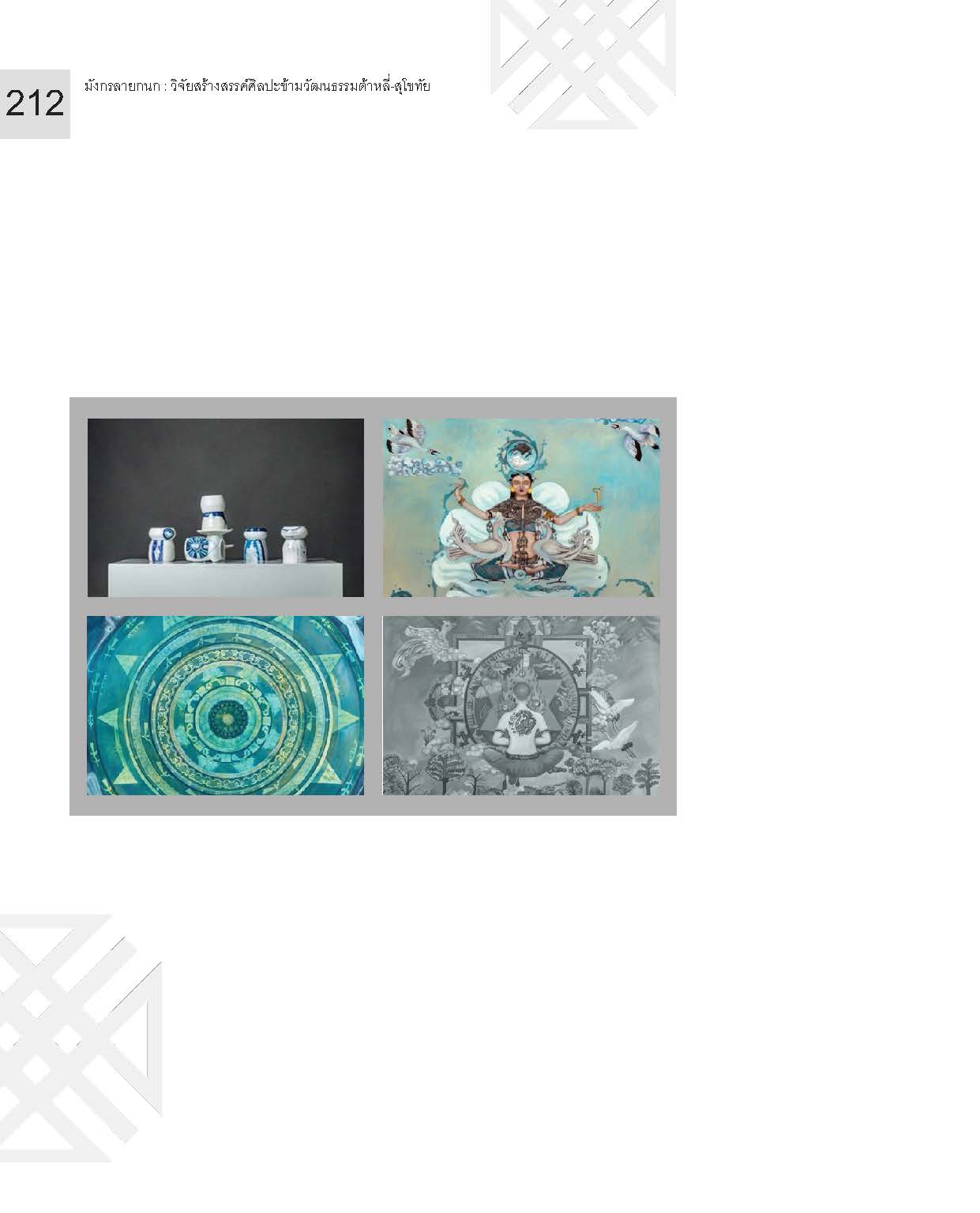
The study examined the history and geography, culture and art of Dali and Sukhothai based on the background of Sino-Thai relations and the historical origin of the two places. Through documentary research, fieldwork, and data collection, the relationship between the cultures and arts of the Dali and Sukhothai was sorted out, and the ethnic arts, bronze arts, painting arts, architectural arts, and ceramic arts of the two places were compared and studied. The artistic elements were extracted for the cross-cultural analysis and creation of the "Mong-korn-lai-kanok". This is a Thai pattern of Chinese dragons which combines the Chinese "Mong-korn" and the Thai "Lai-kanok", making the artwork retain the mystery of Oriental culture inits artistic style. The Dali-Sukotai cross-cultural art creation transformed the rich patterns and symbolic elements into a cross-cultural art language.
Article Details

This work is licensed under a Creative Commons Attribution-NonCommercial-NoDerivatives 4.0 International License.
The original manuscript published in the Burapha Arts Journal, Faculty of Fine and Applied Arts, Burapha University, is the property of Burapha University. No part of this text may be reproduced in whole or in part without written permission from the university.
References
FangTie. (2003). The relationship between Nanzhao, Tubo and Tang Dynasty. Chinese Tibetology, 41.
Hays Jeffrey. (n.d.). SUKHOTHAI AND EARLY THAI KINGS. Retrieved 6 May 2020, https://factsanddetails.com/southeast-asia/Thailand/sub5_8a/entry-3185.html
SaimongMangrai Sao. (1969). The Shan States and the British Annexation. New York: Southeast Asia Program.
SilpaBhirasri. (1973). An Appreciation of Sukhothai Art. Bangkok: The Fine Arts Department .
Tong Enzhong. (1983). New archaeological discoveries in Southeast Asia in the past two decades and foreign scholars' research on the origin of ancient civilizations in southern China. Journal of Southwest University for Nationalities, 11.
Wang DaDao. (1991). The pottery of Yunnan bronze culture and its relationship with the pottery of Dongshan, Vietnam and Ban Thanh culture of Thailand. Southern Ethnoarchaeology, 17.
Wang Haiting. (2016). A review of the "Southern Silk Road" research in Yunnan academic circles in the past ten years. Journal of Yunnan Socialist University, 6.
