
Animation creation process to promote learning on the topic of dinosaur species found in Khon Kaen Province.
Article Sidebar
Main Article Content
Abstract
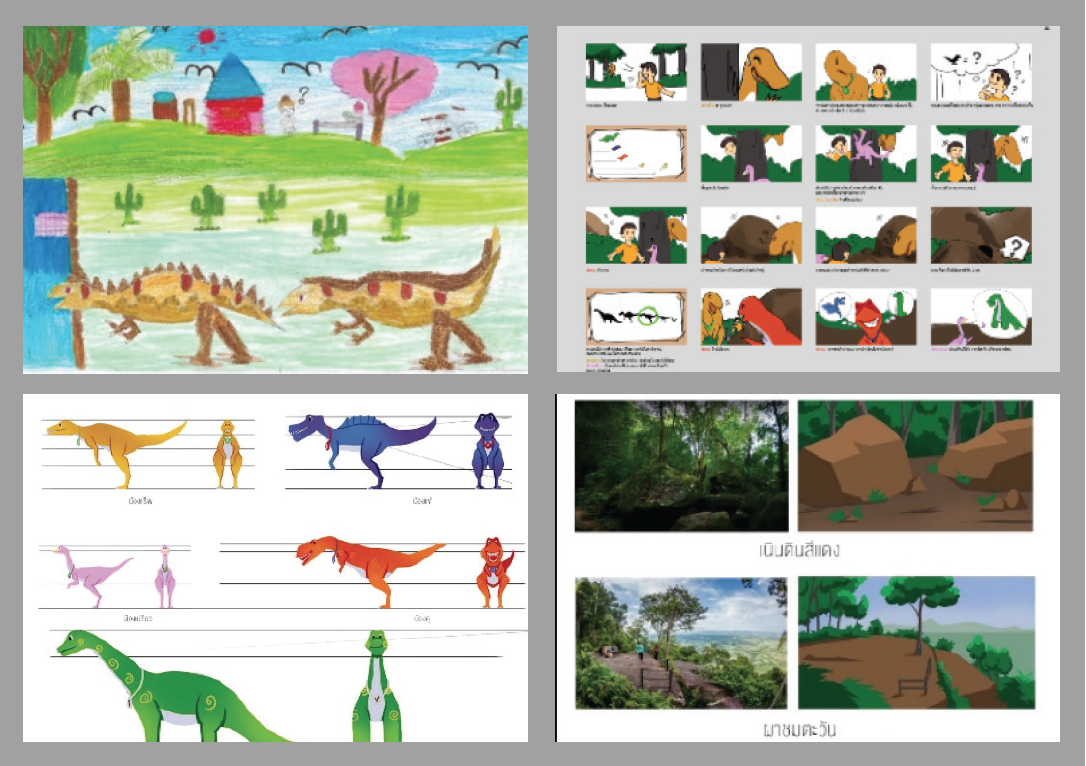
The objectives of this research are 1) to study the species of dinosaurs found in Khon Kaen Province and the identity of communities in Khon Kaen Province. 2) to analyze and find ways to create digital media that promotes learning about the species of dinosaurs found in Khon Kaen Province and the identity of communities in Khon Kaen Province. 3) To create and disseminate digital media works that promote learning about 5 species of dinosaurs by inserting the identity of communities in Khon Kaen Province. The creation of this animation is a study of the use of digital media to create 2D animation to promote learning for school-age children. The first step is studying information in 4 main areas: 1) information about dinosaur species in Khon Kaen Province 2) information about the identity of Khon Kaen Geopark 3) learning theories for school-age children 4) guidelines for creating 2D animation that help promote learning for school-age children, then measure achievement in learning about dinosaur species in Khon Kaen Province. The research tool is a 2D animation about 5 species of dinosaurs that incorporates the identity of the community in Khon Kaen Province. Satisfaction assessment form Questionnaire for viewers and experts in each field. The research method follows the following steps: study and collect information related to the research, use the collected information to summarize the content that will be presented in animated media, send it to experts to assess the accuracy of the content and then analyze the data, select creative approaches that can best promote learning, then design and create animations. After the research and creation process, the animation is used to display and survey audience satisfaction through questionnaires and interviews. The results of the research are as follows: (1) The dinosaurs discovered for the first time in Khon Kaen Province were a total of 5 species, including Phuwiangosaurus sirindhornae, Kinnarimimus, Khon Kaen Ensis. (Kinnareemimus khonkaennsis) Siamotyrannus isanensis (Siamotyrannus isanensis) Siamosaurus suteethorni (Siamosaurus suteethorni) Phuwiangvenator Yaemniyomi (Phuwiangvenator yaemniyomi), which is a name given in honor to various persons involved in the discovery. They also have nicknames for easy remembering: Nong Yong, Nong Preaw, Nong Du, Nong Khae, and Nong Rap, respectively. Each species has distinctive characteristics in terms of physicality, living conditions, diet, and habitat. (2) Guidelines for creating media To promote learning among school-aged children by designing digital media that promotes learning about dinosaur species with 2D animations that capture children's attention. Create a connection with your audience and have a narrative design that emphasizes important information. It was found to help promote learning by the results of the Paired Samples Test. It was found that primary school students in the areas of Phu Wiang District and Wiang Kao District There is a significant difference in the level of learning before and after learning through digital media that promotes learning about dinosaur species found in Khon Kaen Province and the community identity of Khon Kaen Geopark at the 0.01 level. (Sig. = 0.00) with higher learning scores after watching (mean = 14.20) than before watching this media. (mean = 10.59) and (3) the researcher has created and published digital media that promotes learning about 5 species of dinosaurs by inserting the community identity of Khon Kaen Geopark both in Online and offline channels It is displayed for an audience of local people. Museum visitors and the public who are interested.
Article Details

This work is licensed under a Creative Commons Attribution-NonCommercial-NoDerivatives 4.0 International License.
The original manuscript published in the Burapha Arts Journal, Faculty of Fine and Applied Arts, Burapha University, is the property of Burapha University. No part of this text may be reproduced in whole or in part without written permission from the university.
References
Adobe. (n.d.). Understanding the 12 principles of animation. Retrieved from https://bit.ly/3Rspzes
American Psychological Association, Coalition for Psychology in Schools and Education. (2015). Top 20 principles from psychology for pre-K to Grade 12 teaching and learning. Retrieved from http://
www.apa.org/ed/schools/cpse/top-twenty-principles.pdf
Ausubel, D. P. (1968). Educational psychology: A cognitive view. Holt, Rinehart and Winston.
Bloop. (2020). Animation Software: Which One Should You Use?. Retrieved from https://bit.ly/3RuCrRj
Bruner, J. (1961). The act of discovery. Harvard Educational Review, 31(1), 21-32.
Bruner, J. S. (1990). Acts of meaning. Harvard University Press.
Claxton, G. (1997) Hare Brain Tortoise Mind. London: Fourth Estate Limited
Denholm, J.A. (2014) The value of team-based serious game in higher education. Coventry: Coventry University
Esabbiz (2018) ‘รายงานพิเศษ: เปิดโรดแมป Khon Kaen Geopark ขึ้นแท่นอุทยานธรณีโลก. August 31, 2023, from https://www.esanbiz.com
Furniss, M. (2014). Introduction. In Art in Motion, Revised Edition: Animation Aesthetics (2nd ed., pp. ix–x). Indiana University Press. https://doi.org/10.2307/j.ctt2005zgm.3
Gee, J.P. (2005) ‘Good Video Games and Good Learning’. PHI KAPPA PHI FORUM . Retrieved from http://dmlcentral.net
Hannafin, M. J., & Land, S. M. (1997). The foundations and assumptions of technology-enhanced student-centered learning environments. Instructional Science, 25(3), 167-202.
Jensen, E. (2000). Brain-Based learning: The New Science of Teaching & Training. Corwin.
Jones, A., & Oliff, J. (2007). Thinking Animation: Bridging the Gap Between 2D and CG. Boston: Thompson Course Technology.
Kehr, D., (1998). Motion Picture: Animation. Retrieved from https://www.britannica.com/art/animation
Nyfa, & Nyfa. (2022). 5 Types Of Animation: Finding Inspiration In All Styles. NYFA. Retrieved from https://bit.ly/44V6CEk
Prensky, M. (2001) ‘Digital Natives, Digital Immigrants’. On the Horizon (MCB University Press). Retrieved from http://www.marcprensky.com
Satul Geopark (2017) ‘เกี่ยวกับอุทยานธรณีสตูล’. Retrieved from http://www.satun-geopark.com
Selby, A., (2013). Animation. London: Lawrence King.
Stefyn, N. (2019). What Is 2D Animation? Everything You Need To Know. Retrieved from https://bit.ly/3Pj9HIo
Sweller, J. (1988). Cognitive load during problem solving: Effects on learning. Cognitive Science, 12(2), 257-285.
Thapa, A. (2019). The Use of Animation in Delivery of Educational Messages
Among Primary School Children. Journal of Critical Reviews.Retrieved from https://bit.ly/46eOmXw
Thomas, F., & Johnston, O. (1981). Disney Animation: The Illusion of Life.
UNESCO (2017) ‘SATUN UNESCO GLOBAL GEOPARK (Thailand)’. Retrieved from https://bit.ly/3PLm6q1
Vishakha, S. & Yogendra, M. (2019). Animation: A Learning Tool. Novateur Publications. Retrieved from https://bit.ly/3PLr7Or
Vygotsky, L. S. (1978). Mind in society: The development of higher psychological processes. Harvard University Press.
Wells, P., & Moore, S. (2016). The Fundamentals of Animation (2nd Ed.). London: Bloomsbury.
Wickramasinghe, M. W. M. (2021). Impact of using 2D Animation As a Pedagogical Tool. Psychology. Retrieved from https://bit.ly/3sYCrPj
Williams, R. (2012). The animator’s survival kit: A Manual of Methods, Principles and Formulas for Classical, Computer, Games, Stop Motion and Internet Animators. Macmillan.
กนกวรรณ นำมา และคณะ. (2564). การพัฒนาสื่อดิจิทัลวิดีโอร่วมกับการเรียนรู้แบบปฏิสัมพันธ์ในชั้นเรียนเพื่อเสริมสร้างทัศนคติ เชิงบวกต่อการเรียนวิชาคณิตศาสตร์ อย่างมีความสุข. วราสารวิชาการครถศาสตร์อุตสาหกรรม พระจอมเกล้าพระนครเหนือ. 10(2). 1-11.
กรมทรัพยากรธรณี. 2566. ซากดึกดำบรรพ์ และไดโนเสาร์. สืบค้นเมื่อ 8 กรกฎาคม 2566, จาก https://www.dmr.go.th
จรินทร อุ่มไกร และไกยสิทธิ์ อภิระติง. (2562). การพัฒนาสื่อดิจิทัลร่วมกับเทคโนโลยีความจริงเสริม โดยอาศัยการเรียนรู้แบบร่วมมือด้วยเทคนิค STAD ในรายวิชาคอมพิวเตอร์ ชั้นประถมศึกษาปีที่ 6. วารสารโครงงานวิทยาการคอมพิวเตอร์และเทคโนโลยีสารสนเทศ. 5(2). 19-27.
เติมศักดิ์ คทวณิช. 2546. จิตวิทยาทั่วไป. กรุงเทพฯ : ซีเอ็ดยูเคชัน.
มุกดา ศรียงค์, นวลศรี เปาโรหิตย์, สิริวรรณ สาระนาค, สุวิไล เรียงวัฒนสุข, และนิภา แก้วศรีงาม. 2546. จิตวิทยาทั่วไป. กรุงเทพฯ : มหาวิทยาลัยรามคำแหง.
วราวุธ สุธีธร. 2550. ไดโนเสาร์ของไทย. สำนักวิจัยซากดึกดำบรรพ์และพิพิธภัณฑ์ธรณีวิทยา/กรุงเทพฯ: กรมทรัพยากรธรณี
เว็บไซต์จังหวัดขอนแก่น, 2019. แผนพัฒนาจังหวัดขอนแก่น พ.ศ 2561 - 2565 (ฉบับทบทวน). สืบค้นเมื่อ 8 กรกฎาคม 2566, จาก https://bit.ly/3PrzLBt
สำนักงานสถิติจังหวัดขอนแก่น, 2019. รายการสถิติการท่องเที่ยว. สืบค้นเมื่อ 8 กรกฎาคม 2566, จาก http://khonkaen.nso.go.th
สำนักงานสถิติจังหวัดขอนแก่น. 2563. ข้อมูลสรุปจังหวัดขอนแก่น. สืบค้นเมื่อ 8 กรกฎาคม 2566, จาก https://bit.ly/46htWxd
สำนักวิจัยการอนุรักษ์ป่าไม้และพันธุ์พืช. 2560. สารานุกรมพืชในประเทศไทย. สืบค้นเมื่อ 8 กรกฎาคม 2566, จาก https://bit.ly/3RfEKqJ
องค์การบริหารส่วนจังหวัดขอนแก่น, 2564. รายงานการติดตามและประเมินผลโครงการส่งเสรมการท่องเที่ยวเชิงอนุรักษ์”อุทยานธรณีขอนแก่น (Khon Kaen Geo park). สืบค้นเมื่อ 8 กรกฎาคม 2566, จาก https://bit.ly/40Mx4Q0
