Product Design for Mixed-Alternative Tourism in a Community: A Case Study of Baan Kao Din High Stay Community Enterprise, Sriracha District, Chonburi Province
Article Sidebar
Main Article Content
Abstract
Tourism plays a vital role in driving the economy and generating income for communities. This research aims to 1) study the development approach of mixed-alternative tourism that aligns with the local resources of the Baan Kao Din High Stay Community Enterprise, Sriracha District, Chonburi Province, and 2) develop tourism-supporting products with a focus on community participation and sustainable use of resources. A mixed-methods research design was employed, comprising qualitative data collection through interviews, focus group discussions, and observation, along with quantitative data from questionnaires. The data were analyzed based on principles of participatory development and experience design.
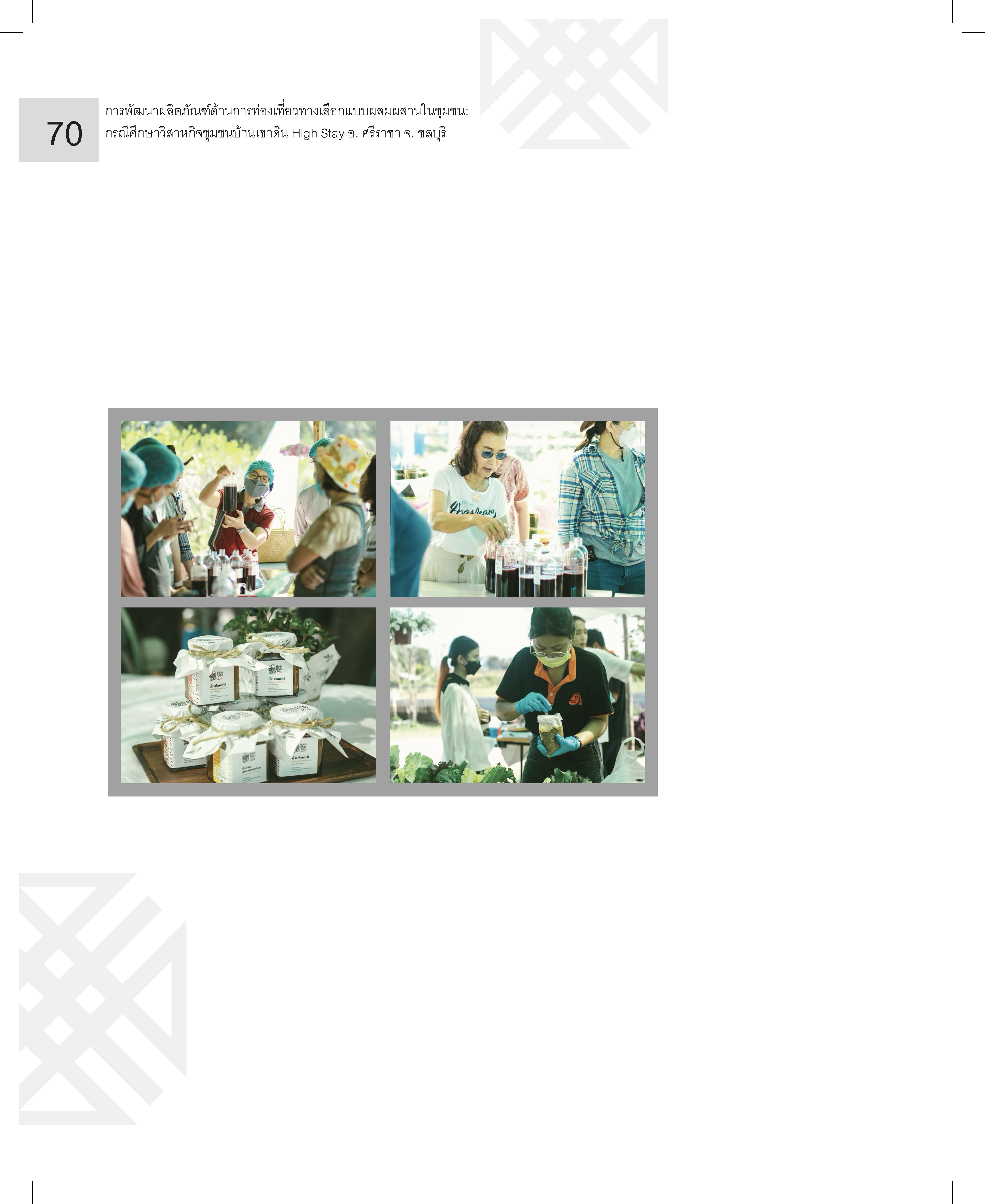
The results revealed that: 1) an appropriate model of mixed-alternative tourism for the community context requires sustainable utilization of local resources, community engagement, and infrastructure that supports tourism; and 2) the development of a prototype activity, “Food & Fun @ Chaiyo Farm,” offered learning and experiential opportunities through activities such as the creation of local products—mulberry wine, shrimp paste chili dip, and herbal chili paste—which helped connect tourists with the community's way of life. Additional activities included health promotion through organic vegetable consumption and creative art workshops using natural materials, such as eco-printing with leaves, which promote meaningful experiences and the sustainable use of local resources. The study found that the community could develop high-quality and meaningful tourism products that meet the needs of tourists seeking unique and authentic experiences. This has led to job creation and additional income for local residents. Satisfaction evaluations from participants showed a high level of satisfaction across areas including location, service, and activities. The proposed product development approach can foster long-term resilience for the community and serve as a practical model for expanding mixed-alternative tourism in other communities with similar characteristics.
Article Details

This work is licensed under a Creative Commons Attribution-NonCommercial-NoDerivatives 4.0 International License.
The original manuscript published in the Burapha Arts Journal, Faculty of Fine and Applied Arts, Burapha University, is the property of Burapha University. No part of this text may be reproduced in whole or in part without written permission from the university.
References
เก็จกนก เอื้อวงศ์, & พิชิต ฤทธิ์จรูญ. (2556). การวิจัยทางการบริหารการศึกษา. นนทบุรี: มหาวิทยาลัยสุโขทัยธรรมาธิราช
จิตติ มงคลชัยอรัญญา. (2556). การท่องเที่ยวโดยชุมชน: จากแนวคิดสู่การปฏิบัติ. กรุงเทพฯ: สำนักงานพัฒนาการท่องเที่ยว กระทรวงการท่องเที่ยวและกีฬา.
นฤมล เรืองสกุล. (2563). การท่องเที่ยวโดยชุมชนกับการสร้างอัตลักษณ์ในพื้นที่ท่องเที่ยวท้องถิ่น. วารสารวิจัยและพัฒนา มหาวิทยาลัยราชภัฏนครปฐม, 15(2), 45–59.
วัชรินทร์ อินทพรหม. (2563). การทบทวนวรรณกรรมสำหรับการวิจัยเชิงคุณภาพ. วารสารวิชาการ มหาวิทยาลัยกรุงเทพธนบุรี, 1(9)
สินธะวา คามดิษฐ์. (2556). แนวทางการสัมภาษณ์เชิงลึกเพื่อการพัฒนาการท่องเที่ยว. กรุงเทพฯ: สำนักพิมพ์แห่งจุฬาลงกรณ์มหาวิทยาลัย
สุภางค์ จันทวานิช. (2549). วิธีการวิจัยเชิงคุณภาพ. กรุงเทพฯ: สำนักพิมพ์จุฬาลงกรณ์มหาวิทยาลัย
Asker, S., Boronyak, L., Carrard, N., & Paddon, M. (2010). Effective community based tourism:
A best practice manual. Sustainable Tourism Cooperative Research Centre.
Chambers, R. (1994). Participatory rural appraisal (PRA): Analysis of experience. World Development, 22(9), 1253–1268. https://doi.org/10.1016/0305-750X(94)90003-5
Likert, R. (1932). A technique for the measurement of attitudes. Archives of Psychology, 22(140), 1–55.
Pine, B. J., & Gilmore, J. H. (1999). The experience economy: Work is theatre & every business a stage. Harvard Business School Press.
UNWTO. (2022). Tourism trends 2022. Retrieved from https://www.unwto-tourismacademy.ie.edu/2021/08/tourism-trends-2022
World Economic Forum. (2022). International travel levels tipped to soar again in 2022. Retrieved from https://www.weforum.org/agenda/2022/06/international-travel-2022-covid19-tourism
