
The Development of Fashion Textiles from Lace Waste through the Integration of Crochet Techniques under the Upcycling Concept for Generation Z
Article Sidebar
Main Article Content
Abstract
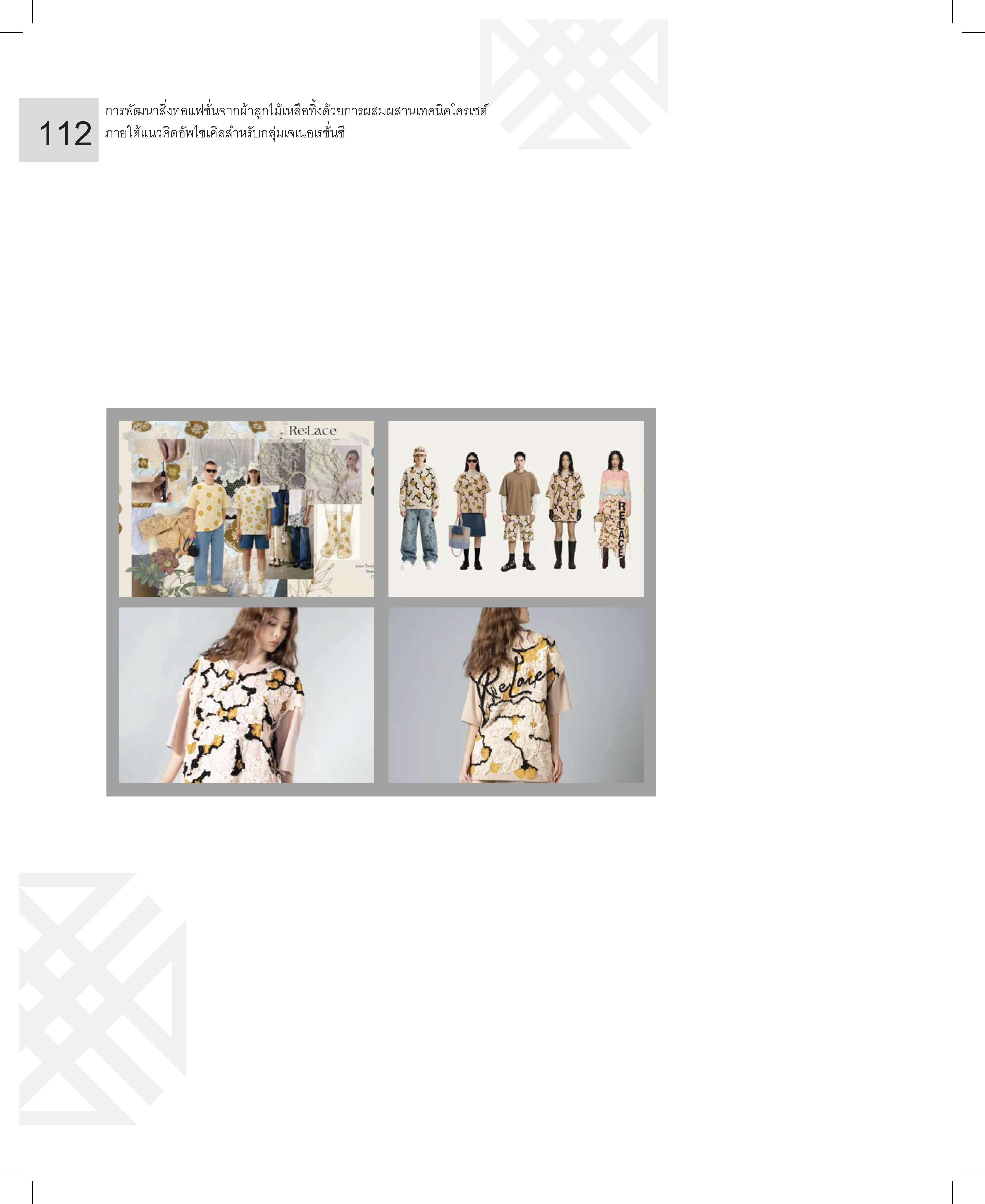
This research explores the development of fashion textiles from discarded lace by integrating crochet techniques under the upcycling concept for Generation Z. The study employs a mixed methodology approach, combining quantitative data collection with experimental and creative textile development. The primary objective is to experiment with and develop surface construction techniques using lace waste and crochet methods to create innovative textiles, ultimately leading to the design of fashion products tailored to Generation Z. Findings indicate that crochet techniques effectively transform various textures and patterns of lace remnants into new, unique textile surfaces. This approach aligns with sustainable design practices by maximizing the value of waste materials. The resulting products reflect the identity of Generation Z, who prioritize self-expression and environmental consciousness. This study thus provides a viable framework for creatively repurposing textile waste into value-added fashion items suited to the values and lifestyles of emerging consumer groups.
Article Details

This work is licensed under a Creative Commons Attribution-NonCommercial-NoDerivatives 4.0 International License.
The original manuscript published in the Burapha Arts Journal, Faculty of Fine and Applied Arts, Burapha University, is the property of Burapha University. No part of this text may be reproduced in whole or in part without written permission from the university.
References
สำนักงานเศรษฐกิจอุตสาหกรรม. (2565). รายงานอุตสาหกรรมสิ่งทอไทย ปี 2565. กระทรวงอุตสาหกรรม. DeLong, M., & Fiore, A. M. (2019). The power of fashion: Towards design thinking in fashion. Bloomsbury Publishing.
Ellen MacArthur Foundation. (2017). A new textiles economy: Redesigning fashion’s future. Retrieved March 22, 2025, from https://ellenmacarthurfoundation.org Francis, T., & Hoefel, F. (2018). True Gen: Generation Z and its implications for companies, McKinsey & Company. Retrieved April 10, 2025, from https://www.mckinsey.com/industries/consumer-packaged-goods/our-insights/true-gen-generation-z-and-its-implications-for-companies
Grimaud, C. (2021). Surface and texture in textile-based fashion design, Journal of Textile Design Research and Practice, 9(2), 157–172.
Joy, A., Sherry Jr, J. F., Venkatesh, A., Wang, J., & Chan, R. (2012). Fast Fashion, Sustainability, and the Ethical Appeal of Luxury Brands, 16(3), 273–295. Retrieved March 30, 2025, from https://doi.org/10.2752/175174112X13340749707123
McDonough, W., & Braungart, M. (2002). Cradle to cradle: Remaking the way we make things. North Point Press.
McKinsey & Company. (2020). The State of Fashion 2020: Navigating Uncertainty. Retrieved April 5, 2025, from https://www.mckinsey.com
Niinimäki, K., Peters, G., Dahlbo, H., Perry, P., Rissanen, T., & Gwilt, A. (2020). The environmental price of fast fashion. Nature Reviews Earth & Environment, 1(4), 189–200. Retrieved March 25, 2025, from https://doi.org/10.1038/s43017-020-0039-9
Rissanen, T., & McQuillan, H. (2016). Zero waste fashion design. Bloomsbury Publishing. RMIT University. (2024). Gen Z supports sustainability — and fuels ultra-fast fashion. How does that work?.Retrieved April 5, 2025, from https://www.rmit.edu.au/news/acumen/gen-z-supports-sustainability-and-fuels-ultra-fast-fashion
Simeon, P., & Buonincontri, P. (2022). Fashion consumption in the digital age: The influence of Gen Z on omnichannel strategies, Journal of Retailing and Consumer Services, 64, 102772. Retrieved April 11, 2025, from https://doi.org/10.1016/j.jretconser.2021.102772
Textile World. (2024). Garson and Shaw: Half of Gen Z believes pressure to buy fast fashion damages mental health. Retrieved April 5, 2025, from https://www.textileworld.com/textile-world/knitting-apparel/2024/09/garson-and-shaw-half-of-gen-z-believes-pressure-to-buy-fast-fashion-damages-mental-health
Thailand Textile Institute. (2022). Textile waste management and circular economy pilot project in lace fabric factories. Bangkok: Ministry of Industry.
