
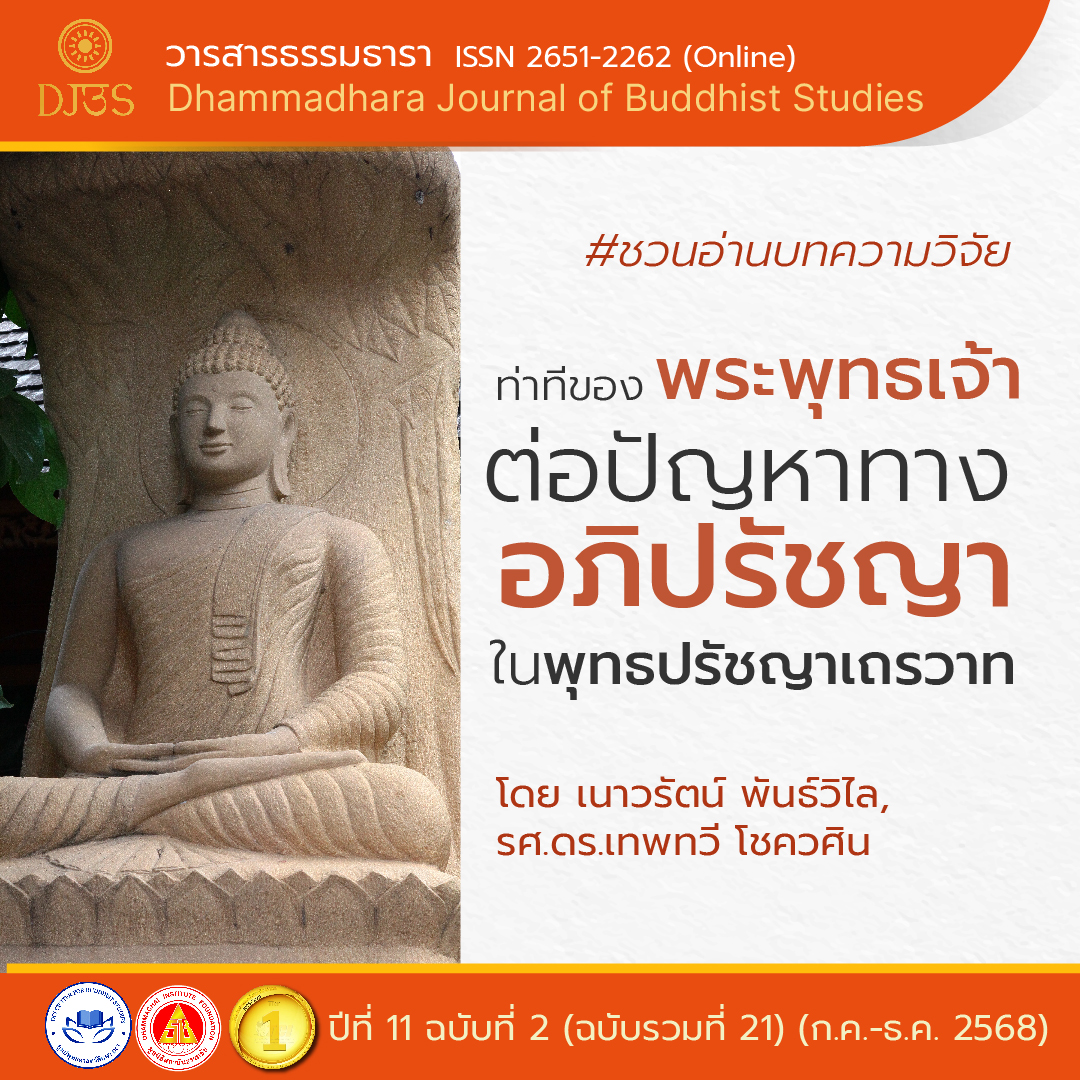
The Buddha’s Attitudes on Metaphysical Questions in Theravada Buddhist Philosophy
Article Sidebar
Main Article Content
Abstract
The purpose of this study piece is to look into the Buddha's perspectives on metaphysical issues in Theravada Buddhist philosophy. The research examines the avyākatapañhā, or questions the Buddha declined to answer, as a metaphysical category in Buddhist philosophy. We argue whether it is correct to say that the Buddha left all metaphysical concerns unanswered.
The findings indicate that metaphysical questions in Buddhism can be classified into two categories. The first comprises questions the Buddha declined to answer (avyākatapañhā), which usually entail extreme ideas (antagāhikadiṭṭhi) that do not lead to the cessation of suffering and are not conducive to the practice of the holy life. According to erotetic logic, these inquiries are not suggestive statements that can be immediately confirmed or denied. The Buddha's silence rejects the logical framework of such issues, commonly described as catuṣkoṭi (tetralemma).
The second group includes metaphysical questions that the Buddha did answer. These reflect insights about the interaction between humans and the external world, as well as metaphysical questions concerning human nature such as the non-self, the nature of the five aggregates, the law of karma, and the definition of the term 'world'. What distinguishes these inquiries is that they are not designed to generate a binary yes-or-no response; rather, they attempt to comprehend what the Buddha taught on those topics and how those teachings contribute to liberation. As a result, the Buddha's stance on metaphysical problems should not be read as a wholesale denial, but rather as a selective engagement guided by whether the answers serve the path to liberation. The unwillingness to answer certain questions implies a rejection of defective structures and assumptions included in the questions themselves, especially when they do not further fulfill the goal of enlightenment.
Article Details

This work is licensed under a Creative Commons Attribution-NonCommercial-ShareAlike 4.0 International License.
ลิขสิทธิ์ สำนักการศึกษา วัดพระธรรมกาย

References
• ภาษาไทย
---1. คัมภีร์แปลภาษาไทย
มหาจุฬาลงกรณราชวิทยาลัย. พระไตรปิฎกภาษาไทย ฉบับมหาจุฬาลงกรณราชวิทยาลัย, เล่มที่ 9, 11, 12, 13, 14, 15, 16, 18, 24. กรุงเทพมหานคร: โรงพิมพ์มหาจุฬาลงกรณราชวิทยาลัย, 2539.
---2. หนังสือ
ปรุตม์ บุญศรีตัน. พุทธอภิปรัชญา: ความจริงเกี่ยวกับจักรวาล โลก มนุษย์และสังสารวัฏ. สำนักพิมพ์แห่งจุฬาลงกรณ์มหาวิทยาลัย: กรุงเทพมหานคร, 2556.
---3. บทความ
พระสมุห์ประยูร สุธมฺโม (บัวพันธ์), พระครูวิจิตรศีลาจาร และพระครูสิริธรรมาภิรัต. “ศึกษาทัศนะของพระพุทธเจ้าที่ทรงมีต่ออัพยากตปัญหา.” วารสารวิชาการ มจร บุรีรัมย์, ปีที่ 2, ฉบับที่ 1, (มกราคม – มิถุนายน, 2560): 1-12.
วิทย์ วิศทเวทย์. “ทัศนะทางอภิปรัชญาในพุทธศาสนาเถรวาท.” วารสารพุทธ-ศาสน์ศึกษา จุฬาลงกรณ์มหาวิทยาลัย, ปีที่ 4, ฉบับที่ 1, (มกราคม – เมษายน, 2540): 38-52.
---4. วิทยานิพนธ์
ฐานิสรา ประธานราษฎร์นิกร. “การศึกษาเชิงวิเคราะห์เรื่องอัพยากตปัญหา (ปัญหาที่พระพุทธเจ้าไม่ทรงพยากรณ์).” วิทยานิพนธ์ปริญญามหาบัณฑิต, มหาวิทยาลัยธรรมศาสตร์, 2548.
• ภาษาต่างประเทศ
---1. หนังสือ
Collins, Steven. Selfless persons: Imagery and thought in Theravada Buddhism. Cambridge: Cambridge University Press, 2004.
Harvey, Peter. The Selfless Mind: Personality, consciousness and Nibbāna in early Buddhism. Abingdon: Routledge Curzon, 2004.
Jayatilleke, K. N.. Early Buddhist Theory of Knowledge. London: George Allen & Unwin LTD, 1963.
Kalupahana, David J.. Buddhist Philosophy: A Historical Analysis. Honolulu: The University Press of Hawaii, 1984.
Shulman, Eviatar. Rethinking the Buddha: Early Buddhist Philosophy as Meditative Perception. Cambridge: Cambridge University Press, 2014.
Smart, Ninian. Doctrine and Argument in Indian Philosophy. 2nd revised edition. Leiden: E.J. Brill, 1992.
---2. บทความ
Karunadasa, Yakupitiyage. “The Unanswered Questions: Why Were They Unanswered? A Re-examination of the Textual Data.” Pacific World, Third series, no. 9, (Fall 2007): 3-31.
Organ, Troy Wilson. “The Silence of the Buddha.” Philosophy East and West, 4, no. 2 (July 1954): 125-140.
Prior, Mary and Arthur Prior. “Erotetic Logic.” The Philosophical Review, 64, no. 1, (January 1955): 43–59.
