
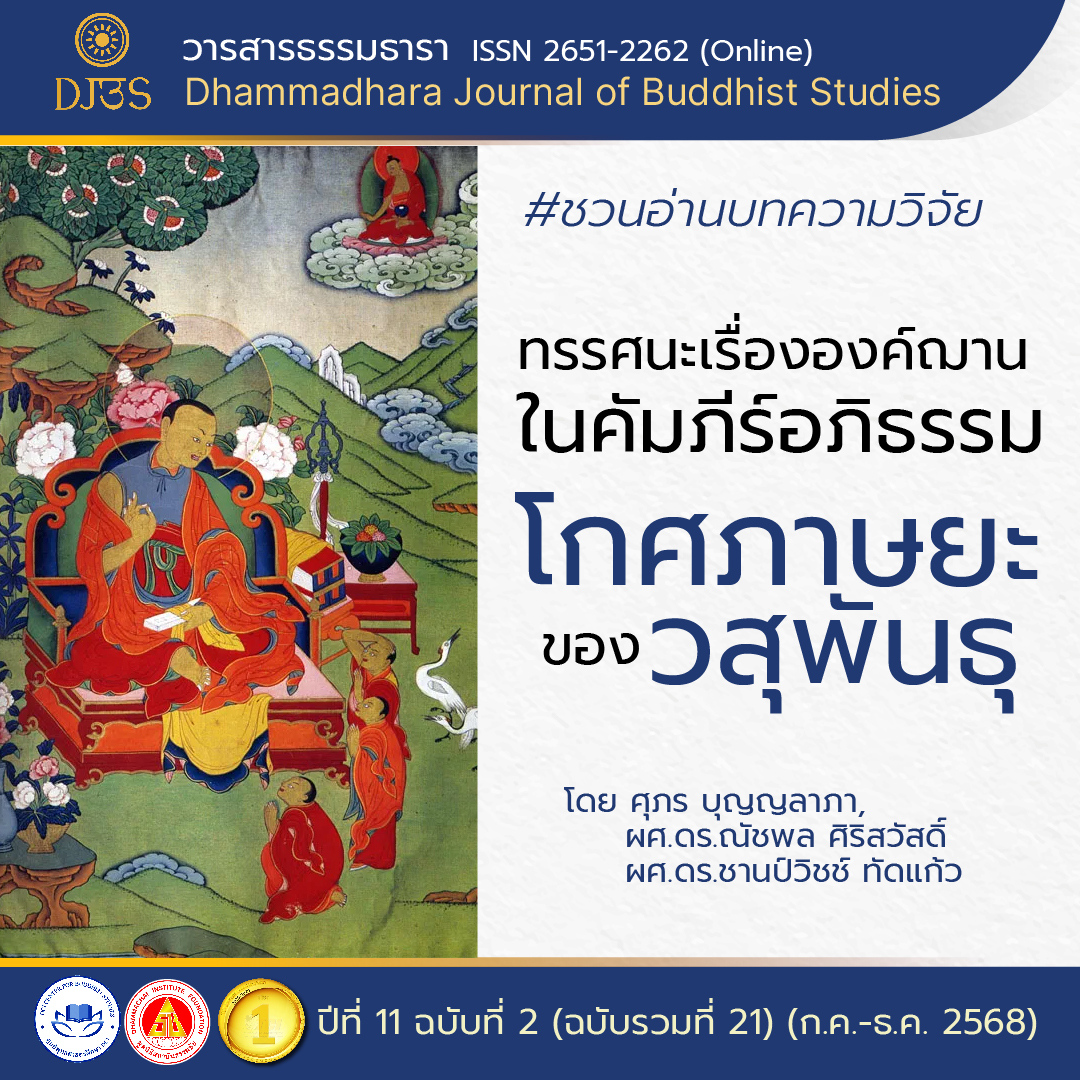
Viewpoints of Dhyānāṅga in Vasubandhu’s Abhidharmakośabhāṣya
Article Sidebar
Main Article Content
Abstract
In Abhidharmakośabhāṣya, Nirdeśa 8 Samāpatti-Nirdeśa, Vasubandhu demonstrates dhyānāṅga in two places. Previous academic studies tend to show that dhyānāṅga in these two places conform to Sarvāstivāda’s tradition. Nevertheless, this does not explain the reason behind the discrepancy of Vasubandhu’s viewpoints. I suggest that he aims to propose his new categorization of dhyānāṅga. To remap the old categorization, he formulates his own reasoning and applies many Sūtras as evidence to support his own theory.
Research results showed that dhyānāṅga of Sarvāstivāda’s tradition follows mental states experienced during dhyāna, as described in Sūtras to a great extent. Vasubandhu, however, introduces a principle that dharmas should be considered as dhyānāṅga only if they are gradually omitted (apakarśa) once the practitioners attain the higher stages of dhyāna. After comparing dharmas considered as dhyānāṅga of Sarvāstivāda’s tradition with dhyānāṅga of Vasubandhu’s, these dharmas can be categorized into three groups: (1) The dharmas Vasubandhu considers as dhyānāṅga but interprets the meaning differently. These include initial inquiry - investigation (vitarka-vicāra) and pleasantness (sukha). (2) The dharma Vasubandhu similarly considers as dhyānāṅga and indicates the same meaning. This is joy (prīti). (3) The dharmas Vasubandhu does not consider as dhyānāṅga. There are internal pure calmness (adhyātmasaṃprasāda), mindfulness (smṛti), awareness (samprajñāna), equanimity (upekṣā), neither-painful-nor-pleasant feeling (aduḥkhāsukhā vedanā), and concentration (samādhi).
Although parts of dhyānāṅga are aligned to that of Sarvāstivāda’s, and other parts do not, Vasubandhu presents all the dharmas and demonstrates them coherently. This makes the proposed viewpoint of dhyānāṅga complete and well-rounded.
Article Details

This work is licensed under a Creative Commons Attribution-NonCommercial-ShareAlike 4.0 International License.
ลิขสิทธิ์ สำนักการศึกษา วัดพระธรรมกาย

References
• ภาษาไทย
---1. คัมภีร์บาลีอักษรไทย
มหามกุฏราชวิทยาลัย. สยามรฏฺสฺส เตปิฏกฏฺกถา. พระนคร: โรงพิมพ์มหามกุฏราชวิทยาลัย, 2535.
มหามกุฏราชวิทยาลัย. สยามรฏฺสฺส เตปิฏกํ. พระนคร: โรงพิมพ์มหามกุฏราชวิทยาลัย, 2552.
---2. บทความ
พระมหาไตรภพ ธมฺมารกฺขิโต (รอดจันทร์) และพนัสดิษฐ์ ประภากร. “นามกายในคัมภีร์พระพุทธศาสนาเถรวาท: การตีความความหมายที่เป็นไปได้.” วารสารปณิธาน, ปีที่ 19, ฉบับที่ 1, (มกราคม – มิถุนายน 2566): 70-91.
พระมหาพงศ์ศักดิ์ ฐานิโย. “สมถวิปัสสนาในคัมภีร์อภิธรรม นิกายสรวาสติวาท.” วารสารธรรมธารา, ปีที่ 3, ฉบับที่ 1 (ฉบับรวมที่ 4), (มกราคม-มิถุนายน 2560): 193-230.
• ภาษาต่างประเทศ
---1. คัมภีร์
Abhidharmakośa-Bhaṣya of Vasubandhu: The Treasury of the Abhidharma and Its Commentary (4 vols.). Translated into French by Louis de La Vallée Poussin, Annotated English Translation by Gelong Lodrö Sangpo, With a New Introduction by Bhikkhu KL Dhammajoti. Delhi: Motilal Banarsidass, 2012.
Asaṅga. Abhidharma Samuccaya of Asanga. India: Visva-Bharati, 1950.
Dessein, Bart. Saṃyuktābhidharmahṛdaya: Introduction, translation. (Buddhist Tradition Series). Delhi: Motilal Banarsidass, 1999.
Pradhan, Prahallad. Abhidharmakośa-bhāṣyam of Vasubandhu. Patna: Kashi Prasad Jayaswal Research Institute, 1975.
Taishō Issaikyō Kankōkai 大正一切經刊行會 (Taisho Tripitaka Publication Association). Taishō Shinshū Daizōkyō 大正新脩大藏經 (Taishō Revised Tripiṭaka) Vol. 1. Tokyo: Daizo shuppan Kabushiki Gaisha, 1988.
Willemen, Charles. The Essence of Scholasticism Abhidharmahṛdaya. T1550. New Delhi: Motilal Banarsidass, 2006.
---2. หนังสือ
Rāhula, Walpola. Zen and the Taming of the Bull: Towards the Definition of Buddhist Thought: Essays. London: Gordon Fraser, 1978.
Stuart, Daniel Malinowski. Thinking About Cessation: The Pṛṣṭhapālasūtra of the Dīrghāgama in Context. Wien: Arbeitskreis für Tibetische und Buddhistische Studien, Universität Wien, 2013.
---3. พจนานุกรม
Monier-Williams, M.. A Sanskrit-English Dictionary: Etymologically and philologically arranged with special reference to Cognate Indo-European languages. Oxford, The Clarendon Press, 1899.
---4. บทความ
Abe, Shinya (阿部真也). “Dhyāna in the Sarvāstivāda (説一切有部における静慮).” Journal of Indian and Buddhist Studies (印度學佛教學研究), 55, no. 2, (March 2007): 523–527.
Buswell, Jr., Ropbert E., and Padmanabh S. Jaini. “The Development of Abhibharma Philosophy.” Encyclopedia of Indian Philosophies Volume VII Abhidharma Buddhism To 150 A.D. Edited by Karl H. Potter, Ropbert E. Buswell, Jr., Padmanabh S. Jaini and Noble Ross Reat. Delhi: Motilal Banarsidass Publishers, Private Limited, 1996: 73-119.
Dhammajoti, K. L.. “The Contribution of Saṃghabhadra to Our Understanding of Abhidharma Doctrines.” Text, history, and philosophy: Abhidharma across Buddhist scholastic traditions. Edited by Dessein, Bart and Weijen Teng. Boston: Brill, 2016: 223–247.
Kichise, Masaru (吉瀬勝). “A Study of the dhyānāntara in the Abhidharmakośabhāṣya (倶舎論における中間定解釈).” Journal of Indian and Buddhist Studies (印度學佛教學研究), 31, no. 1, (December 1982): 320–325.
Kuan, Tse-Fu. “Clarification on Feelings in Buddhist Dhyāna/Jhāna Meditation.” Journal of Indian Philosophy, 33, no. 3, (June 2005): 285-319.
---5. วิทยานิพนธ์
Suen, Stephen. “Methods of spiritual praxis in the Sarvāstivāda: A Study Primarily Based on the Abhidharmamahāvibhāṣā.” PhD diss., The University of Hong Kong, 2009.
