
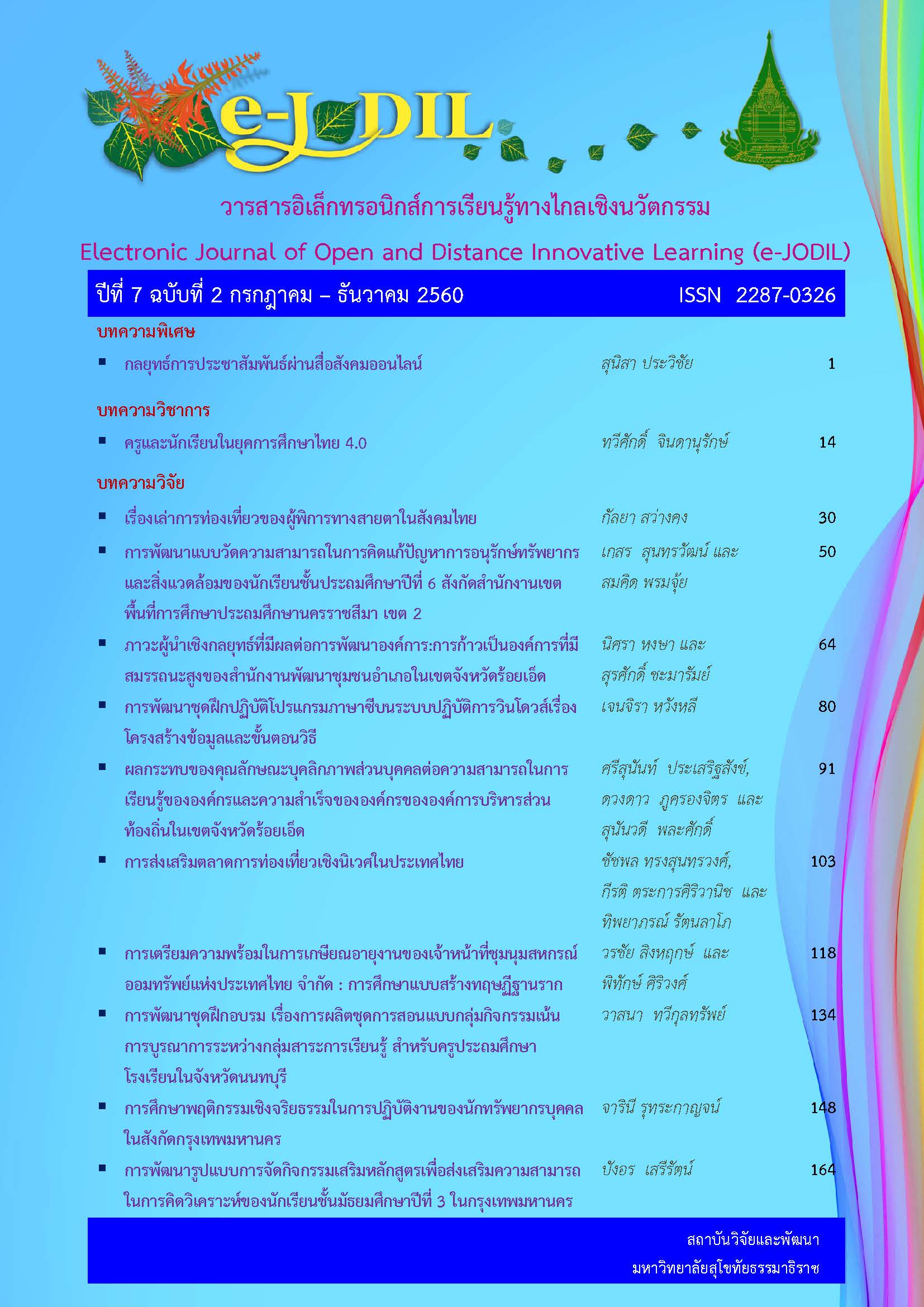
Travel Stories of Visually Impaired People in Thai Society
Article Sidebar
Main Article Content
Abstract
The objectives of this qualitative research were 1) to study travel experiences of visually impaired people; and 2) to study problems and obstacles while traveling of visually impaired people. This study applied the life history, and narrative approach. The data were collected through an in-depth interview with 10 working age people who were visually impaired and had travel experiences. The results showed that visually impaired people wanted to travel like ordinary people. They normally traveled with their families, however they could travel by themselves. They were well- prepared before travelling, and tried to help themselves before asking support from others. The popular attractions were natural attractions, temples and shopping centers. The main problems and obstacles they faced while travelling could be divided into 3 main issues: 1) access to tourism information; 2) tourism facilities; and 3) attitudes of people in society. The visually impaired people urged a cooperation of both the government and related agencies to solve the problems in order to help them travel and equally access to services just like ordinary people.
Downloads
Article Details
บทความ ข้อความ ภาพประกอบ ตารางประกอบ ที่ตีพิมพ์ในวารสารเป็นความคิดเห็นและความรับผิดชอบของผู้เขียนแต่เพียงผู้เดียว ไม่เกี่ยวข้องกับมหาวิทยาลัยสุโขทัยธรรมาธิราชแต่อย่างใด
บทความที่เสนอพิจารณาในวารสาร e-JODIL ต้องเป็นบทความที่ไม่เคยส่งไปลงพิมพ์ เผยแพร่ หรืออยู่ระหว่างการพิจารณาของวารสารอื่น
กองบรรณาธิการขอสงวนสิทธิ์ในการพิจารณาและตัดสินการตีพิมพ์บทความในวารสาร
References
กรมส่งเสริมและพัฒนาคุณภาพชีวิตคนพิการ. (2556). พระราชบัญญัติส่งเสริมและพัฒนาคุณภาพชีวิตคนพิการ พ.ศ.2550 และที่แก้ไขเพิ่มเติม (ฉบับที่ 2) พ.ศ. 2556. สืบค้นเมื่อ 3 พฤษภาคม 2559, จาก http://dep.go.th/th/node/446.
กระทรวงการพัฒนาสังคมและความมั่นคงของมนุษย์. (2559). การดำเนินงานจดทะเบียนคนพิการทั่วประเทศ เดือนกุมภาพันธ์ 2559. กรมส่งเสริมและพัฒนาคุณภาพชีวิตคนพิการ. สืบค้นเมื่อ 10 มิถุนายน 2559, จาก https://www.m-society.go.th/article_attach/16279/19239.pdf.
กาญจนา มิตตานนท์สกุล. (2553). เจตคติและปัญหาในการให้บริการต่อคนพิการของคนขับรถแท็กซี่. วารสาร วิทยาลัยราชสุดาเพื่อการวิจัยและพัฒนาคนพิการ, 6 (2), 59-73.
เกษวดี พุทธภูมิพิทักษ์. (2554). ประสบการณ์การท่องเที่ยวของผู้พิการในประเทศไทย. มหาวิทยาลัยนเรศวร.
คณะกรรมการพัฒนาการเศรษฐกิจและสังคมแห่งชาติ. (2558). ร่าง แผนพัฒนาเศรษฐกิจและสังคมแห่งชาติฉบับที่ 12 พ.ศ. 2560 – 2565.” เอกสารประกอบการระดมความคิดเห็นทิศทางแผนพัฒนาฯ ฉบับที่ 12: กรกฏาคม.
คณะกรรมการส่งเสริมคุณภาพชีวิตคนพิการแห่งชาติ. (2554). แผนพัฒนาคุณภาพชีวิตคนพิการแห่งชาติ ฉบับที่ 4 (2555-2559). กรุงเทพฯ: โรงพิมพ์เทพเพ็ญวานิสย์.
ชูกลิ่น อุนวิจิตร ญานัท ศิริสาร และ ไพรัช โรงสะอาด. (2557). แนวทางการพัฒนาการนันทนาการและการท่องเที่ยวเพื่อคนพิการในจังหวัดเชียงราย. วารสารวิทยาลัยราชสุดา, 10 (13), 36-50.
นภาภรณ์ หะวานนท์. (2550). การสร้างความรู้ภายใต้กระบวนทัศน์สร้างสรรค์สังคม. วารสารลุ่มน้ำโขง, 3(3), 1-23.
นิศา ชัชกุล. (2557). อุตสาหกรรมการท่องเที่ยว. กรุงเทพฯ: สำนักพิมพ์จุฬาลงกรณ์มหาวิทยาลัย.
บริษัทอินทัชรีเสิร์ชแอนด์คอนซัลแทนซ์ จำกัด. (2555). โครงการสำรวจมุมมองของชาวไทยต่อการท่องเที่ยวเพื่อการจัดแบ่งกลุ่มฐานของลูกค้า (Customer segment). รายงานขั้นสุดท้ายเสนอต่อการท่องเที่ยวแห่งประเทศไทย.
พิทักษ์ ศิริวงศ์ และ ปัทมอร เส็งแดง. (2554) การท่องเที่ยวของผู้พิการทางการเคลื่อนไหวในสังคมไทย. วารสาร Veridian E-Journal, 4(2), 221-228.
มนัสสินี บุญมีศรีสง่า, เคียงดาว ศรีมากเปี่ยม, ฐิติมา โสรัตยาทร, ถาวร ทรัพย์อัมพร, ทิพยา เดชชัยยันต์, ปฐมพงษ์แก้วบุญมา และวริศรา มานะกิจ. (2557). รูปแบบการท่องเที่ยวของผู้พิการทางการเคลื่อนไหวเพศชาย
สมาคมคนพิการพัฒนาตนเอง กรุงเทพฯ. ใน การประชุมวิชาการระดับชาติ “ศึกษาศาสตร์วิจัย” ครั้งที่ 1 (น.1185). สงขลา: มหาวิทยาลัยสงขลานครินทร์ วิทยาเขตปัตตานี.
สถาบันวิจัยสังคม จุฬาลงกรณ์มหาวิทยาลัย. (2554). โครงการทบทวนแผนยุทธศาสตร์กองทุนส่งเสริมและพัฒนาคุณภาพชีวิตคนพิการ พ.ศ. 2553-2556 และแผนปฏิบัติการประจำปีบัญชี 2555. รายงานวิจัยฉบับสมบูรณ์
เสนอต่อคณะกรรมการกองทุนส่งเสริมและพัฒนาคุณภาพชีวิตคนพิการ.
สถาบันสร้างเสริมสุขภาพคนพิการ. (2554). เรื่องน่ารู้ Universal Design: การออกแบบเพื่อคนทั้งมวล. สืบค้นเมื่อ 9 พฤษภาคม 2559, จาก http://www.thaihealth.or.th/Content/17180.html.
สำนักงานสถิติแห่งชาติ. (2559). ผู้พิการต้องการแบบไหน. สืบค้นเมื่อ 1 พฤษภาคม 2559, จาก http://service.nso.go.th/nso/nsopublish/citizen/news/news_disabled.jsp.
สุภางค์ จันทวาณิช. (2540). วิธีการวิจัยเชิงคุณภาพ. (พิมพ์ครั้งที่ 7). กรุงเทพฯ: สำนักพิมพ์แห่งจุฬาลงกรณ์มหาวิทยาลัย.
Bowtell James. (2015). Assessing the value and market attractiveness of the accessible tourism industry in Europe: a focus on major travel and leisure companies. Journal of Tourism Futures, 1(3), 203-222.
Brielle Gillovic and Alison McIntosh. (2015). Stakeholder perspectives of the future of accessible tourism in New Zealand. Journal of Tourism Futures, 1(3), 223-239.
Darcy, S. and Dickson, T. (2009). A whole-of-life approach to tourism: the case for accessible tourism Experiences. Journal of Hospitality and Tourism Management, 16(1), 32-44.
European Commission, DG Enterprise and Industry. (2013). Economic impact and travel patterns of accessible tourism in Europe – final report. Retrieved May 5, 2016, from www.accessibletourism.org/
resources/toolip/doc/2014/07/06/study-a-economic-impact-and-travel-patterns-of-accessible-tourism-in-europe-fi.pdf.
Freeman, Ina, and Noureddine Selmi. (2010). French versus Canadian of Tourism: Response to the Disabled. Journal of Travel Research, 49(4), 471-485.
Hersh, M.A. (2010). The Design and Evaluation of Assistive Technology Product and Devices Part 1: Design, International Encyclopedia of Rehabilitation. Retrieved May 20, 2016, from http://cirrie.buffalo.edu/
ency-clopedia/en/article/309.
Hersh, M.A. (2016). Improving Deafblind Travelers’ Experiences: An International Survey. Journal of Travel Research, 55(3), 380-394.
Mace, Ronald. (1988). Universal Design: Housing for the Lifespan of All People. Washington, DC: US Department of Housing and Urban Affairs.
Pagan, Ricardo. (2014). The Impact of Holiday Trips on Life Satisfaction and Domains of Life Satisfaction: Evidence for German Disabled Individuals. Journal of Travel Research, 52(1), 1-21.
Poria, Yaniv, Arie Reichel, and Yael Brandt. (2011). Blind People’s Tourism Experiences: An Exploratory Study. In Accessible Tourism Concepts and Issue, edited by D. Buhalis and S. Darcy. Bristol, UK: Channel View.
Small, Jenny, Simon Darcy and Tanja Packer. (2012). The Embodied Tourist Experiences of People with Vision Impairment: Manage Implications beyond the Visual Gaze. Tourism Management, 33(4), 941-950.
Stumbo, N. and Pegg, S. (2005). Travellers and tourists with disabilities: a matter of priorities and loyalties, Tourism Review International, 8(3), 195-209.
United Nations. (1990). Disability Statistics Compendium. New York: United Nations.
World Tourism Organization. (2013). Recommendations on accessible tourism. Retrieved May 9, 2016, from http://ethics.unwto.org/content/resolutions-and-recommendations-tourism-accessibility.
