
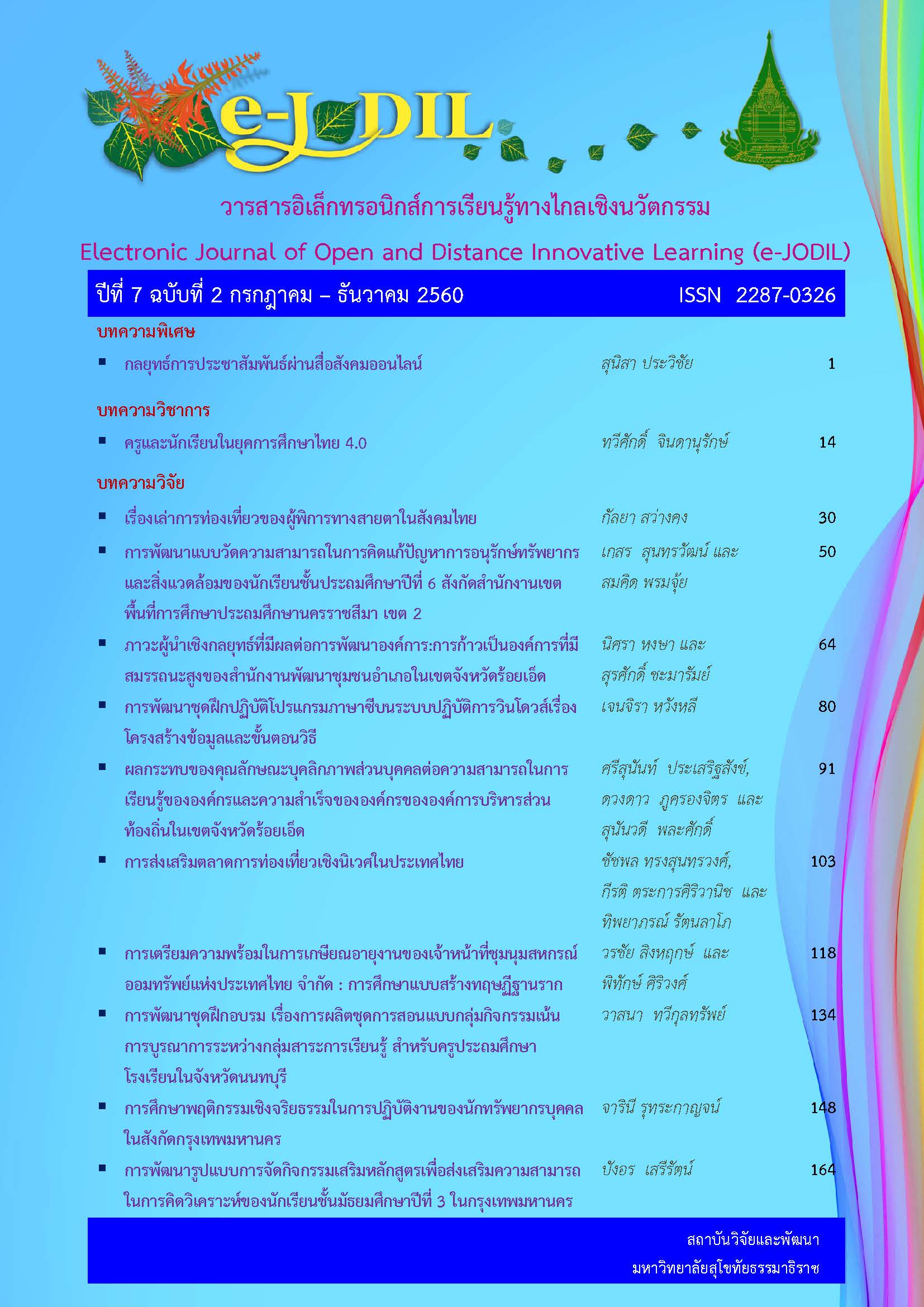
Market Promotion for Ecotourism in Thailand
Article Sidebar
Main Article Content
Abstract
The objectives of this research were (1) to study characteristics and tourist behaviors of eco-tourists in Thailand; (2) to study the needs for and satisfaction with eco-tourism of eco-tourists in Thailand; (3) to study factors affecting the decision to partake in eco-tourism of eco-tourists in Thailand; and (4) to propose guidelines for marketing promotion of eco-tourism in Thailand. The research sample consisted of 1,000. They were classified into 502 Thai tourists and 498 foreign tourists, Thai and foreign eco-tourists who studied tourist information, had previous experiences in at least two tourist activities in Doi Inthanon National Park, Khao Yai National Park, Kaeng Krachan National Park, Kui Buri National park, Khao Sok National Park, and Surin Islands National Park from July 2015 to April 2016. The employed data collecting instruments for the quantitative study were a questionnaire for tourists. In the qualitative study, the key informants consisted of officer heads of national parks, representatives of The Tourism Authority of Thailand (TAT), Office of Tourism and Sports, Subdistrict Administrative organization (SAO), tour operators and ecotourism in the areas, representatives of local administrative organizations in charge of national park areas, representatives of tourism work agencies, community leaders in tourism sites, and representatives of tourist companies with business operation in national parks. Data were analyzed with descriptive statistics of frequency, percentage, mean, and standard deviation, and with inferential statistical procedure of multiple regression analysis. Research results showed that (1) regarding characteristics and tourist behaviors of eco-tourists in Thailand, the majority of Thai tourists were females, aged 21 – 30 years, with bachelor’s degree educational level, being single, being company employees with average monthly salary of 25,587 baht, spending time of 1 – 2 days for sight-seeing in the national park and doing three main activities of trekking in the forest, nature study, and taking photographs/sound recording, spending on the average of 2,776 baht within the national park, choosing to stay in resorts near the national park, and managing their tourist activities by themselves; as for foreign tourists, the majority were females, aged 21 – 30 years, with bachelor’s degree educational level, being single, being company employees with average monthly salary of 46,003 baht, spending time of 1 – 2 days for sight-seeing in the national park and doing three main activities of trekking in the forest, nature study, and taking photographs/sound recording, spending on the average of 3,394 baht within the national park, choosing to stay in resorts near the national park, and managing their tourist activities by themselves. (2) regarding the needs for and satisfaction with eco-tourism of eco-tourists, both Thai and foreign tourists had the needs for and satisfaction with the majority of eco-tourism factors at the high level; however, if in-depth analysis of specific tourist areas were undertaken, it was found that Thai tourists who visited Surin Islands National Park had the needs for and were satisfied with eco-tourism factors at the highest level (3) regarding factors affecting the decision to partake in eco-tourism of eco-tourists in Thailand, it was found that for the needs of Thai tourists, the factors of tourist area, tourism management with social responsibility, tourism personnel, and price were factors that affected their decision for making the trips; all of these need factors were positive factors that correlated with their subsequently obtained satisfaction; as for the needs of foreign tourists, the price factor was the factor that affected their decision for making the trips, with their opinion that the present prices were appropriate. (4) regarding guidelines for marketing promotion of eco-tourism in Thailand, the promotion could be directed toward two main markets, namely, the market for Thai tourists and the market for foreign tourist; for the Thai tourists market, The focus should be on upgrading the level of ecotourism marketing plan, promotion of ecotourism activities, integration of marketing communications, for the foreign tourists market, the focus should be on integration of marketing ecotourism, sale promotion, promotion of specific target groups and publicity through a variety of media.
Downloads
Article Details
บทความ ข้อความ ภาพประกอบ ตารางประกอบ ที่ตีพิมพ์ในวารสารเป็นความคิดเห็นและความรับผิดชอบของผู้เขียนแต่เพียงผู้เดียว ไม่เกี่ยวข้องกับมหาวิทยาลัยสุโขทัยธรรมาธิราชแต่อย่างใด
บทความที่เสนอพิจารณาในวารสาร e-JODIL ต้องเป็นบทความที่ไม่เคยส่งไปลงพิมพ์ เผยแพร่ หรืออยู่ระหว่างการพิจารณาของวารสารอื่น
กองบรรณาธิการขอสงวนสิทธิ์ในการพิจารณาและตัดสินการตีพิมพ์บทความในวารสาร
References
การท่องเที่ยวแห่งประเทศไทย. (ม.ป.ป.). โครงการศึกษาสถานการณ์และโอกาสการส่งเสริมตลาดการท่องเที่ยวกลุ่ม Eco & Adventure. กรุงเทพฯ: การท่องเที่ยวแห่งประเทศไทย.
ปิยวรรณ คงประเสริฐ. (2551). การท่องเที่ยวเชิงนิเวศแบบบูรณาการเพื่อการวางแผนพัฒนาการท่องเที่ยว อย่างยั่งยืนที่เกาะพะงัน จังหวัดสุราษฎร์ธานี (วิทยานิพนธ์ปริญญาวิทยาศาสตร์มหาบัณฑิต). มหาวิทยาลัยศรีนครินทรวิโรฒ, กรุงเทพฯ.
รัชนีกร แซ่วัง. (2555). จาก...เวลาว่างแบบ “ผู้หญิง”สู่...หลากหลายมิติแห่งการท่องเที่ยว. วารสารการบริการและการท่องเที่ยวไทย, 7(1), 83-90.
สมชัย เบญจชย. (2549). การท่องเที่ยวเชิงนิเวศ, ในเอกสารประกอบการบรรยาย หลักสูตร “การบริหารจัดการป่าชุมชนและการพัฒนาอาชีพด้านป่าไม้” ประจำปีงบประมาณ พ.ศ.2549. กรุงเทพฯ: กรมป่าไม้.
สำนักงานคณะกรรมการพัฒนาการเศรษฐกิจและสังคมแห่งชาติ. (2556). รายงานผลการศึกษาการท่องเที่ยวเชิงนิเวศอย่างยั่งยืนบนเส้นทางสีเขียว กรณีพื้นที่ภาคตะวันออกเฉียงเหนือ.
สำนักอุทยานแห่งชาติ. (2559). สรุปรายงานสถิตินักท่องเที่ยวที่. สืบค้นเมื่อวันที่ 12 ตุลาคม 2559. จาก http://www.dnp.go.th/NPRD/develop/Stat_Tourist.php
อมรรัตน์ วงศ์เป็ง. (2550). ปัจจัยทางการตลาดที่มีอิทธิพลต่อการตัดสินใจท่องเที่ยวประเทศไทยของนักท่องเที่ยวชาวยุโรป (วิทยานิพนธ์ปริญญาบริหารธุรกิจมหาบัณฑิต). มหาวิทยาลัยเทคโนโลยีราชมงคลธัญบุรี, ปทุมธานี.
Ballantine, J. and Eagles, P. (1994). Defining ecotourists, Journal of Sustainable Tourism, 2(4), 210-214.
Benjamin B. Wolman. (1973). Dictionary of Behavioral Science. Van Nostand: Reinheld Company, p. 384.
Blackwell, R. D., Miniard, P. W., & Engel, J. F. (2001). Consumer behavior. (9thed.). Fort Worth: Harcourt College.
Kotler, P., Bowen, J. &Makens, J. (2010). Marketing for Hospitality and Tourism. (5th ed.), Pearson Education, Inc., New Jersey.
Mill, R. C. & Morrison, A. M. (1992). The tourism system: An introductory text. (2nd ed.). Englewood Cliffs, NJ: Prentice Hall.
