
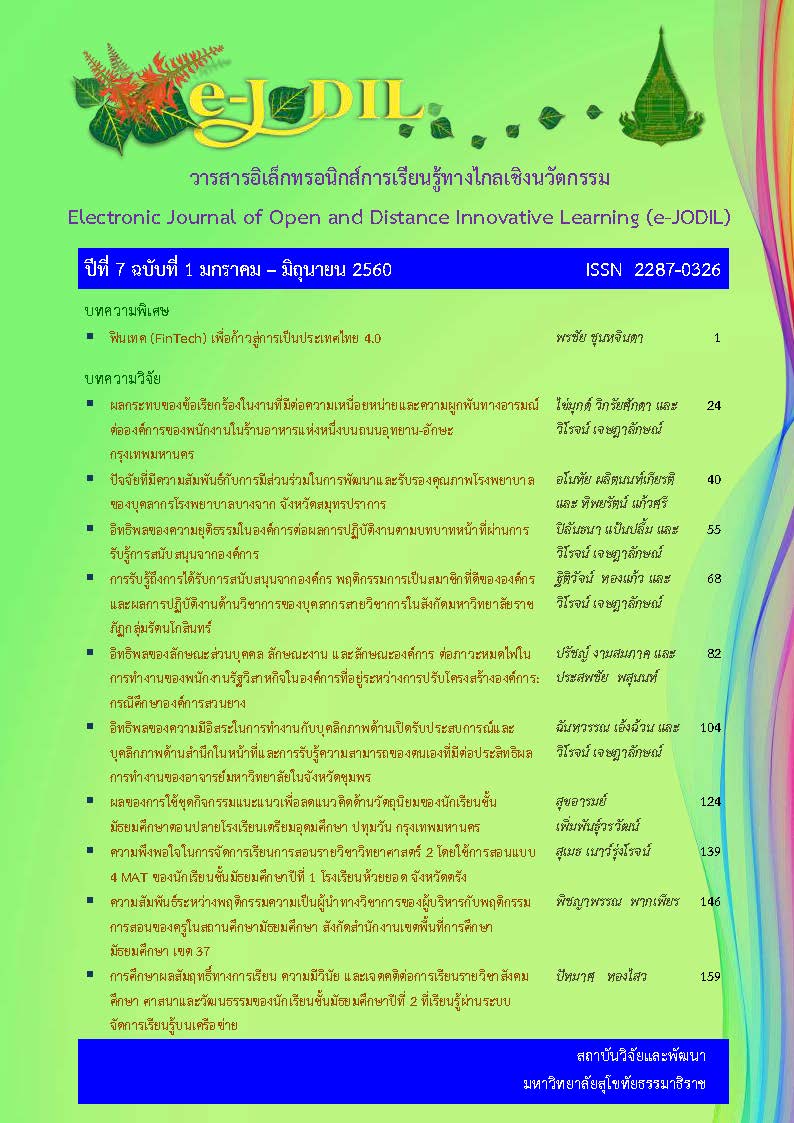
FinTech: Towards Thailand 4.0
Article Sidebar
Main Article Content
Abstract
Interest in Financial Technology, also known as FinTech, has significantly and globally escalated as its new financial solutions and innovations hold immense potential benefits to all businesses, especially in terms of value-added, and also to national competitiveness. It is most likely that these financial technologies will be adopted widely for improving other services and activities. For this reason, financial innovations creation and implementation of FinTech businesses can serve Thai Government’s policy to drive Thailand to 4.0 paradigm. Even though Thai government-private sector cooperation for FinTech business development has already taken place, the number of academic studies for FinTech is limited, especially in Thailand. Therefore, the objective of this article is to provide a better understanding and sources of information for those involved in Thailand’s FinTech industry. The result of this study shows that FinTech ecosystem in Thailand has some distinctive characteristics and Thai people’s service specialization is being one of them. Nevertheless, to be able to compete with overseas service providers, there are many areas for improvement and development, such as uncertain regulatory environment, shortage of human resources and low level of domestic innovation.
Downloads
Article Details
บทความ ข้อความ ภาพประกอบ ตารางประกอบ ที่ตีพิมพ์ในวารสารเป็นความคิดเห็นและความรับผิดชอบของผู้เขียนแต่เพียงผู้เดียว ไม่เกี่ยวข้องกับมหาวิทยาลัยสุโขทัยธรรมาธิราชแต่อย่างใด
บทความที่เสนอพิจารณาในวารสาร e-JODIL ต้องเป็นบทความที่ไม่เคยส่งไปลงพิมพ์ เผยแพร่ หรืออยู่ระหว่างการพิจารณาของวารสารอื่น
กองบรรณาธิการขอสงวนสิทธิ์ในการพิจารณาและตัดสินการตีพิมพ์บทความในวารสาร
References
สภาวิจัยแห่งชาติ. (2559). (ร่าง) ยุทธศาสตร์งานวิจัยเศรษฐกิจไทย เรื่อง “เทคโนโลยีทางการเงิน (ฟินเทค) กับการพัฒนาระบบการเงินไทย”.
สถาบันวิจัยเพื่อการพัฒนาประเทศไทย. (2559). New Development Model: โมเดลใหม่การพัฒนาเศรษฐกิจไทย.
ส่วนบริหารและพัฒนาเทคโนโลยีการทะเบียน สำนักบริหารการทะเบียน. (2559). สถิติประชากรและบ้าน – จำนวนประชากรแยกรายอายุ. กรมการปกครอง กระทรวงมหาดไทย.
สำนักงานคณะกรรมการพัฒนาการเศรษฐกิจและสังคมแห่งชาติ (สศช.). (2559). ร่างแผนพัฒนาเศรษฐกิจและสังคมแห่งชาติ ฉบับที่ 12 (พ.ศ. 2560 - 2564). สำนักนายกรัฐมนตรี.
Allen F., and Babus A. (2008). Networks in Finance. Wharton Financial Institutions Center. Working Paper No. 08-07.
Barrdear J., and Kumhof M. (2016). Staff Working Paper No. 605: the Macroeconomics of Central Bank Issued Digital Currencies. Bank of England.
Bose I., and Mahapatra R. (2001). Business Data Mining — A Machine Learning Perspective. Information & Management. 39 (3). pp. 211 – 225.
Chen H., Chiang R., and Storey V. (2012). Business Intelligence and Analytics: From Big Data to Big Impact. MIS Quarterly. 36 (4). pp. 1165 - 1188.
Duarte J., Siegel S., and Young L. (2012). Trust and Credit: The Role of Appearance in Peer-to-Peer Lending. Review of Financial Studies. 25 (8). pp. 2455 – 2484.
EY. (2016). UK FinTech on the Cutting Edge: An Evaluation of the International FinTech Sector. HM Treasury (United Kingdom).
Fintechranking. (2016). Infographics: Global FinTech Landscape. Web site: http://fintechranking.com /2016/08/04/infographics-global-fintech-landscape/
Froomkin M. (1997). The Internet as a Source of Regulatory Arbitrage. Borders in Cyberspace. Brian Kahin and Charles Nesson, eds. (MIT Press 1997).
Härle P., Havas A., and Samandari H. (2016). The Future of Bank Risk Management. McKinsey & Company.
Harvey C. (2016). Cryptofinance. National Bureau of Economic Research.
Hendershott T., Jones C., and Menkveld A. (2011). Does Algorithmic Trading Improve Liquidity?. Journal of Finance. 66 (1). pp. 1 – 33.
Hendershott T. and Riordan R. (2013). Algorithmic Trading and the Market for Liquidity. Journal of Financial and Quantitative Analysis. 48 (4). pp. 1001 - 1024.
Houston J., Lin C., and Ma Y. (2012). Regulatory Arbitrage and International Bank Flows. Journal of Finance. 67 (5). pp. 1845 – 1895.
KASIKORN Business-Technology Group (KBTG). (2559). KBTG: Technology Focus.
Lin M., Prabhala N., and Viswanathan S. (2012). Judging Borrowers by the Company They Keep: Friendship Networks and Information Asymmetry in Online Peer-to-Peer Lending. Management Science. 59 (1). pp. 17 – 35.
Lusardi A. and Mitchell O. (2011). Financial Literacy and Planning: Implications for Retirement Wellbeing. Working Paper. National Bureau of Economic Research.
Mollick E. (2014). The Dynamics of Crowdfunding: An Exploratory Study. Journal of Business Venturing. 29 (1). pp. 1 – 16.
Murphy D., Shrieves R., and Tibbs S. (2009). Understanding the Penalties Associated with Corporate Misconduct: An Empirical Examination of Earnings and Risk. Journal of Financial and Quantitative Analysis. 44 (1). pp. 55-83.
Rodriguez J. (2007). Measuring Financial Contagion: A Copula Approach. Journal of Empirical Finance. 14 (3). pp. 401–423.
Sangroya A., Kumar S., Dhok J., and Varma V. (2010). Towards Analyzing Data Security Risks in Cloud Computing Environments. Communications in Computer and Information Science. 54. pp. 255 – 265.
Skinner C. (2016). The Five Major Use Cases for Financial Blockchains. Brave New Coin.
Tambunlertchai K. (2015). Financial Inclusion, Financial Regulation, and Financial Education in Thailand. ADBI Working Paper Series. Asian Development Bank Institute.
Venture Scanner. (2016). Financial Technology Market Overview – Q4 2016. Web site: https://venturescannerinsights.wordpress.com/tag/venture-capital/
Williams-Grut O. (2016). WEF: Here are the 6 Biggest Risks in FinTech. Business Insider. World Bank. (2016). Thailand Overview 2016.
World Economic Forum. (2015). The Future of Financial Services: How Disruptive Innovations are Reshaping the Way Financial Services are Structured, Provisioned and Consumed.
World Intellectual Property Organization (WIPO). (2016). WIPO Patent Report: Statistics on Worldwide Patent Activity. The World Bank.
Wyman O. (2016). The Role of Financial Services in Society: Understanding the Impact of Technology- Enabled Innovation on Financial Stability. World Economic Forum.
Zhang X., Wuwong N., Li H., and Zhang X. (2010). Information Security Risk Management Framework
for the Cloud Computing Environments. 2010 10th IEEE International Conference on Computer and Information Technology.
