
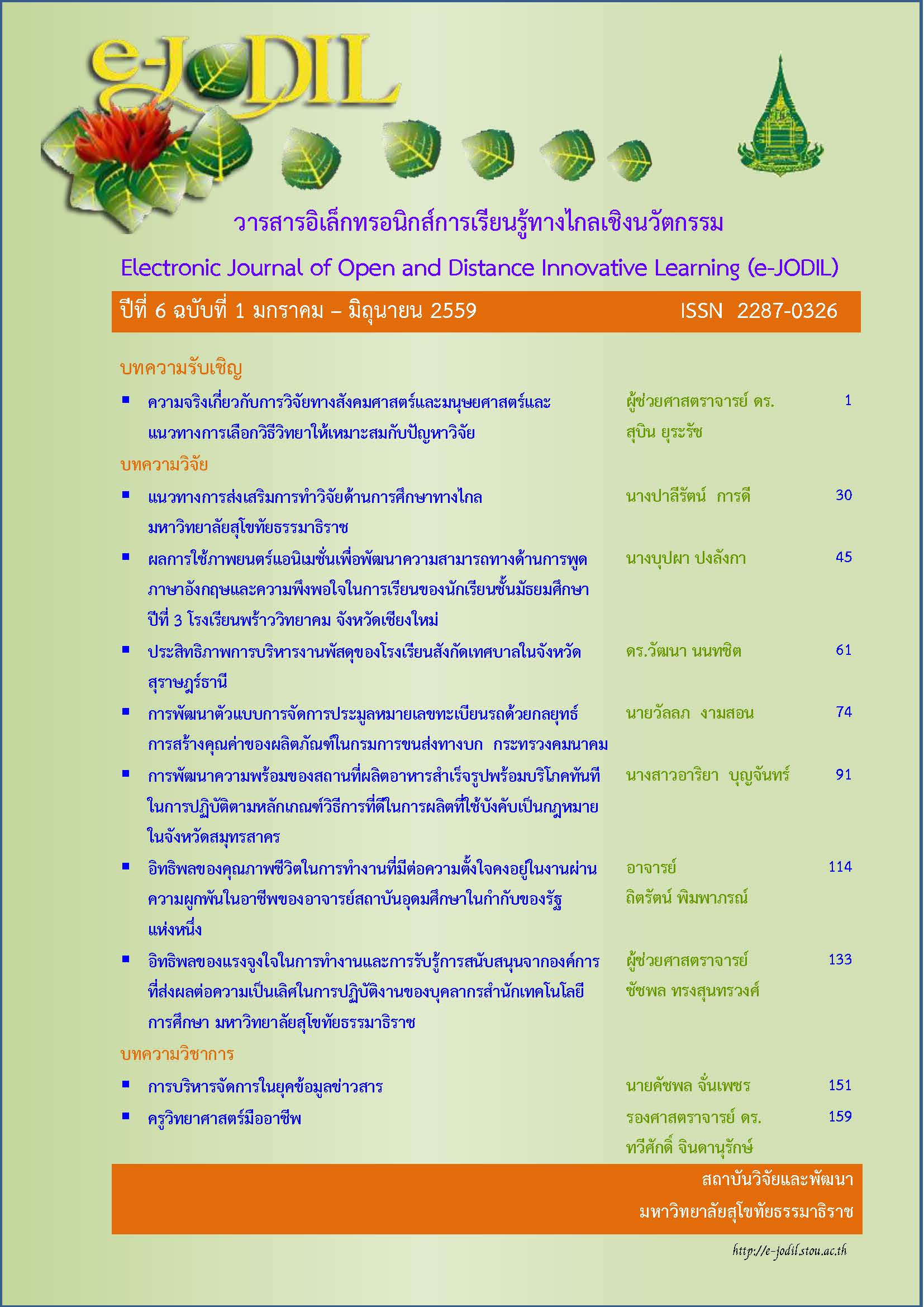
The Fact of Research in Social Sciences and Humanities and the Guideline of Selecting Research Methodology Suit to a Research Problem
Article Sidebar
Main Article Content
Abstract
The objective of this article is to propose the four facts of research in social sciences and humanities consisting of (1) the definition and factors of research, (2) findings conclusion of the research in social sciences and humanities, (3) the categories of the research in social sciences and humanities, and (4) research methodologies in social sciences and humanities, and to propose the guidelines of selecting the methodology suit to research problem. The synthesis and analysis results showed that there are three categories of the research in social sciences and humanities comprising (1) quantitative research, (2) qualitative research, and (3) mixed-methods research. These research methodologies are different in terms of their concept and characteristics. To select the appropriate and correct research methodology depends on research problem leading to make the research findings enough valuable to utilization.
Downloads
Article Details
บทความ ข้อความ ภาพประกอบ ตารางประกอบ ที่ตีพิมพ์ในวารสารเป็นความคิดเห็นและความรับผิดชอบของผู้เขียนแต่เพียงผู้เดียว ไม่เกี่ยวข้องกับมหาวิทยาลัยสุโขทัยธรรมาธิราชแต่อย่างใด
บทความที่เสนอพิจารณาในวารสาร e-JODIL ต้องเป็นบทความที่ไม่เคยส่งไปลงพิมพ์ เผยแพร่ หรืออยู่ระหว่างการพิจารณาของวารสารอื่น
กองบรรณาธิการขอสงวนสิทธิ์ในการพิจารณาและตัดสินการตีพิมพ์บทความในวารสาร
References
สำนักงานคณะกรรมการการอุดมศึกษา. (2557). คู่มือการประกันคุณภาพการศึกษาภายใน ระดับอุดมศึกษา พ.ศ. 2557. กรุงเทพฯ: ภาพพิมพ์.
สำนักงานคณะกรรมการการอุดมศึกษา. (2556). ระเบียบคณะกรรมการการอุดมศึกษาเกี่ยวกับมาตรฐานหลักเกณฑ์และวิธีการพิจารณาแต่งตั้งคณาจารย์ในสถาบันอุดมศึกษาเอกชนให้ดำรงตำแหน่งทางวิชาการ. กรุงเทพฯ: สำนักงานคณะกรรมการการอุดมศึกษา.
สุบิน ยุระรัช. (2554). การนำผลประเมินคุณภาพไปใช้ประโยชน์อย่างคลาดเคลื่อนในสถาบันอุดมศึกษา: มุมมองเชิงทฤษฎีและข้อมูลเชิงประจักษ์. วารสารศรีปทุมปริทัศน์ ฉบับมนุษยศาสตร์และสังคมศาสตร์, 11 (1), 132-140.
Caracelli, V.J. & Greene, J.C. (1993). “Data Analysis Strategies for Mixed-Method Evaluation Designs.” Educational Evaluation and Policy Analysis, 15 (2), 195-207.
Cohen, J. (1977). Statistical Power Analysis for the Behavioral Sciences. New York: Academic Press.
Creswell, J. W. (2005). Educational Research: Planning, Conducting, and Evaluating Quantitative and Qualitative Research. 2nd Ed. Upper Saddle River, New Jersey: Pearson Education.
Creswell, J.W., & Plano Clark, V.L. (2007). Designing and conducting mixed methods research. Thousand Oaks: Sage.
Faul, F., Erdfelder, E., Lang, A.-G., & Buchner, A. (2007). G*Power 3: A flexible statistical power analysis program for the social, behavioral, and biomedical sciences. Behavior Research Methods,39,175-191.
Kerlinger, F. N. & Lee, H. B. (2000). Foundations of behavioural research. 4th ed. Singapore: Wadsworth.
Krejcie, R. V. & Morgan, D. W. (1970). Determining Sample Size for Research Activities. Educational and Psychological Measurement, 30 (3), 607-610.
Maslow, A.H. 1943. A Theory of Human Motivation. Psychological Review, 50, 370-396.
McMillan, J. H. & Schumacher, S. (1993). Research in education: A conceptual understanding. New York: HaprerCollins.
Rossman, G. B., & Wilson, B.L. (1985). “Number and words: Combining Quantitative and Qualitative Methods in a Single Large-scale Evaluation Study.” Evaluation Review, 9 (5), 627-643.
Streubert, Helen J. & Carpenter, Dona R. (Eds.) (1995). Qualitative Research in Nursing: Advancing the Humanist Imperative. Philadelphia: Lippincott.
Tashakkori, A. & Teddie, C. (1998). Mixed Methodology: Combining qualitative and quantitative approaches. Thousand Oaks, CA: Sage.
Yamane, T. 1973. Statistics: An Introductory Analysis. 3rd ed. USA: Harper & Row.
