
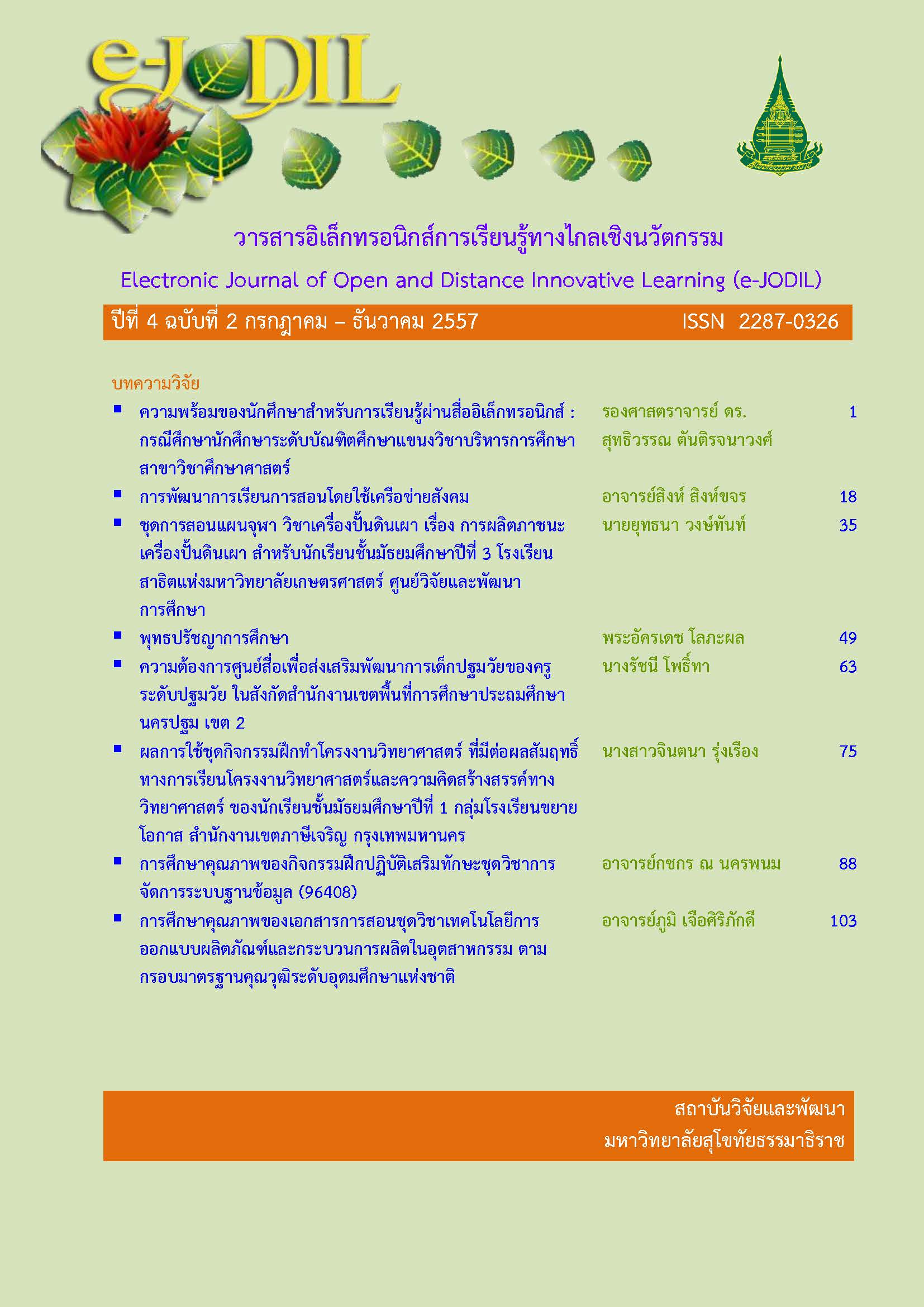
Students’ Readiness for E-learning: A Case Study of Graduate Students in Educational Administration Department School of Educational StudiesSukhothai Thammathirat Open University
Article Sidebar
Main Article Content
Abstract
The purposes of this research were (1) to study readiness for e-learning of graduate students in Educational Administration Department, School of Educational Studies, Sukhothai Thammathirat Open University ; (2) to compare readiness for e-learning of graduate students in Educational Administration Department, School of Educational Studies, Sukhothai Thammathirat Open University as classified by gender, age, and technology experience .
The research sample consisted of 162 graduate students in Educational Administration Department, School of Educational Studies, Sukhothai Thammathirat Open University, obtained by simple random sampling. The research instrument was a rating scale questionnaire with 0.86 level of reliability.The statistics used for data analysis were percentage, mean, standard deviation, t-test, and ANOVA.
The finding indicated that, graduate students in Educational Administration Department, School of Educational Studies, Sukhothai Thammathirat Open University had high reading for E-learning. The aspects the students ranked most were technology access, motivation, time management skills, technology skills, and study skills, respectively. Further, there was no significant difference in readiness for E-learning of students in Educational Administration Department, School of Educational Studies, Sukhothai Thammathirat Open University as classified by gender, age group, education levels, and technology experiences.
Downloads
Article Details
บทความ ข้อความ ภาพประกอบ ตารางประกอบ ที่ตีพิมพ์ในวารสารเป็นความคิดเห็นและความรับผิดชอบของผู้เขียนแต่เพียงผู้เดียว ไม่เกี่ยวข้องกับมหาวิทยาลัยสุโขทัยธรรมาธิราชแต่อย่างใด
บทความที่เสนอพิจารณาในวารสาร e-JODIL ต้องเป็นบทความที่ไม่เคยส่งไปลงพิมพ์ เผยแพร่ หรืออยู่ระหว่างการพิจารณาของวารสารอื่น
กองบรรณาธิการขอสงวนสิทธิ์ในการพิจารณาและตัดสินการตีพิมพ์บทความในวารสาร
References
กมลรัตน์ หล้าสุวงษ์. (2540). จิตวิทยาสังคม. กรุงเทพมหานคร: ภาควิชาการแนะแนวและจิตวิทยาการศึกษา คณะศึกษาศาสตร์ มหาวิทยาลัยศรีนครินทรวิโรฒ ประสานมิตร
กาญจนา โชคเหรียญสุขชัย. (2548). การศึกษาความเป็นไปได้ในการนำระบบ E-Learning มาปรับใช้ในระดับบัณฑิตศึกษา. วารสารวิชาการ มหาวิทยาลัยหอการค้าไทย, ปีที่ 25 ฉบับเดือนมกราคม-เมษายน 2548
ณัฐพงษ์ วัฒนบุตร. (2548). e-Learning http://student.thaiairline.com/elearn_main.asp
พรรณี ชูทัยเจนจิต. (2538). จิตวิทยาการเรียนการสอน. กรุงเทพมหานคร: บริษัทคอมแพคท์ พริ้นท์ จํากัด.
ยืน ภู่วรวรรณ. 2544. การอภิปรายทางวิชาการ. เรื่อง E-Learning มิติใหม่แห่งการเรียนรู้. 25 กรกฎาคม 2544 ณ อาคารวิทยทัศน์ มหาวิทยาลัยสุโขทัยธรรมาธิราช.
ถนอมพร เลาหจรัสแสง. (2545). หลักการออกแบบ และการสร้างเว็บเพื่อการเรียนการสอน. กรุงเทพฯ: อรุณการพิมพ์
ปัญญา ศิริโรจน์. (2555). มาทำความรู้จัก e-Learning ภาควิชาเทคโนโลยีการศึกษา มหาวิทยาลัยรามคำแหง. http://www.edu.ru.ac.th/et-ram/archives/Article/Know%20e-learning.pdf
ปัทมาพร เย็นบำรุง. 2544.การอภิปรายทางวิชาการ. เรื่อง E-Learning มิติใหม่แห่งการเรียนรู้. 25 กรกฎาคม 2544. ณ อาคารวิทยทัศน์ มหาวิทยาลัยสุโขทัยธรรมาธิราช.
ทองสง่า ผ่องแผ้ว. (2548). การศึกษาความคิดเห็นความพร้อมและการยอมรับการเรียนการสอนแบบอีเลินนิ่ง (e- Learning) ของอาจารย์มหาวิทยาลัยมหาสารคาม. รายงานการวิจัย, มหาวิทยาลัยมหาสารคาม. มหาสารคาม.
ทวีวัฒน์ วัฒนกุลเจริญ. 2547. การพัฒนารูปแบบการวัดประเมินตามสภาพจริงจากการเรียนอิเล็กทรอนิกส์ที่ใช้วิธีการเรียนตามสถานการณ์ ที่ส่งผลต่อการรับรู้ความสามารถของตนเองของผู้เรียนในสถานศึกษาระดับอุดมศึกษา. วิทยานิพนธ์ครุศาสตรดุษฎีบัณฑิต (เทคโนโลยีและสื่อสารการศึกษา), จุฬาลงกรณ์มหาวิทยาลัย. กรุงเทพฯ.
วิภาดา คุปตานนท์ และมุกดา โควหกุล. (2551). วิจัยเรื่องศึกษาความพร้อมของนักศึกษาตลอดจนปัญหาและอุปสรรคที่มีผลต่อการเรียนการสอนระบบ e-Learning. วารสารพัฒนาการเรียนการสอน มหาวิทยาลัยรังสิต, ปีที่ 2 (ฉบับที่ 1). เดือนมกราคม – มิถุนายน 2551
รุจิรา เรือนเมย. (2550). องค์ประกอบ e-Learning. http://www.learners.in.th/blogs/posts/156312สฤษดิ์พงษ์ ลิมปิษเฐียร. 2544. การอภิปรายทางวิชาการ. เรื่อง E-Learning มิติใหม่แห่งการเรียนรู้. 25 กรกฎาคม 2544. ณ อาคารวิทยทัศน์ มหาวิทยาลัยสุโขทัยธรรมาธิราช.
สาคร บุญดาว สำรวย กมลายุตต์ และวรัญญา ปุณณวัฒน์. (2547). การศึกษาสถานภาพการจัดการเรียนทางอิเล็กทรอนิกส์ของมหาวิทยาลัยในประเทศไทย. สถาบันวิจัยและพัฒนา มหาวิทยาลัยสุโขทัยธรรมาธิราช. นนทบุรี.
สุมาลี อาภรณ์พินิจเลิศและพนม บุญญ์ไพร. (2552). ความพร้อมของผู้เรียน ในการเรียนด้วย e-Learning ผ่านเครือข่ายคอมพิวเตอร์ ของนักเรียนนักศึกษาแผนกคอมพิวเตอร์ธุรกิจ วิทยาลัยเทคนิค ประจวบคีรีขันธ์.วันที่ 10 เมษายน 2544. http://202.142.212.15/~krupanom/index.php?option=com_content&view=article&id=4:e-learningG2&catid=2learninG2&catid=2:research&Itemid=4
ศิริชัย นามบุรี. (2554). การเรียนการสอนในระบบอีเลิร์นนิ่ง. วารสารวิทยาศาสตร์และเทคโนโลยี. ปีที่ 15 (ฉบับที่ 1).
ศิริวรรณ อนันต์โท.(2546). องค์ประกอบของ E-Learning. http://student.thaiairline.com/elearn_main.asp.
อลิสา ทรงศรีวิทยา. (2554). วิจัยเรื่องศึกษาความพร้อมที่มีต่อการเรียนแบบอีเลิร์นนิ่งของนักศึกษาสาขาวิชาคอมพิวเตอร์และเทคโนโลยีสารสนเทศ มหาวิทยาลัยเทคโนโลยีพระจอมเกล้าธนบุรี. วันที่ 10 กรกฎาคม 2544. http://www.niteschan.com/nec2011/3_Day%202/E2/E2_5_31.pdf
อัญชลีพร วิสิทธิ์วงษ์ และมธุรดา ม่วงมัน. (2554). การศึกษาความคิดเห็น ความพร้อมและการยอมรับในการเรียนการสอนแบบ e-learning ของอาจารย์วิทยาลัยพยาบาลบรมราชชนนี สวรรค์ประชารักษ์นครสวรรค์. การพยาบาลและการศึกษา. ปีที่ 4 (ฉบับที่ 1) มกราคม – เมษายน 2554
Aydin, C. H., & Tasci, D. (2005). Measuring Readiness for e-Learning: Reflections from an Emerging Country. EducationalTechnology & Society, 8 (4), 244-257.
Borotis, S., & Poulymenakou, A. (2004). e-LearningReadiness Components: Key Issues to Consider Before Adopting e-Learning Interventions. Retrieved on Nov. 2,2005. from http://www.eltrun.gr/papers/eLReadiness_ELEARN2004.pdf
Chapnick, S. (2000). Are You Ready for ELearning?. Retrieved on Dec. 19, 2004 from http://www.astd.org/ASTD/Resources/dyor/article_archives.htm.
Clank, Ruth, Colvin. and Mayer, Richard(2003). e-Learning and the Science of Instruction. U.S.A., John Wiley&Sons,Inc, 2003
GGuglielmino, P. J., & Guglielmino, L. M. (2003). Are your learners ready for e-learning?InG.8Figueira, Eduardo. Evaluating the Effectiveness of E-Learning Strategies for Small and Medium Enterprises. University of Évora. Available online at http://www.theknownet.com/ict_smes_seminars/papers/Figueira.html
Good, Carter V. (Ed.). (1973). Dictionary of Education (3 ed.). New York, NY: McGraw- Hill.
Hortor, William and Horton, Katherin.(2003) E-Learning Tools and Technologies. U.S.A. : Wiley Publishing, 2003. 574 pp.
Kaur, K., & Abas, Z. (2004). An Assessment of e-Learning Readiness at the Open University Malaysia. International Conference onComputers in Education (ICCE2004), Melbourne, Australia.
Khan, Badrul H. (2007) “A Framework for e-Learning”. Available Online at http://bookstoread.com/framework
Knowledge Advisors. Metrics that Matter Measurement Solution. Avalable online at http://knowledgeadvisors.com/Docs/MTMValueProposition.pdf
May, C. R. and R. M. Campbell. (1981). “Readiness for Learning: Assumptions and Realities.” Theory into Practice 20: 130-34.For a review, see Kagan, S. L. (1990). “Readiness 2000: Rethinking Rhetoric and Responsibility.” Phi Delta Kappan, 72 (4):272-279.
M. Piskurich (Ed.) (2003). The AMA handbookof e-learning: Effective design,implementation, and technology solutions,New York: AMACOM, 87-98.
Penina Mungania (2003). The Seven E-learning Barriers Facing Employees. University of Louisville. Available online at http://www.masie.com/researchgrants/2003 /ungania_Final_Report.pdf
Robbs , Richard. (2000). “Advantages of e-learning”. Learning Technology, Computer Centre, University of Leicester. Available online at http://www.le.ac.uk/cc/rjm1/etutor/elearning/advdofelearning.html
Rosenberg, M. (2000). The E-Learning Readiness Survey. Retrieved on Dec. 19, 2004 from http://www.ucalgary.ca/srmccaus/eLearnin Survey.pdf
Spiros p. Borotis, and Angeliki Poulymenakou. (2004). E-Learning readiness components: key issues to consider before adopting e-Learning interventions. In eLearn 2004 Conference Proceedings, pp. 1622-1629, November 2004.
So, Teddy and Swatman, Paula M.C. (2006).e-Learning Readiness of Hong Kong Teachers. Available online at http://www.insyl.unisa.edu.au/publications/working- papers/2006-05.pdf
Watkins, R., Leigh, D., & Triner, D. (2006). Assessing readiness for E-Learning. Performance Improvement Quarterly,17(4), 66-79.
