
The Development of Computer Assisted Instruction on Homepage Design for Grade 8 Students
Article Sidebar
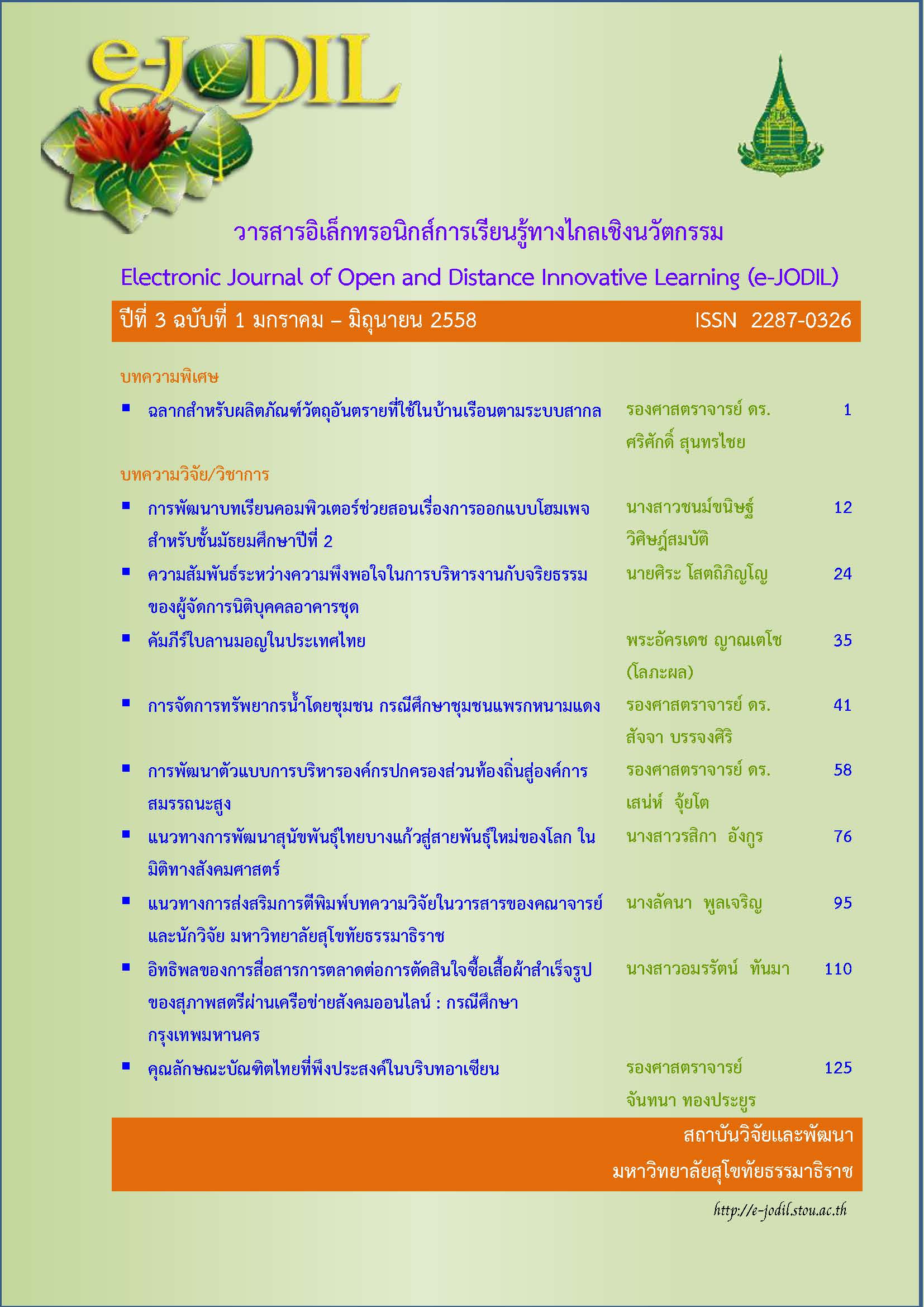
Main Article Content
Abstract
The purposes of this research were to 1) develop computer assisted instruction on homepage design for Mathayom Suksa 2 students based on the specified efficiency criterion, 2) compare the achievement of Mathayom Suksa 2 students between the group learning with the developed CAI and the group that did not learn with the CAI, and 3) study students’ satisfaction on the constructed CAI.
The research sample, obtained by cluster sampling, was 2 classes (each with 58 students) of Mathayom Suksa 2 students at Rittiyawannalai School. One studied through the use of the developed CAI while the other didn’t learn with the CAI. The instruments used were a learning achievement test, and a satisfaction questionnaire. Statistics for data analysis were the E1/E2 efficiency index, mean, standard deviation, and t-test.
The results of the study revealed that
1) the developed CAI attained the efficiency of 82.72/83.48, thus met the specified 80/80 efficiency criterion;
2) the students’ achievement scores of the group learning with the CAI were significantly higher than the scores of those who did not learn with the CAI at the .05 level of statistical significance.
3) The student’s satisfaction on the CAI was at the highest level.
Downloads
Article Details
บทความ ข้อความ ภาพประกอบ ตารางประกอบ ที่ตีพิมพ์ในวารสารเป็นความคิดเห็นและความรับผิดชอบของผู้เขียนแต่เพียงผู้เดียว ไม่เกี่ยวข้องกับมหาวิทยาลัยสุโขทัยธรรมาธิราชแต่อย่างใด
บทความที่เสนอพิจารณาในวารสาร e-JODIL ต้องเป็นบทความที่ไม่เคยส่งไปลงพิมพ์ เผยแพร่ หรืออยู่ระหว่างการพิจารณาของวารสารอื่น
กองบรรณาธิการขอสงวนสิทธิ์ในการพิจารณาและตัดสินการตีพิมพ์บทความในวารสาร
References
กรมสามัญศึกษา, กระทรวงศึกษาธิการ. (2546). พระราชบัญญัติการศึกษาแห่งชาติ พ.ศ. 2542 และที่แก้ไขเพิ่มเติม (ฉบับที่ 2) พ.ศ. 2545 พร้อมกฎกระทรวงที่เกี่ยวข้อง และพระราชบัญญัติการศึกษาภาคบังคับ พ.ศ. 2545. กรุงเทพฯ: องค์การค้าคุรุสภา.
เชิดศักดิ์ โฆวาสินธุ์. (2549). การวิจัยทางการศึกษา. กรุงเทพฯ: โอเดียนสโตร์.
พวงรัตน์ ทวีรัตน์. (2549). วิธีการวิจัยทางพฤติกรรมศาสตร์และสังคมศาสตร์. (พิมพ์ครั้งที่ 10). กรุงเทพฯ : สำนักทดสอบทางการศึกษาและจิตวิทยา มหาวิทยาลัยศรีนครินทรวิโรฒประสานมิตร.
เยาวลักษณ์ วงศ์พิมพ์. (2548). การพัฒนาบทเรียนช่วยการเรียนรู้ระบบมัลติมิเดีย วิชาคณิตศาสตร์ เรื่องทฤษฎีปีทาโกรัส สำหรับนักเรียนชั้นมัธยมศึกษาปีที่ 3. ปริญญานิพนธ์ศึกษาศาสตรมหาบัณฑิต มหาวิทยาลัยมหาสารคาม, มหาสารคาม.
ล้วน สายยศ และอังคณา สายยศ. (2548). เทคนิคการวิจัยทางการศึกษา. (พิมพ์ครั้งที่ 9). กรุงเทพฯ : สุวีริยาสาส์น.
วชิระ วิชชุวรนันท์. (2542). คู่มือการพัฒนาบทเรียนคอมพิวเตอร์ช่วยสอน. กำแพงเพชร : คณะครุศาสตร์ สถาบันราชภัฏกำแพงเพชร.
วิทยากร เชียงกูล. (2549). รายงานสภาวะการศึกษาไทยปี 2547/2548 รากเหง้าของปัญหาและแนวทางแก้ไข. กรุงเทพฯ : สำนักคณะกรรมการการศึกษาแห่งชาติ.
Petock, Michael A. (1996). Computer assisted instruction and the Pythagorean theorem (algebra, geometry). (Online). Available : http://www.lib.umi.com/dissertations/fullcit/ 1380040. Retrieved November 28,2008
Quinteros, Alfredo Dario. (1996). An evaluation of a computer assisted instruction program, “Architecture and Mathematics”. (Online). Available : http://www.lib.umi. com/dissertations/fullcit/1380087. Retrieved November 28,2008
Richardson, William James. (1997). Intergalactic Proportions (computer assisted instruction). (Online). Available : http://www.lib.umi.com/dissertations/fullcit/ 1383846. Retrieved November 28,2008
