
UNDERSTANDING OF ELECTRIC CURRENT CONCEPTS AND SCIENTIFIC EXPLANATORY PERFORMANCE OF GRADE 11 STUDENTS LEARNING THROUGH INTERACTIVE LECTURE DEMONSTRATION SUPPLEMENTED WITH PhET SIMULATIONS
Article Sidebar
Main Article Content
Abstract
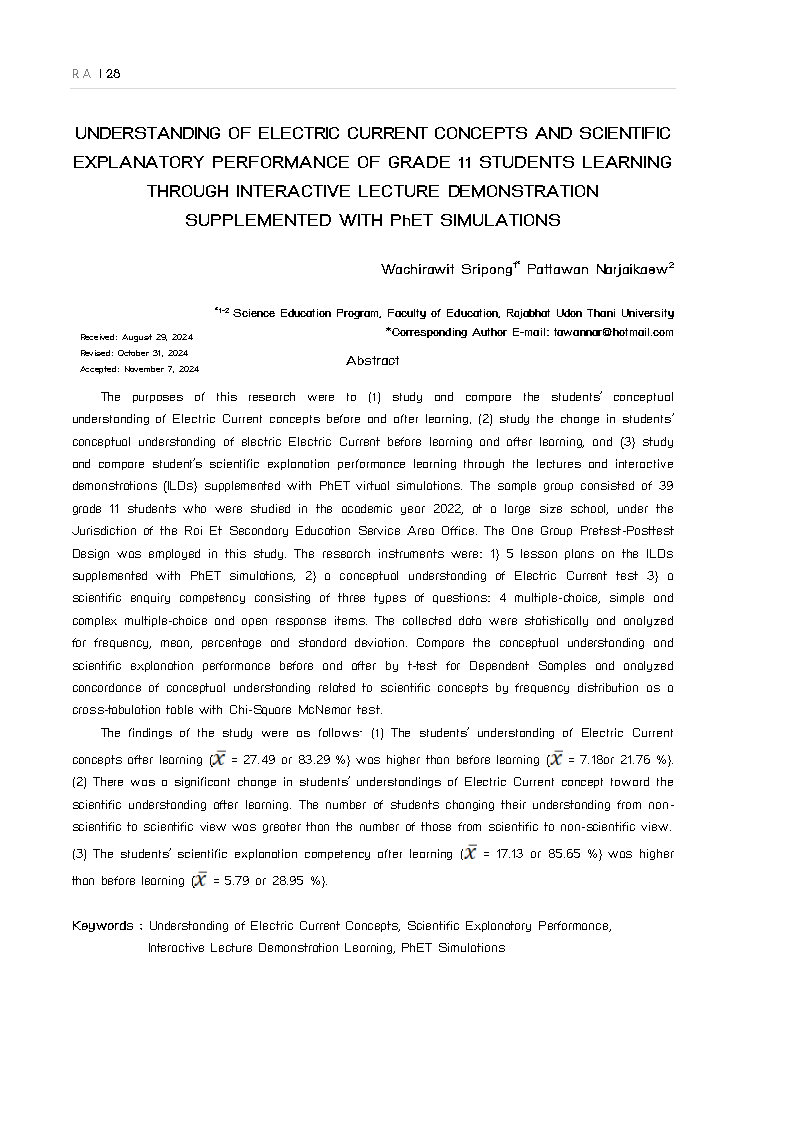
The purposes of this research were to (1) study and compare the students’ conceptual understanding of Electric Current concepts before and after learning, (2) study the change in students’ conceptual understanding of electric Electric Current before learning and after learning, and (3) study and compare student’s scientific explanation performance learning through the lectures and interactive demonstrations (ILDs) supplemented with PhET virtual simulations. The sample group consisted of 39 grade 11 students who were studied in the academic year 2022, at a large size school, under the Jurisdiction of the Roi Et Secondary Education Service Area Office. The One Group Pretest-Posttest Design was employed in this study. The research instruments were: 1) 5 lesson plans on the ILDs supplemented with PhET simulations, 2) a conceptual understanding of Electric Current test 3) a scientific enquiry competency consisting of three types of questions: 4 multiple-choice, simple and complex multiple-choice and open response items. The collected data were statistically and analyzed for frequency, mean, percentage and standard deviation. Compare the conceptual understanding and scientific explanation performance before and after by t-test for Dependent Samples and analyzed concordance of conceptual understanding related to scientific concepts by frequency distribution as a cross-tabulation table with Chi-Square McNemar test.
The findings of the study were as follows: (1) The students’ understanding of Electric Current concepts after learning ( = 27.49 or 83.29 %) was higher than before learning ( = 7.18or 21.76 %). (2) There was a significant change in students’ understandings of Electric Current concept toward the scientific understanding after learning. The number of students changing their understanding from non-scientific to scientific view was greater than the number of those from scientific to non-scientific view. (3) The students’ scientific explanation competency after learning ( = 17.13 or 85.65 %) was higher than before learning ( = 5.79 or 28.95 %).
Article Details

This work is licensed under a Creative Commons Attribution-NonCommercial-NoDerivatives 4.0 International License.
References
กระทรวงศึกษาธิการ. (2551). หลักสูตรแกนกลางขั้นพื้นฐาน พุทธศักราช 2551. กรุงเทพฯ: กระทรวงศึกษาธิการ.
กระทรวงศึกษาธิการ. (2560). ตัวชี้วัดและสาระการเรียนรู้แกนกลางกลุ่มสาระการเรียนรู้วิทยาศาสตร์. กรุงเทพฯ: กระทรวงศึกษาธิการ.
กฤตภัค โคตรหานาม. (2556). ผลการจัดการเรียนรู้ฟิสิกส์ เรื่องการสั่นของสปริงโดยใช้การสาธิตประกอบคำบรรยายอย่างมีปฏิสัมพันธ์ผ่านสิ่งแวดล้อมปฏิบัติการทดลองด้วยคอมพิวเตอร์สำหรับนักเรียนชั้นมัธยมศึกษาปีที่ 4: กรณี MBL สถานการณ์จำลองบนคอมพิวเตอร์และการรวมกันของทั้งคู่ (วิทยานิพนธ์ปริญญามหาบัณฑิต). ขอนแก่น: มหาวิทยาลัยขอนแก่น.
ขวัญหทัย กวดนอก และ ชาญวิทย์ คำเจริญ. (2566). การพัฒนาปฏิบัติการฟิสิกส์พื้นฐานด้วยการใช้สื่อจำลองโต้ตอบเสมือนจริง. วารสารบรรณศาสตร์ มศว., 16(2), 51–61.
จิราวรรณ รักคง และคณะ. (2564). การพัฒนาผลสัมฤทธิ์ทางการเรียนรู้วิทยาศาสตร์ เรื่อง ความดันและแรงพยุงของของเหลว ด้วยการจัดการเรียนรู้แบบสืบเสาะหาความรู้ (5Es) ร่วมกับเทคนิค POE และการใช้สถานการณ์จำลองบนคอมพิวเตอร์สำหรับนักเรียนชั้นมัธยมศึกษาปีที่ 2. วารสารศาสตร์การศึกษาและการพัฒนามนุษย์, 5(1), 40–51.
จุฑารัตน์ เบญพาด, ชุติมา ศรีสำราญ, ศุภรัตน์ ทัศนิเจริญ, กิตติพงษ์ เสียงเสนาะ, มัทนี เสียงเสนาะ และ ณัฐภัทร ปิ่นเนตร. (2564). การใช้สื่อจำลองโต้ตอบเสมือนจริงเรื่องการสะท้อนและการหักเหของแสงของนักเรียนชั้นมัธยมศึกษาปีที่ 5/1 โรงเรียนศรีวิชัยวิทยา. ใน การประชุมวิชาการระดับชาติครั้งที่ 13 มหาวิทยาลัยราชภัฏนครปฐม. นครปฐม: มหาวิทยาลัยราชภัฏนครปฐม.
ชาญวิทย์ คำเจริญ และ ดารกา พลัง. (2562). การใช้สื่อจำลองโต้ตอบเสมือนจริง: การเคลื่อนที่แนววิถีโค้ง. วารสารครุศาสตร์อุตสาหกรรม, 18(3), 13–22.
พฤกษา ปากหวาน. (2559). ผลการจัดการเรียนรู้แบบสาธิตเชิงปฏิสัมพันธ์ เสริมด้วยเทคนิคการใช้คำถามต่อมโนมติเสียง และความสามารถในการคิดวิเคราะห์ของนักเรียนชั้นมัธยมศึกษาปีที่ 5 (วิทยานิพนธ์ปริญญามหาบัณฑิต). อุดรธานี: มหาวิทยาลัยราชภัฏอุดรธานี.
พัดตาวัน นาใจแก้ว. (2556). รูปแบบการจัดการเรียนรู้. อุดรธานี: มหาวิทยาลัยราชภัฏอุดรธานี.
พัดตาวัน นาใจแก้ว. (2560). การศึกษาการจัดการเรียนรู้ตามแนวคอนสตรัคติวิสต์ของไดรเวอร์และเบลล์เสริมด้วยเทคนิคการใช้คำถามต่อความเข้าใจมโนมติสารละลายกรด-เบส และความสามารถในการคิดวิเคราะห์ของนักเรียนชั้นมัธยมศึกษาปีที่ 1. ใน การประชุมวิชาการและนำเสนอผลงานวิจัยระดับชาติ ราชธานีวิชาการ ครั้งที่ 3 (น. 842–853). อุบลราชธานี: มหาวิทยาลัยราชธานี.
Abraham, M. R., Williamson, V. M., & Westbrook, S. L. (1994). A cross-age study of the understanding five concepts. Journal of Research in Science Teaching, 31(2), 147–165.
David, F. R. (2007). Strategic management (11th ed.). New Jersey: Prentice-Hall. Lederman, N. G. (2002). Views of nature of science questionnaire: Toward valid and meaningful assessment of learners’ conception of nature of science. Journal of Research in Science Teaching, 39(6), 497–518.
McNeill, K. L., & Krajcik, J. (2008). Inquiry and scientific explanations: Helping students use evidence and reasoning. In J. Luft, R. Bell, & J. Gess-Newsome (Eds.), Science as inquiry in the secondary setting (pp. 121–134). Arlington, VA: National Science Teacher Association Press.
Sokoloff, D. R., & Thornton, R. K. (1997). Using interactive lecture demonstrations to create an active learning environment. Oregon: University of Oregon.
