
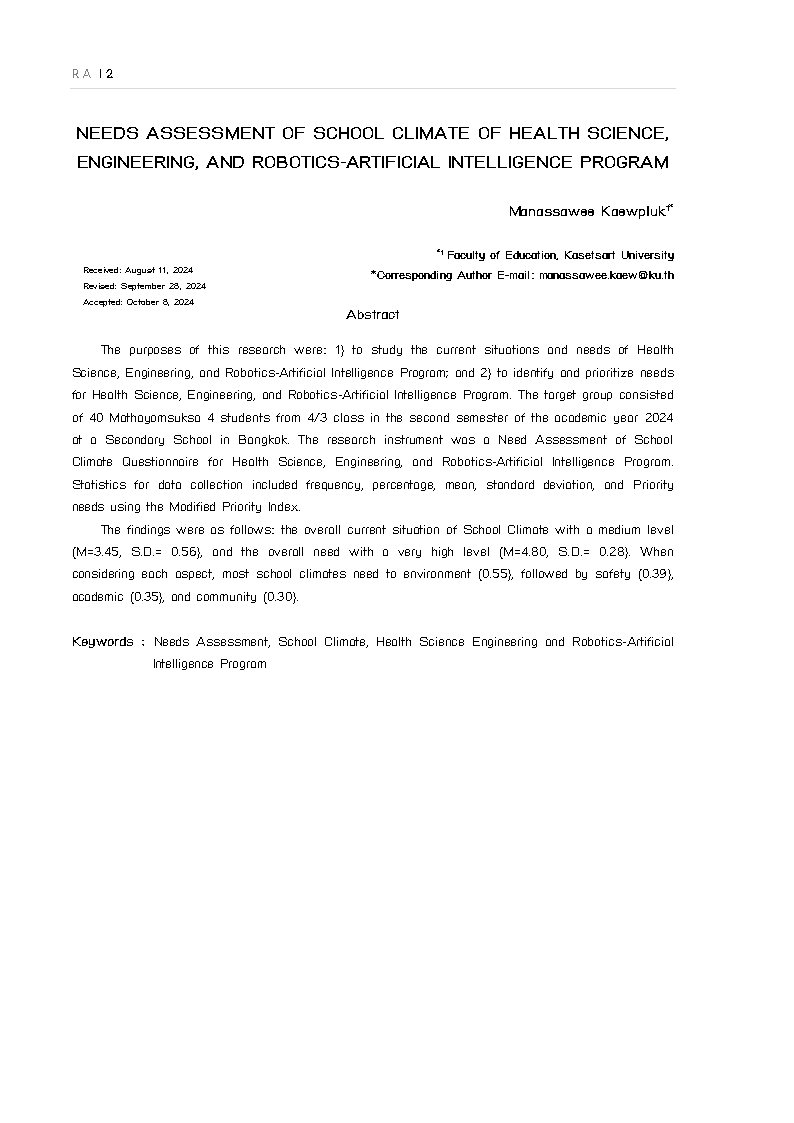
NEEDS ASSESSMENT OF SCHOOL CLIMATE OF HEALTH SCIENCE, ENGINEERING, AND ROBOTICS-ARTIFICIAL INTELLIGENCE PROGRAM
Article Sidebar
Main Article Content
Abstract
The purposes of this research were: 1) to study the current situations and needs of Health Science, Engineering, and Robotics-Artificial Intelligence Program; and 2) to identify and prioritize needs for Health Science, Engineering, and Robotics-Artificial Intelligence Program. The target group consisted of 40 Mathayomsuksa 4 students from 4/3 class in the second semester of the academic year 2024 at a Secondary School in Bangkok. The research instrument was a Need Assessment of School Climate Questionnaire for Health Science, Engineering, and Robotics-Artificial Intelligence Program. Statistics for data collection included frequency, percentage, mean, standard deviation, and Priority needs using the Modified Priority Index.
The findings were as follows: the overall current situation of School Climate with a medium level (M=3.45, S.D.= 0.56), and the overall need with a very high level (M=4.80, S.D.= 0.28). When considering each aspect, most school climates need to environment (0.55), followed by safety (0.39), academic (0.35), and community (0.30).
Article Details

This work is licensed under a Creative Commons Attribution-NonCommercial-NoDerivatives 4.0 International License.
References
ณัฐทยา นวไตรลาภ. (2560). โมเดลเชิงสาเหตุของภาวะผู้นําทางเทคโนโลยีของผู้บริหารและบรรยากาศโรงเรียนผ่านการรู้เทคโนโลยีและการมองโลกในแง่ดีทางวิชาการที่ส่งผลต่อประสิทธิผลการสอนของครูผู้สอนภาษาอังกฤษในโรงเรียนมาตรฐานสากล (ปริญญานิพนธ์ปริญญาดุษฎีบัณฑิต). กรุงเทพฯ: มหาวิทยาลัยเกษตรศาสตร์.
แน่งน้อย เพ็งพันธ์. (2562). ภาวะผู้นำเชิงสร้างสรรค์ของผู้บริหารสถานศึกษาที่ส่งผลต่อประสิทธิผลของโรงเรียนมัธยมศึกษาสังกัดสำนักงานคณะกรรมการการศึกษาขั้นพื้นฐานในเขตปริมณฑลของกรุงเทพมหานคร (ปริญญานิพนธ์ปริญญาดุษฎีบัณฑิต). กรุงเทพฯ: มหาวิทยาลัยเกษตรศาสตร์.
ทิพย์วรรณ สุพิเพชร. (2565). การบริหารจัดการสภาพแวดล้อมในโรงเรียนพระปริยัติธรรมแผนกสามัญศึกษาสู่ความสำเร็จขององค์การยุคใหม่. วารสารมจร กาญจนปริทรรศน์, 2(3), 100–210.
ประภาพรรณ ยดย้อย. (2564). การเปรียบเทียบประสิทธิภาพของโมเดลการถดถอยเชิงลำดับชั้นที่มีอัตสหสัมพันธ์เชิงพื้นที่และโมเดลการถดถอยพหุระดับสำหรับการทำนายความอยู่ดีมีสุขของนักเรียน (วิทยานิพนธ์ปริญญามหาบัณฑิต). กรุงเทพฯ: จุฬาลงกรณ์มหาวิทยาลัย.
วัชรศักดิ์ สุดหล้า. (2560). การพัฒนาเครื่องมือวัดและส่งเสริมบรรยากาศโรงเรียนเพื่อสุขภาวะและความยึดมั่นผูกพันกับงานของครู: การวิจัยประสบการณ์ผู้ใช้ (วิทยานิพนธ์ปริญญามหาบัณฑิต). กรุงเทพฯ: จุฬาลงกรณ์มหาวิทยาลัย.
วิวัฒน์ มีสุวรรณ์. (2559). อินเทอร์เน็ตเพื่อสรรพสิ่ง (Internet of Things) กับการศึกษา Internet of Things on Education. วารสารวิชาการนวัตกรรมสื่อสารสังคม, 4(2), 82–92.
ภวทิพย์ ภาคภูมิ. (2560). แนวทางการจัดการเรียนการสอนที่สอดคล้องกับองค์ประกอบของความสามารถในการสื่อสารทางคณิตศาสตร์ของนักเรียนประถมศึกษาปีที่ 6 (วิทยานิพนธ์ปริญญามหาบัณฑิต). กรุงเทพฯ: จุฬาลงกรณ์มหาวิทยาลัย.
สุวิมล ว่องวาณิช. (2562). การวิจัยประเมินความต้องการจำเป็น (พิมพ์ครั้งที่ 4). กรุงเทพฯ: สำนักพิมพ์แห่งจุฬาลงกรณ์มหาวิทยาลัย.
สมพร ทะเยี่ยม. (2566). วิจัยเชิงปฏิบัติการแบบมีส่วนร่วมเพื่อสร้างบรรยากาศทางบวกของโรงเรียน (ปริญญานิพนธ์ปริญญาดุษฎีบัณฑิต). ขอนแก่น: มหาวิทยาลัยมหามกุฏราชวิทยาลัย วิทยาเขตอีสาน.
Cohen, J., & Espelage, D. (2021). School climate and its effects on student learning. Retrieved November 6, 2024, from https://www.apa.org.
National Center on Safe Supportive Learning Environments. (2022). School climate improvement resource package. U.S. Department of Education. Retrieved November 6, 2024, from https://safesupportivelearning.ed.gov.
Thapa, A., Cohen, J., Guffey, S., & Higgins-D’Alessandro, A. (2013). A review of school climate research. Review of Educational Research, 83(3), 357–385. from https://doi.org/10.3102/0034654313483907.
Wang, M., & Degol, J. L. (2016). School climate: A review of the construct, measurement, and impact on student outcomes. Educational Psychology Review, 28, 315–352. from https://doi.org/10.1007/s10648-015-9318-8.
Zimmerman, B. J. (2008). Investigating self-regulation and motivation: Historical background, methodological developments, and future prospects. American Educational Research Journal, 45(1), 166–183. from https://doi.org/10.3102/0002831207312909.
