
The Development of a Social Empowerment Model Affecting the Sufficiency Way of Life Among Ethnic Groups: A Case Study of the Lisu Tribe in Wiang Haeng District, Chiang Mai Province
Article Sidebar
Main Article Content
Abstract
The objectives of this research were to: 1) study the general background information of the Lisu ethnic group and their needs for social empowerment influencing their sufficiency way of life in Wiang Haeng District, Chiang Mai Province, 2) develop a social empowerment model that impact the sufficiency way of life of the Lisu ethnic group in Wiang Haeng District, Chiang Mai Province, and 3) implement the social empowerment model to enhance the sufficiency way of life of the Lisu ethnic group in Wiang Haeng District, Chiang Mai Province. The sample used in the research were community leaders and individuals from four Lisu ethnic villages: Ban Paek Saem, Ban Sam Muen, Ban Mae Tae, and Ban Lao Wu. The research instruments were structured interview forms, in-depth interview guides, focus group discussion recording forms and questionnaires. Qualitative data were analyzed using content analysis.
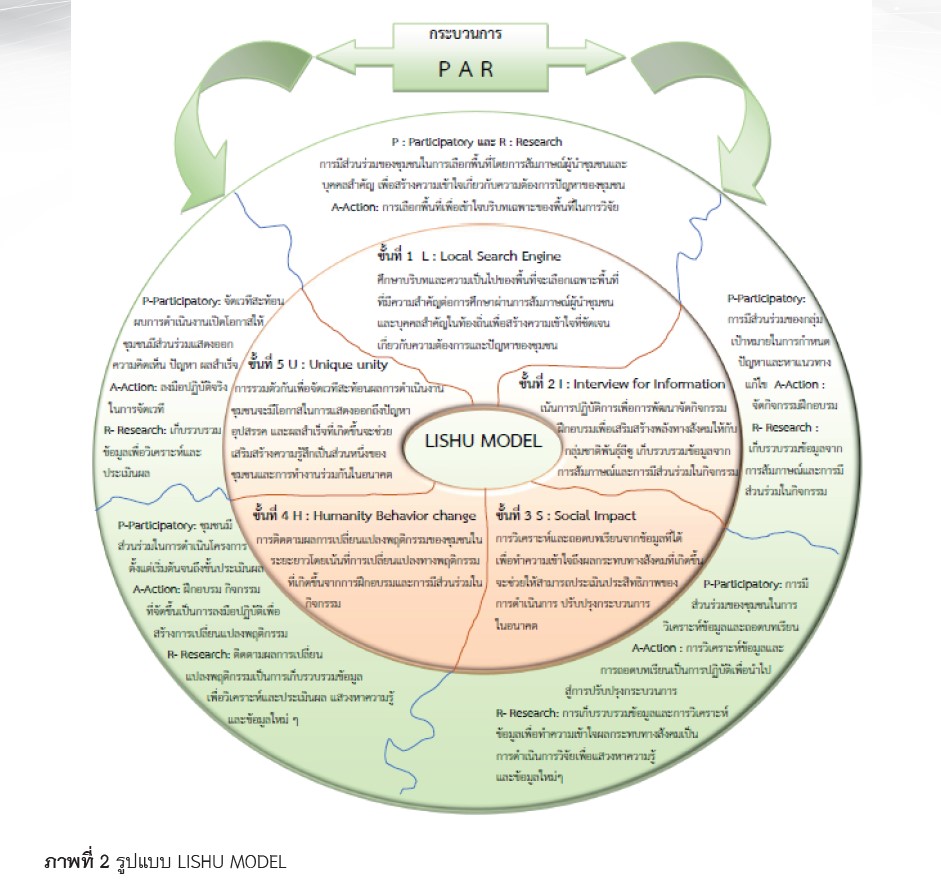
The result revealed that 1) The Lisu ethnic group in Wiang Haeng District, Chiang Mai Province, lived in harmony with the principles of sufficiency and sought to enhance social empowerment to improve their quality of life in various dimensions. Their needs could be categorized into eight aspects as follows: 1. living life in moderation, 2. living with stability in life, 3. living by making decisions at a sufficiency level with reason, 4. living by preparing for impacts and changes in various aspects, 5. living with comprehensive knowledge of various academic subjects, 6. living by reasoning rationally and having good immunity, 7. living with awareness of morality, honesty, and patience, and 8. living by using intelligence in life. 2) The model for social empowerment that influences the way of life of the Lisu ethnic group in Wiang Haeng District, Chiang Mai Province, was called the LISHU Model which comprised a five-step process: (1) Local Search Engine, involving the identifying and gathering of local resources and knowledge, (2) Interview for Information, focusing on the collection of qualitative and quantitative data through interviews, (3) Social Impact, emphasizing the assessing and understanding of community-wide effects, (4) Humanity Behavior Change, aiming at fostering positive behavioral transformation within the community, and (5) Unique Unity, which strengthening community cohesion and identity. 3. The results of applying the social empowerment model influencing the sufficiency lifestyle of the Lisu ethnic group in Wiang Haeng District, Chiang Mai Province, revealed that the community demonstrated the ability to enhance social empowerment, effectively contributing to their sufficiency-based way of life.
Downloads
Article Details

This work is licensed under a Creative Commons Attribution-NonCommercial-NoDerivatives 4.0 International License.
The articles published are copyrighted by the Graduate School, Chiang Mai Rajabhat University.
The opinions expressed in each article of this academic journal are solely those of the individual authors and do not reflect the views of Chiang Mai Rajabhat University or its faculty members. The responsibility for the content of each article rests entirely with the respective authors. In the event of any errors, the authors alone are responsible for their own articles.
References
Blanchard, K. (1996). Empowerment take more than a minute. San Francisco: Berrett-Kocher.
Bourdieu, P. (1986). The forms of capital. In J. G. Richardson (Ed.), Handbook of theory and research for the sociology of education (pp. 241-258). Westport, CT: Greenwood Press.
Chutinantakul, W. (2019). Applicability of the sufficiency economy philosophy for living a life: A case study of Military Officials of National Defence College, National Defence Studies Institute. (Master’s thesis, Administration in public administration, Faculty of Public Administration, Rangsit University). [In Thai]
Dessaint, A. Y. (1971). Lisu annotated bibliography. Behavior Science Notes, 6(2), 71-94.
Durrenberger, E. P. (1976). The economy of a Lisu village 1. American Ethnologist, 3(4), 633-644.
Fals-Borda, O. (1991). Knowledge and social movements. California: Merrill Publications, University of California, Santa Cruz.
Inrak, C. (2019). Paradigm for the development of educational administrators in the 21st century. Journal of Educational Administration Silapakorn University, 10(2), 1-9. [In Thai]
Khempech, T. (2008). Lifestyle and environment of the long-lived elderly of Lisu tribe. (Master’s thesis, Health promotion field, Faculty of Education, Chiang Mai University). [In Thai]
Kieffer, C.H. (1984). Citizen empowerment: A developmental perspective. Prevention in Human Services, 3(2-3), 354-361.
King Bhumibol Adulyadej. (1999). The royal development projects. Bangkok: Royal Development Projects Board. [In Thai]
Korten, D. C. (1990). When corporations rule the world. Doubleday.
Na Chiangmai, E. (2009). Effects of group process on knowledge, attitude, and behaviors of care-givers of type 2 diabetes elders at Huay Han Primary Care Unit, Lamphun Province. (Master’s thesis, Public Health Major, Chiang Mai University. [In Thai]
Ostrom, E. (1990). Governing the commons: The evolution of institutions for collective action. Cambridge University Press.
Pathranarakul, P. (2007). Government management and public empowerment. Thai Journal of Public Administration, 5(1), 87-122. [In Thai]
Phitakprawet, T. (2003). The power of the technical community for lecturers. Nonthaburi: Department of Health, Ministry of Public Health. [In Thai]
Putnam, R. D. (2000). Bowling alone: The collapse and revival of American community. N.P.: Simon & Schuster.
Rowlands, J. (1998). Empowerment and social change: What we mean and what we do. Community Development Journal, 33(1), 3-20.
Seers, D. (1979). The concept of basic needs: On the critique of development theories and the design of development projects. Journal of Development Studies, 14(3), 117-137.
Sen, A. (1999). Health in development. Bulletin of the World Health Organization, 77(8), 619.
Scott, J. C. (1990). Domination and the arts of resistance: Hidden transcripts. Connecticut, US: Yale University Press.
Shulei, S. (2022). Cultural inheritance and transformation of Lisu ethnic group: A case study of Ban Thahor, Sai Khaaw Subdistrict, Phan District, Chiang Rai Province. (Master’s thesis, Communicative Thai as a Second Language, Faculty of Liberal Arts, Huachiew Chalermprakiet University). [In Thai]
Suwan, B. (2002). Sufficiency economy: A pathway to sustainable development. Bangkok: Thammasat University Press. [In Thai]
Walker, A. (1998). Social capital: Theory and research. Cambridge: Cambridge University Press.
Weber, M. (1922). Economy and society: An outline of interpretive sociology (G. Roth & C. Wittich, Eds.). University of California Press.
