
การพัฒนารูปแบบการเสริมสร้างพลังทางสังคมที่มีผลต่อวิถีชีวิตพอเพียง ของกลุ่มชาติพันธุ์: กรณีศึกษาชนเผ่าลีซูในเขตอำเภอเวียงแหง จังหวัดเชียงใหม่
Article Sidebar
Main Article Content
บทคัดย่อ
งานวิจัยนี้มีวัตถุประสงค์เพื่อ 1) ศึกษาข้อมูลพื้นฐานทั่วไปของกลุ่มชาติพันธุ์ลีซูและความต้องการในการเสริมสร้างพลังทางสังคมที่มีผลต่อวิถีชีวิตพอเพียงของกลุ่มชาติพันธุ์ลีซูในเขตอำเภอเวียงแหง จังหวัดเชียงใหม่ 2) สร้างรูปแบบการเสริมสร้างพลังทางสังคมที่มีผลต่อวิถีชีวิตพอเพียงของกลุ่มชาติพันธุ์ลีซูในเขตอำเภอเวียงแหง จังหวัดเชียงใหม่ และ 3) ใช้รูปแบบการเสริมสร้างพลังทางสังคมที่มีผลต่อวิถีชีวิตพอเพียงกลุ่มชาติพันธุ์ลีซูในเขตอำเภอเวียงแหง จังหวัดเชียงใหม่ กลุ่มตัวอย่างที่ใช้ในการวิจัย ได้แก่ ผู้นำชุมชนและบุคคลในชุมชนที่เป็นกลุ่มชาติพันธุ์ลีซู 4 หมู่บ้าน ได้แก่ บ้านแปกแซม บ้านสามหมื่น บ้านแม่แตะ และบ้านเลาวู เครื่องมือที่ใช้ในการวิจัย ได้แก่ 1) แบบสัมภาษณ์แบบมีโครงสร้าง 2) แบบสัมภาษณ์เชิงลึก 3) แบบบันทึกการสนทนากลุ่ม และ 4) แบบสอบถาม วิเคราะห์ข้อมูลเชิงคุณภาพโดยการวิเคราะห์เนื้อหา
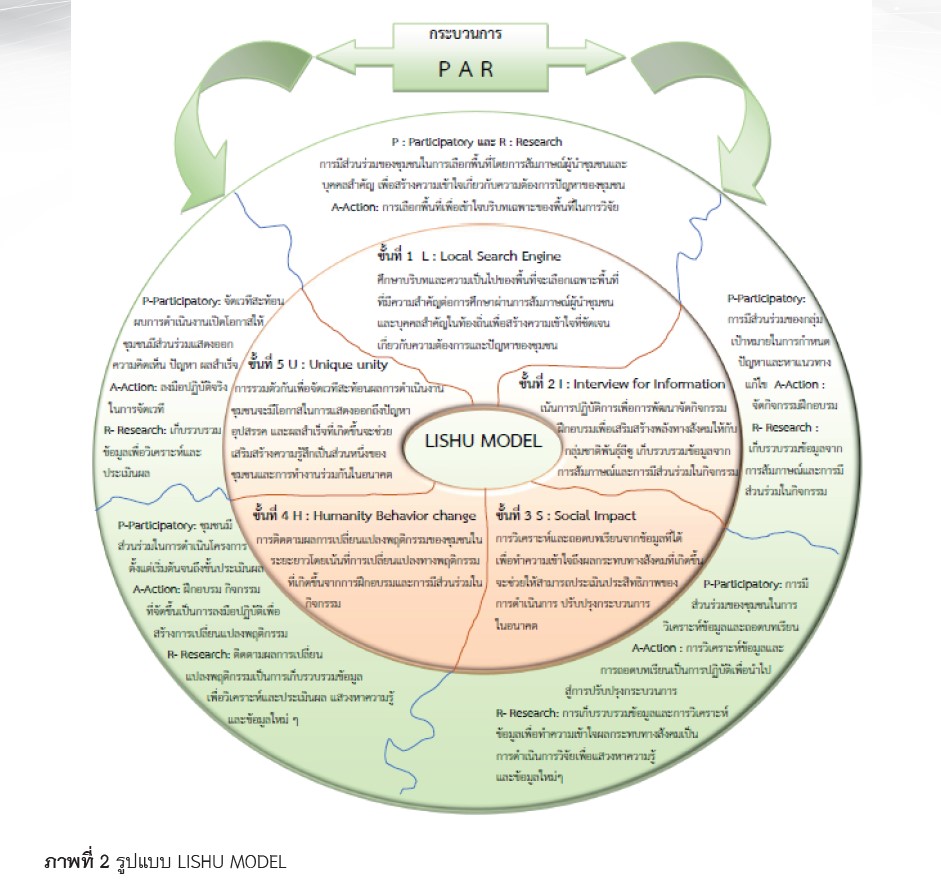
ผลการวิจัยสรุปได้ว่า 1) กลุ่มชาติพันธุ์ลีซูในอำเภอเวียงแหง จังหวัดเชียงใหม่ มีวิถีชีวิตที่สอดคล้องกับหลักการพอเพียงและมีความต้องการในการเสริมสร้างพลังทางสังคมเพื่อพัฒนาคุณภาพชีวิตในหลากหลายมิติ รวมถึงความต้องการใน 8 ด้าน ได้แก่ การดำเนินชีวิตอย่างพอประมาณ ความมั่นคงในการดำรงชีวิต การตัดสินใจอย่างมีเหตุผล การเตรียมพร้อมรับผลกระทบ การมีความรู้ที่รอบด้านเกี่ยวกับวิชาการต่าง ๆ การใช้เหตุผลอย่างมีภูมิคุ้มกัน การตระหนักในคุณธรรม และการใช้สติปัญญาในการดำเนินชีวิต 2) รูปแบบการเสริมสร้างพลังทางสังคมที่มีผลต่อวิถีชีวิตกลุ่มชาติพันธุ์ลีซูในเขตอำเภอเวียงแหง จังหวัดเชียงใหม่ คือ รูปแบบ LISHU Model ประกอบด้วยกระบวนการ 5 ขั้นตอน ได้แก่ ขั้นที่ 1 Local Search Engine ขั้นที่ 2 Interview for Information ขั้นที่ 3 Social Impact ขั้นที่ 4 Humanity Behavior Change และขั้นที่ 5 Unique Unity และ 3) ผลการใช้รูปแบบการเสริมสร้างพลังทางสังคมที่มีผลต่อวิถีชีวิตพอเพียงกลุ่มชาติพันธุ์ลีซูในเขตอำเภอเวียงแหง จังหวัดเชียงใหม่ พบว่า มีความสามารถในการพัฒนาการเสริมสร้างพลังทางสังคมที่มีผลต่อวิถีชีวิตพอเพียงของกลุ่มชาติพันธุ์ลีซูในเขตอำเภอเวียงแหง จังหวัดเชียงใหม่
Downloads
Article Details

อนุญาตภายใต้เงื่อนไข Creative Commons Attribution-NonCommercial-NoDerivatives 4.0 International License.
บทความที่ได้รับการตีพิมพ์เป็นลิขสิทธิ์ของบัณฑิตวิทยาลัย มหาวิทยาลัยราชภัฎเชียงใหม่
ข้อความที่ปรากฏในบทความแต่ละเรื่องในวารสารวิชาการเล่มนี้เป็นความคิดเห็นส่วนตัวของผู้เขียนแต่ละท่านไม่เกี่ยวข้องกับมหาวิทยาลัยราชภัฎเชียงใหม่ และคณาจารย์ท่านอื่นๆ ในมหาวิทยาลัยฯ แต่อย่างใด ความรับผิดชอบองค์ประกอบทั้งหมดของบทความแต่ละเรื่องเป็นของผู้เขียนแต่ละท่าน หากมีความผิดพลาดใด ๆ ผู้เขียนแต่ละท่านจะรับผิดชอบบทความของตนเองแต่ผู้เดียว
เอกสารอ้างอิง
Blanchard, K. (1996). Empowerment take more than a minute. San Francisco: Berrett-Kocher.
Bourdieu, P. (1986). The forms of capital. In J. G. Richardson (Ed.), Handbook of theory and research for the sociology of education (pp. 241-258). Westport, CT: Greenwood Press.
Chutinantakul, W. (2019). Applicability of the sufficiency economy philosophy for living a life: A case study of Military Officials of National Defence College, National Defence Studies Institute. (Master’s thesis, Administration in public administration, Faculty of Public Administration, Rangsit University). [In Thai]
Dessaint, A. Y. (1971). Lisu annotated bibliography. Behavior Science Notes, 6(2), 71-94.
Durrenberger, E. P. (1976). The economy of a Lisu village 1. American Ethnologist, 3(4), 633-644.
Fals-Borda, O. (1991). Knowledge and social movements. California: Merrill Publications, University of California, Santa Cruz.
Inrak, C. (2019). Paradigm for the development of educational administrators in the 21st century. Journal of Educational Administration Silapakorn University, 10(2), 1-9. [In Thai]
Khempech, T. (2008). Lifestyle and environment of the long-lived elderly of Lisu tribe. (Master’s thesis, Health promotion field, Faculty of Education, Chiang Mai University). [In Thai]
Kieffer, C.H. (1984). Citizen empowerment: A developmental perspective. Prevention in Human Services, 3(2-3), 354-361.
King Bhumibol Adulyadej. (1999). The royal development projects. Bangkok: Royal Development Projects Board. [In Thai]
Korten, D. C. (1990). When corporations rule the world. Doubleday.
Na Chiangmai, E. (2009). Effects of group process on knowledge, attitude, and behaviors of care-givers of type 2 diabetes elders at Huay Han Primary Care Unit, Lamphun Province. (Master’s thesis, Public Health Major, Chiang Mai University. [In Thai]
Ostrom, E. (1990). Governing the commons: The evolution of institutions for collective action. Cambridge University Press.
Pathranarakul, P. (2007). Government management and public empowerment. Thai Journal of Public Administration, 5(1), 87-122. [In Thai]
Phitakprawet, T. (2003). The power of the technical community for lecturers. Nonthaburi: Department of Health, Ministry of Public Health. [In Thai]
Putnam, R. D. (2000). Bowling alone: The collapse and revival of American community. N.P.: Simon & Schuster.
Rowlands, J. (1998). Empowerment and social change: What we mean and what we do. Community Development Journal, 33(1), 3-20.
Seers, D. (1979). The concept of basic needs: On the critique of development theories and the design of development projects. Journal of Development Studies, 14(3), 117-137.
Sen, A. (1999). Health in development. Bulletin of the World Health Organization, 77(8), 619.
Scott, J. C. (1990). Domination and the arts of resistance: Hidden transcripts. Connecticut, US: Yale University Press.
Shulei, S. (2022). Cultural inheritance and transformation of Lisu ethnic group: A case study of Ban Thahor, Sai Khaaw Subdistrict, Phan District, Chiang Rai Province. (Master’s thesis, Communicative Thai as a Second Language, Faculty of Liberal Arts, Huachiew Chalermprakiet University). [In Thai]
Suwan, B. (2002). Sufficiency economy: A pathway to sustainable development. Bangkok: Thammasat University Press. [In Thai]
Walker, A. (1998). Social capital: Theory and research. Cambridge: Cambridge University Press.
Weber, M. (1922). Economy and society: An outline of interpretive sociology (G. Roth & C. Wittich, Eds.). University of California Press.
