
A Comparative Study of Passive Construction in French and Thai
Article Sidebar
Main Article Content
Abstract
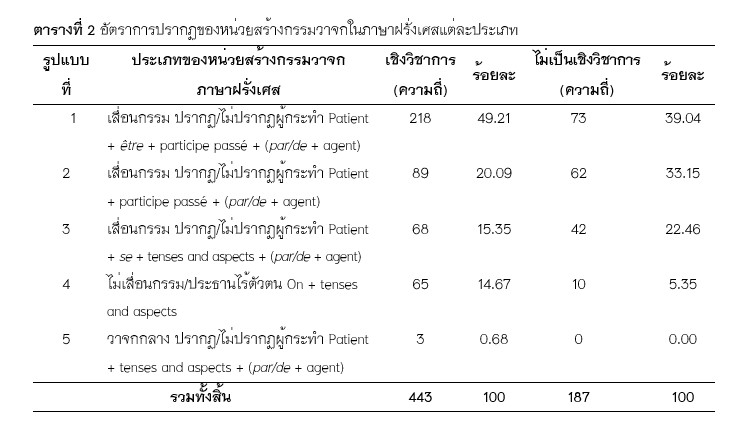
This study aimed to 1) analyze the occurrence of passive voice constructions in French within academic and non-academic texts and 2) compare passive construction in French and Thai based on a theory of Functional-Typological Grammar by Givón. The research employed both qualitative and quantitative approaches, utilizing document-based research methods. The texts were categorized into two groups: academic texts and non-academic texts. The research instruments used in the research were a data storage tables to analyze passive voice constructions in both French and Thai. The analysis included categorizing types of passive voice constructions in French and their corresponding translations in Thai, as well as conducting statistical analysis based on the frequency of occurrence in both academic and non-academic texts. The study then compared the structural characteristics of passive voice constructions in the original French texts with their Thai translations. The results showed that French passive construction was found in academic documents at 70.32 % and at 29.68 % for non-academic texts. Results showed promotional passive (type 1) that signified passive with auxiliary with agent / without agent Patient + être + participe passé + (par/de+ agent) which was mostly found in both academic and non-academic texts. In academic texts, it was found at 49.21 % and in non-academic texts, at 39.04 %.
Results of a comparison between French and Thai passive construction showed that: 1. Prototypical French passive construction was promotional passive with/without patient (Patient + être + participe passé + (par/de + agent)) and prototypical Thai passive construction was promotional adversative passive. 2. Less prototypical French passive construction was promotional passive with/without patient (Patient + participe passé + (par/de + agent)), promotional passive with/without patient (Patient + se + tenses and aspects + (par/de + agent)), impersonal non-promotional passive (On + tenses and aspects) and middle voice with/without patient (Patient + tenses and aspects + (par/de + agent)). On the part of less prototypical Thai passive construction, object-fronting positive promotional passive, object-fronting neutral promotional passive, verb-nominalization promotional passive, verb- adjectivization promotional passive and impersonal non-promotional passive were prominent. There was no verb- adjectivization promotional passive in this pair translated Thai passive construction. The study also found that passive voice constructions appeared more frequently in French source texts than in their Thai translations. Among all passive constructions, prototype passives were the most frequently used in both academic and non-academic contexts.
Downloads
Article Details

This work is licensed under a Creative Commons Attribution-NonCommercial-NoDerivatives 4.0 International License.
The articles published are copyrighted by the Graduate School, Chiang Mai Rajabhat University.
The opinions expressed in each article of this academic journal are solely those of the individual authors and do not reflect the views of Chiang Mai Rajabhat University or its faculty members. The responsibility for the content of each article rests entirely with the respective authors. In the event of any errors, the authors alone are responsible for their own articles.
References
Alliance française Bangkok. (2002-2008). Dossier. Le Magazine, 228 – 259. [in French]
Boramanan, N. (2005). Translation of the constitution of the French Republic, 1958. (2nd ed.). Bangkok: Winyuchon Publishing. (Translated from constitution of the French Republic of October 4, 1958) [In Thai]
Buddhapong, S. (2001). Study of the substitution of the passive form (to be + past participle) by the pronominal form from a corpus in the French daily newspaper “Le Monde”. (Master’s thesis, French Studies Thammasat University). [In French]
Buddhapong, S. (2010). Contrastive study of the means expressing the passive in French and Thai. (Doctoral dissertation, Linguistic Paris-Sorbonne University Paris IV). [In French]
Chevalier, J.C., Blanche-Benveniste, C., Arrivé, M., & Peytard, J. (1964). Larousse grammar of contemporary French. Paris: Larousse. [In French]
Coty, R. and The Members of the Charles de Gaulle Government. (1958). Constitution of the French Republic of October 4, 1958. The constitution of the Fifth Republic, in France. [In French]
Dubois, J. & Lagane, R. (1997). The modern French grammar. Larousse-Bordas. France, 120-123. [In French]
Foucault, M. (1975). The chapter 'Docile Bodies' from discipline and punish. Gallimard. [In French]
Givón, T. (2001). Syntax: An introduction (Volume I, II). Amsterdam/ Philadelphia: John Benjamins Publishing Company.
Givón, T. (1979). On understanding grammar. United States of America: Academic Press.
Grevisse, M. (1986). Le Bon usage. S.A. Gembloux, Edition J. Duculot. [In French]
Malikul, S. (2013). French grammar. (3rd ed.). Bangkok: Khao Fang Publishing. [In Thai]
Phoktham, T. (2011). The body under control: The beginning of power in the modern way. (2nd ed.). Bangkok: Kobfai Publishing. (Translated from The Chapter 'Les Corps Dociles' from Surveiller et Punir) [In Thai]
Singnoi Wongwattana, U. (2013). Passive constructions in Thai: An analysis in the framework of functional-typological grammar. Language and Linguistics Journal, Thammasat University, Bangkok, 31(2), 1-34. [In Thai ]
