
Development of Learning Unit Integrating Artificial Intelligence with Alberta's Inquiry Model to Enhance Reading and Media Literacies of Grade 6 Students
Article Sidebar
Main Article Content
Abstract
The objectives of this research were to: 1. develop a learning unit integrating artificial intelligence with Alberta's Inquiry Model to enhance the reading and media literacies of Grade 6 students, 2. study the reading literacy of Grade 6 students, and 3. study the media literacy for Grade 6 students. The first phase was a study to examine the quality and suitability of a learning unit integrating artificial intelligence with Alberta's Inquiry Model. The population and samples used in the research consisted of 7 experts in integrated learning unit development. The instruments used in the research were a learning unit integrating artificial intelligence with Alberta's Inquiry Model, and a quality assessment form of a learning unit. Data were analyzed using arithmetic means, and standard deviations. The second phase was a study to examine the reading literacy and media literacy of Grade 6 students after learning from the learning unit integrating artificial intelligence with Alberta's Inquiry Model. Samples used in the research consisted of 44 Grade 6/2 students from The Prince Royal's College School, Chiang Mai Province. They were chosen by cluster random sampling. The instruments used in the research were a learning unit integrating artificial intelligence with Alberta's Inquiry Model, a reading literacy assessment form, and a media literacy assessment form. Data were analyzed using arithmetic means, standard deviations, percentages, and t-test.
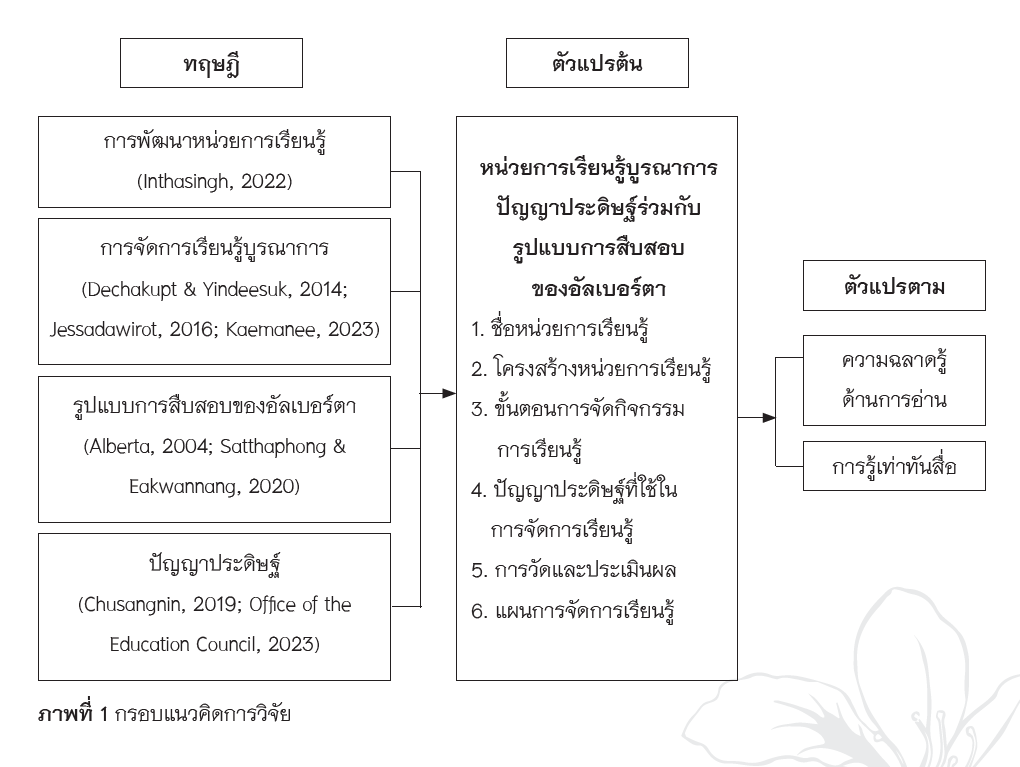
The results revealed the following: 1. The learning unit integrating artificial intelligence with Alberta's Inquiry Model to enhance the reading and media literacies of Grade 6 students consisted of the following components: 1.1 the name of the learning unit, 1.2 the structure of the learning unit, 1.3 learning activities, 1.4 artificial intelligence used in learning management, 1.5 learning measurement and evaluation, and 1.6 a learning management plan. Overall, the propriety level in the quality of the learning unit was at the highest level, with a mean of 4.57 and a standard deviation of 0.18 2. Students' reading literacy after studying with the learning unit integrating was at a very good level, with a mean of 21.80 and a standard deviation of 0.21. This represented 87.20 percent, which was higher than the criterion set of 80 percent at the .01 level of confidence. Finally, 3. Students' media literacy after studying with the learning unit integrating was at a very good level, with a mean of 4.37 and a standard deviation of 0.34. This represented 87.40 percent, which was higher than the criterion set of 80 percent at the .01 level of confidence.
Downloads
Article Details

This work is licensed under a Creative Commons Attribution-NonCommercial-NoDerivatives 4.0 International License.
The articles published are copyrighted by the Graduate School, Chiang Mai Rajabhat University.
The opinions expressed in each article of this academic journal are solely those of the individual authors and do not reflect the views of Chiang Mai Rajabhat University or its faculty members. The responsibility for the content of each article rests entirely with the respective authors. In the event of any errors, the authors alone are responsible for their own articles.
References
Alberta, L. (2004). Focus on inquiry: A teacher’s guide to implementing inquiry-based learning. Edmonton: Alberta Learning and Teaching Resources Branch.
Benjakul, S., & Vanichwatanavorachai, S. (2023). The development of the enrichment curriculum to enhance reading literacy for the student teachers in the Thai language program. Panyapiwat Journal, 15(3), 242–252. Retrieved from https://so05.tci-thaijo.org/index.php/pimjournal/article/view/262977 [in Thai]
Biggins, O. (2020). Media and Information Literacy. Suthiparithat Journal, 26(80), 147–162. Retrieved from https://so05.tci-thaijo.org/index.php/DPUSuthiparithatJournal/article/view/245654
British Broadcasting Corporation Thailand [BBC Thai]. (2023). Singaporean children rank 1st in the latest PISA exam, While Thai students face a crisis with the lowest scores in 20 years across all skills. Retrieved from https://www.bbc.com/thai/articles/c6prx0em6d6o [in Thai]
Bureau of Academic Affairs and Educational Standards. (2015). Training program for enhancing student quality to prepare for international assessments (PISA) “Reading Literacy”. Retrieved from http://www.dusitaram.ac.th/download/pisa_training/2_Reading/2-1_7.pdf [in Thai]
Child and Youth Media Institute. (2020). The indicators of individual media, information, and digital literacy to promote democratic citizenship. [in Thai]
Chusangnin, C. (2019). Artificial intelligence for learning. Retrieved from https://www.scimath.org/article-technology/item/10110-ai-10110 [in Thai]
Dechakupt, P. & Yindeesuk, P. (2014). Teach how to write an integrated plan based on child-centered approach. Bangkok: Chulalongkorn University Press. [in Thai]
Hongsai, T. (2019). Promoting critical thinking of early childhood children by using inquiry. Journal of Education Studies, 47(2), 83–102. Retrieved from https://so02.tci-thaijo.org/index.php/EDUCU/article/view/196045
Inthasingh, S. (2022). Educational institution curriculum management. Lampang: Kumnum Publishing. [in Thai]
Jessadawirot, S. (2016). Development of school curriculum. Bangkok: Ramkhamhaeng University. [in Thai]
Kaemanee, T. (2023). Science of teaching knowledge for effective learning process management. Bangkok: Chulalongkorn University Press. [in Thai]
Ministry of Education. (2010). Guidelines for learning assessment and evaluation based on the basic education core curriculum B.E. 2551. Retrieved from https://sgs.bopp-obec.info/ [in Thai]
Nagaoka, C. A. & Santawee K. (2019). The Factors Influencing Information and Digital Media Literacy of Youth in Bangkok. The Journal of Social Communication Innovation, 7(1), 55–64. Retrieved from https://so06.tci-thaijo.org/index.php/jcosci/article/view/199856
Office of the Education Council [OEC]. (2023). The study project on the application of artificial intelligence for developing reading skills of elementary school students. Retrieved from http://backoffice.onec.go.th/uploads/Book/2008-file.pdf [in Thai]
Potter, W. J. (2005). Media literacy (3rd ed.). California: Sage.
Saengsai, K. (2023). Artificial intelligence and educational development. Journal of Applied Education, 1(3), 49–60. Retrieved from https://so16.tci-thaijo.org/index.php/JAE/article/view/264 [in Thai]
Satthaphong, T. & Eakwannang, W. (2020). A development of reading literacy ability in accordance with the PISA test using by reading apprenticeship approach of lower secondary school students. Journal of Education Khon Kaen University, 43(1), 85-98. [in Thai]
Sootlek, K., & Deawwilai D. (2020). The development of curriculum to the development of curriculum to enchance Thai reading literacy for grade 6 students. ARU Research Journal Humanities and Social Sciences, 7(3), 33–40. Retrieved from https://so01.tci-thaijo.org/index.php/rdi-aru/article/view/240682 [in Thai]
Srisaard, B. (2013). Basic research (9th ed.). Bangkok: Suveeriyasarn. [in Thai]
The Institute for the Promotion of Teaching Science and Technology [IPST]. (2023). About PISA. Retrieved from https://pisathailand.ipst.ac.th/about-pisa/ [in Thai]
Wongchai, S. (2020). Learning management strategies for enhancing the reading literacy. Journal of Graduate School, 17(79), 1-10. [in Thai]
Wongyai, W. & Patpol, M. (2019). Creative integration. Bangkok: Innovative Leaders Center of Curriculum and Learning. [in Thai]
