
The Construction of Utopian and Dystopian Societies in Liu Cixin's the Three-Body Problem Trilogy: The Event of the Great War of Extinction
Article Sidebar
Main Article Content
Abstract
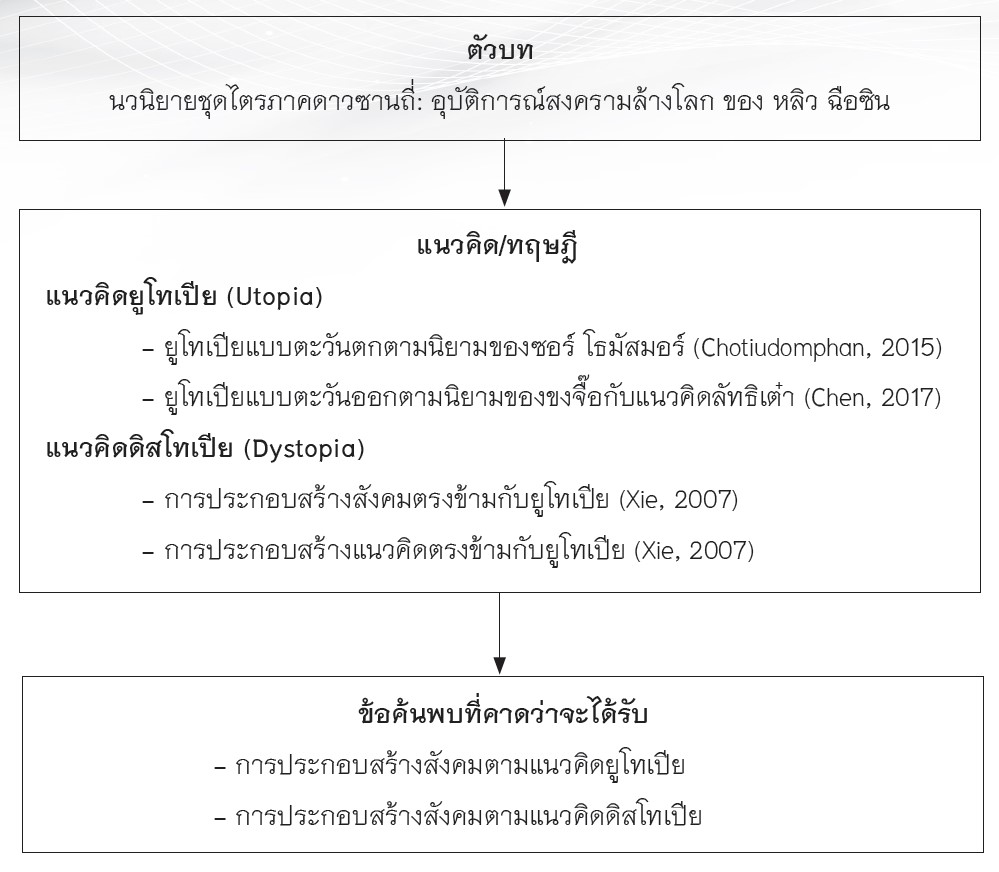
This article aimed to examine the construction of utopian and dystopian societies in the “Three-Body Problem” trilogy by Liu Cixin, using the concepts of Utopia and Dystopia as analytical frameworks. The study revealed that the trilogy constructed both utopian and dystopian societies across five key dimensions. The construction of the utopian society was explored in three aspects: 1) a rural utopia, which emphasized an agricultural society, 2) a political utopia, which promoted social equality and introduced feminist political ideologies, and 3) a utopia based on a reimagined universe. The construction of the dystopian society was analyzed in two aspects: 1) a dystopia rooted in human political systems, which portrayed a society driven by populism and political fanaticism, and 2) a dystopia based on the brutal mechanisms of the universe, where an immoral universe was presented, inhabited by highly advanced extraterrestrial beings who used sophisticated technology to invade and conquer Earth. In this context, humanity faced unprecedented violence and struggled for survival.
Downloads
Article Details

This work is licensed under a Creative Commons Attribution-NonCommercial-NoDerivatives 4.0 International License.
The articles published are copyrighted by the Graduate School, Chiang Mai Rajabhat University.
The opinions expressed in each article of this academic journal are solely those of the individual authors and do not reflect the views of Chiang Mai Rajabhat University or its faculty members. The responsibility for the content of each article rests entirely with the respective authors. In the event of any errors, the authors alone are responsible for their own articles.
References
Chen, Q. (2017). The ethical value of utopian spirit. Beijing: Chinese Academy of Social Sciences. [In Chinese]
Chotiudomphan, S. (2015). Origin and Influence of literature Utopia and Dystopia. Retrieved from https://prachatai.com/journal/2015/07/60233 [In Thai]
Du, W. and Yang, Z. (2016). I am Liu Cixin. Shanxi: Beiyue Literature and Art Publishing House. [In Chinese]
Kupratakul, C. (2011). Dimensions of translating imaginative Iiterature. Journal of Language and Culture, 30(1), 83-98. [In Thai]
Liu, C. (2015). The worst universe, the best earth. Chendu: Sichuan Science and Technology Publishing House. [In Chinese]
Liu, C. (2016). The three-body problem Volume 1. Bangkok: Post Books. [In Thai]
Liu, C. (2017a). The three-body problem Volume 2. Bangkok: Post Books. [In Thai]
Liu, C. (2017b). The three-body problem Volume 3. Bangkok: Post Books. [In Thai]
Liu, Q. (2016). A brief analysis of ecofeminism in the three-body problem. Jilin: Journal of Jilin Radio and Television University, 135(3), 97-98. [In Chinese]
Li, Z. (2016). The modern value of Confucian thought of Great Harmony. In The Third China-South Korea Confucianism Exchange Conference, (pp.264-276). (11-12 Aug 2016), Place of printing: The Shandong Academy of Social Sciences. [In Chinese]
More, T. Sir. (2022). Utopia. Beijing: The Commercial Press. [In Chinese]
Narkwatchara, P. and Ltimeechai, W. (2022). Science and Utopian ideas appearing in the Science Fiction story Nakorn loha nao. Journal of Humanities and Social Sciences Valaya Alongkorn under Royal Patronage, 17(2), 49-58. [In Thai]
Rakchat, K. and Ajchariyabodee, W. (2019). Characteristics concerning dystopian societies appeared in a short story collection book “Singtho Nokkhok”. In The 2nd National Academic Conference for Presentation of Research Results of Humanities and Social Science Students, (pp129-143) (19 Jan 2562Bangkok), Faculty of Humanities and Social Sciences, Suan Sunandha Rajabhat University. [In Thai]
Rakrian, P. (2014). From Dystopia to Utopia: The confrontation of capitalism and environmental ideologies in Kim Stanley Robinson’s Red Mars. Journal of Comparative Literature, 3(3), 19-31. [In Thai]
Sirichai, W. and Sangkhaphanthanon, T. (2023). Utopian and dystopian visions: The duality of nature and environment in Thai literature. Silpakorn Universitye-Journal, 41(5), 44-55. [In Thai]
Song, M. (2020). History, poetics, and text of Chinese science fiction literature. Shanghai: Shanghai Literature and Arts Publishing House. [In Chinese]
Virameteekul, J. and Na Ayutthaya, C. (2022). The study of setting and a fear reflection through Dystopian ideology film in early 21st century. Arch journal Issue, 34(1), 130-147. [In Thai]
Wu, Y. (2008). Science fiction literature theory and discipline system construction. Chongqing: Chongqing Publishing House. [In Chinese]
Xie, J. (2007). Philosophical study of Dystopian thought. Beijing: Chinese Academy of Social Sciences. [In Chinese]
Yang, C. (2016). From “The ultimate Utopia to the human in the universe” The Utopian characteristics of the three- body problem from a perspective of globalization. Beijing: Comparative Literature &World Literature. [In Chinese]
