
การประกอบสร้างสังคมยูโทเปียและสังคมดิสโทเปียในนวนิยายชุดไตรภาค ดาวซานถี่: อุบัติการณ์สงครามล้างโลก ของ หลิว ฉือซิน
Article Sidebar
Main Article Content
บทคัดย่อ
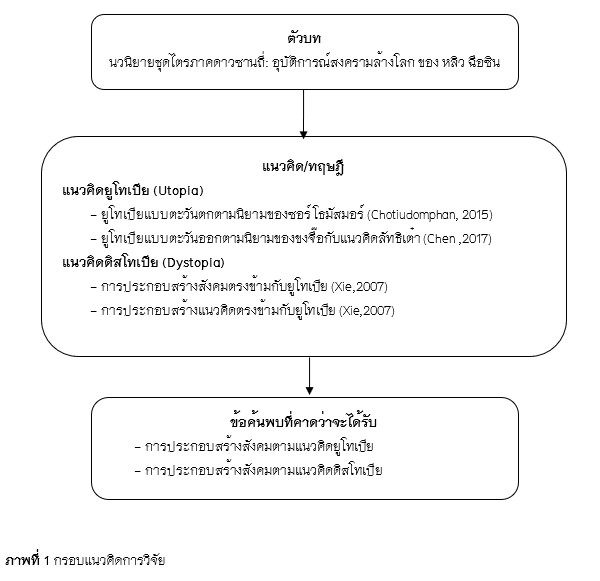
บทความนี้มีวัตถุประสงค์เพื่อศึกษาการประกอบสร้างสังคมยูโทเปียและสังคมดิสโทเปียในนวนิยายชุดไตรภาคดาวซานถี่: อุบัติการณ์สงครามล้างโลก ของ หลิว ฉือซิน เล่ม 1 ถึงเล่ม 3 แปลโดย เรืองชัย รักศรีอักษร สำนักพิมพ์บางกอกโพสต์ โดยใช้แนวคิดยูโทเปีย (Utopia) กับแนวคิดดิสโทเปีย (Dystopia) เป็นแนวทางการวิเคราะห์ตัวบท ผลการศึกษาพบว่า นวนิยายชุดไตรภาคนี้ประกอบสร้างสังคมยูโทเปียกับสังคมดิสโทเปีย รวม 5 ลักษณะ ซึ่งแบ่งเป็นการประกอบสร้างสังคมยูโทเปีย 3 ลักษณะ ได้แก่ 1) สังคมยูโทเปียตามนิยามความเป็นชนบท โดยนำเสนอชนบทที่เน้นเกษตรกรรม 2) สังคมยูโทเปียตามนิยามทางการเมือง โดยนำเสนอความเท่าเทียมทางสังคมและสร้างแนวคิดทางการเมืองในสังคมยูโทเปียแบบสตรีนิยม และ 3) สังคมยูโทเปียตามนิยามจินตนาการจักรวาล โดยนำเสนอจักรวาลที่เกิดขึ้นใหม่ตามจินตนาการ ส่วนการประกอบสร้างสังคมดิสโทเปีย แบ่งเป็น 2 ลักษณะ คือ 1) สังคมดิสโทเปียตามแนวทางการเมืองของโลกมนุษย์ โดยนำเสนอสังคมดิสโทเปียแบบคลั่งไคล้กับสังคมที่มีการปกครองเเบบประชานิยม (Populism) และ 2) สังคมดิสโทเปียตามระบบและกลไกของจักรวาลที่โหดร้าย โดยนำเสนอจักรวาลที่ไร้ศีลธรรม มีมนุษย์ต่างดาวที่มีศักยภาพสูงในจักรวาล ทั้งนี้มนุษย์ต่างดาวสามารถใช้เทคโนโลยีขั้นสูงเข้ามาโจมตีโลกมนุษย์และยึดครองโลกมนุษย์ได้ มนุษย์จึงต้องเผชิญกับสถานการณ์ความรุนแรงที่ไม่เคยปรากฏมาก่อนและต้องต่อสู้เพื่อความอยู่รอดของเผ่าพันธุ์
Downloads
Article Details

อนุญาตภายใต้เงื่อนไข Creative Commons Attribution-NonCommercial-NoDerivatives 4.0 International License.
บทความที่ได้รับการตีพิมพ์เป็นลิขสิทธิ์ของบัณฑิตวิทยาลัย มหาวิทยาลัยราชภัฎเชียงใหม่
ข้อความที่ปรากฏในบทความแต่ละเรื่องในวารสารวิชาการเล่มนี้เป็นความคิดเห็นส่วนตัวของผู้เขียนแต่ละท่านไม่เกี่ยวข้องกับมหาวิทยาลัยราชภัฎเชียงใหม่ และคณาจารย์ท่านอื่นๆ ในมหาวิทยาลัยฯ แต่อย่างใด ความรับผิดชอบองค์ประกอบทั้งหมดของบทความแต่ละเรื่องเป็นของผู้เขียนแต่ละท่าน หากมีความผิดพลาดใด ๆ ผู้เขียนแต่ละท่านจะรับผิดชอบบทความของตนเองแต่ผู้เดียว
เอกสารอ้างอิง
Chen, Q. (2017). The ethical value of utopian spirit. Beijing: Chinese Academy of Social Sciences. [In Chinese]
Chotiudomphan, S. (2015). Origin and Influence of literature Utopia and Dystopia. Retrieved from https://prachatai.com/journal/2015/07/60233 [In Thai]
Du, W. and Yang, Z. (2016). I am Liu Cixin. Shanxi: Beiyue Literature and Art Publishing House. [In Chinese]
Kupratakul, C. (2011). Dimensions of translating imaginative Iiterature. Journal of Language and Culture, 30(1), 83-98. [In Thai]
Liu, C. (2015). The worst universe, the best earth. Chendu: Sichuan Science and Technology Publishing House. [In Chinese]
Liu, C. (2016). The three-body problem Volume 1. Bangkok: Post Books. [In Thai]
Liu, C. (2017a). The three-body problem Volume 2. Bangkok: Post Books. [In Thai]
Liu, C. (2017b). The three-body problem Volume 3. Bangkok: Post Books. [In Thai]
Liu, Q. (2016). A brief analysis of ecofeminism in the three-body problem. Jilin: Journal of Jilin Radio and Television University, 135(3), 97-98. [In Chinese]
Li, Z. (2016). The modern value of Confucian thought of Great Harmony. In The Third China-South Korea Confucianism Exchange Conference, (pp.264-276). (11-12 Aug 2016), Place of printing: The Shandong Academy of Social Sciences. [In Chinese]
More, T. Sir. (2022). Utopia. Beijing: The Commercial Press. [In Chinese]
Narkwatchara, P. and Ltimeechai, W. (2022). Science and Utopian ideas appearing in the Science Fiction story Nakorn loha nao. Journal of Humanities and Social Sciences Valaya Alongkorn under Royal Patronage, 17(2), 49-58. [In Thai]
Rakchat, K. and Ajchariyabodee, W. (2019). Characteristics concerning dystopian societies appeared in a short story collection book “Singtho Nokkhok”. In The 2nd National Academic Conference for Presentation of Research Results of Humanities and Social Science Students, (pp129-143) (19 Jan 2562Bangkok), Faculty of Humanities and Social Sciences, Suan Sunandha Rajabhat University. [In Thai]
Rakrian, P. (2014). From Dystopia to Utopia: The confrontation of capitalism and environmental ideologies in Kim Stanley Robinson’s Red Mars. Journal of Comparative Literature, 3(3), 19-31. [In Thai]
Sirichai, W. and Sangkhaphanthanon, T. (2023). Utopian and dystopian visions: The duality of nature and environment in Thai literature. Silpakorn Universitye-Journal, 41(5), 44-55. [In Thai]
Song, M. (2020). History, poetics, and text of Chinese science fiction literature. Shanghai: Shanghai Literature and Arts Publishing House. [In Chinese]
Virameteekul, J. and Na Ayutthaya, C. (2022). The study of setting and a fear reflection through Dystopian ideology film in early 21st century. Arch journal Issue, 34(1), 130-147. [In Thai]
Wu, Y. (2008). Science fiction literature theory and discipline system construction. Chongqing: Chongqing Publishing House. [In Chinese]
Xie, J. (2007). Philosophical study of Dystopian thought. Beijing: Chinese Academy of Social Sciences. [In Chinese]
Yang, C. (2016). From “The ultimate Utopia to the human in the universe” The Utopian characteristics of the three- body problem from a perspective of globalization. Beijing: Comparative Literature &World Literature. [In Chinese]
