
Chinese Language in the Context of Thai Society: The Transition from Cultural Heritage to Economic Instrument
Article Sidebar
Main Article Content
Abstract
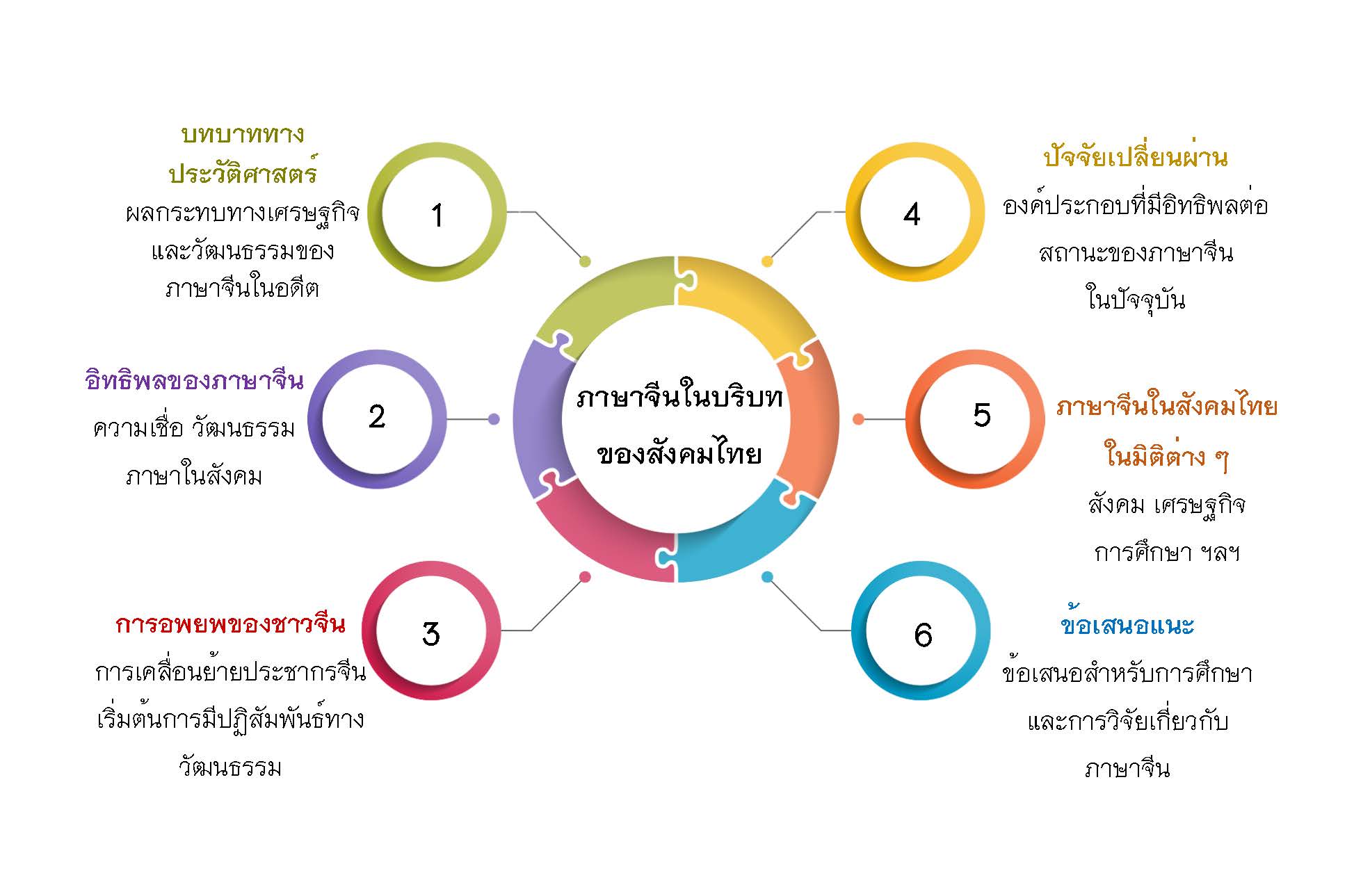
This academic article analyzed the role of the Chinese language in Thai society from the past to the present, highlighting significant changes in its status and value across various dimensions. In the past, Chinese played a crucial role as the living language of the Thai-Chinese community, being used in trade, family communication, rituals, and cultural transmission. However, its role was diminished during certain periods due to cultural assimilation. In the 21st century, as China becomes an economic, political, and cultural superpower, the Chinese language has regained attention and acceptance in Thai society. At present, Chinese is no longer viewed merely as an ethnic language but as a universal language that promotes economic and professional opportunities in various fields, including education, the tourism industry, international trade, and employment in foreign companies. Chinese also plays a role as cultural capital that reflects the identity of the modern new generation. The continuous expansion of Chinese language learning at all educational levels, along with the widespread popularity of the HSK proficiency test, represents the transformation of its status from an ethnic language to a universal language that aligns with the current Thai economic and social systems.
The analysis also pointed to the inequality of opportunities in accessing Chinese language education, which was often limited to those with social and economic capital. Furthermore, Chinese was argued not to be viewed solely in terms of its communicative use or economic value, but to be understood as valuable social and cultural capital in itself. Therefore, the study recommended that Chinese language learning be promoted widely, equitably, and coupled with cross-cultural learning to ensure it becomes a profound cultural heritage passed down sustainably to future generations.
Downloads
Article Details

This work is licensed under a Creative Commons Attribution-NonCommercial-NoDerivatives 4.0 International License.
The articles published are copyrighted by the Graduate School, Chiang Mai Rajabhat University.
The opinions expressed in each article of this academic journal are solely those of the individual authors and do not reflect the views of Chiang Mai Rajabhat University or its faculty members. The responsibility for the content of each article rests entirely with the respective authors. In the event of any errors, the authors alone are responsible for their own articles.
References
Asia Society Policy Institute. (2022). Balancing act: Assessing China’s growing economic influence in ASEAN. Retrieved from https://asiasociety.org/policy-institute/balancing-act-assessing-chinas-growing-economic-influence-asean
Baker, C. & Phongpaichit, P. (2017). A history of Thailand. (3rd ed.). Cambridge, United Kingdom: Cambridge University Press.
Bourdieu, P. (1986). The forms of capital. In J. G. Richardson (Ed.), Handbook of theory and research for the sociology of education (pp. 241–258). Westport, CT: Greenwood Press.
Buaphuan, N. (2017). Cultural heritage and language transmission of Thai Chinese in Doi Mae Salong, Chiang Rai Province. Dusit Thani College Journal, 11(3), 282–295. Retrieved from https://so01.tci-thaijo.org/index.php/journaldtc/article/view/118677 [In Thai]
Chantharonanon, P. (2025). Where did the Chinese in Thailand come from? Tracing the history of early migration to cultural integration. Silpa-mag. Retrieved from https://www.silpa-mag.com/history/article_26173 [In Thai]
Editorial Board. (2019). The Chinese and the founding of Bangkok. Retrieved from https://www.muangboranjournal.com/post/The-Chinese-and-the-founding-of-Bangkok [In Thai]
Edwards, J. (2009). Language and identity. Cambridge, United Kingdom: Cambridge University Press.
Embree, J. (1950). Thailand: A loosely structured social system. American Anthropologist, 52, 181–193. https://doi.org/10.1525/AA.1950.52.2.02A00030
Fan, A. & Pianchana, T. (2024). A study on Chinese language learning motivation of Thai high school students based on self-determination theory. The EUrASEANs: Journal on Global Socio-Economic Dynamics, 3(46), 296–305. https://doi.org/10.35678/2539-5645.3(46).2024.295-305
Giles, H. & Johnson, P. (1987). Ethnolinguistics: A social psychological perspective. In J. C. Turner (Ed.), The social psychology of ethnic relations (pp. 199–229). Pergamon.
GoEast Mandarin. (n.d.). Official website of GoEast Mandarin. Retrieved from https://goeastmandarin.com/resources/
Jaiuea, M., Jaiuea, P., & Singhasena, P. (2023). The learning model of Chinese communication for cultural tourism of community enterprise in Chinese community, Tha Uthen District, Nakhon Phanom Province. Journal of Education MCU, 11(2), 459–471. Retrieved from https://so02.tci-thaijo.org/index.php/jemri/ article/view/276173 [In Thai]
Kasikorn Research Center. (2025, January 24). Chinese tourists to Thailand expected to reach 7 million due to slow Chinese economy and high tourism competition. Retrieved from https://www.kasikornresearch.com/th/analysis/k-social-media/Pages/Ch-Tourism-CIS3553-FB-2025-01-24.aspx [In Thai]
Ketngam, T. (2018). An assessment of the benefits of foreign language proficiency to Thai employees in selected business firms in Rayong Province Thailand. (Master’s thesis, Thammasat University). Retrieved from https://ethesisarchive.library.tu.ac.th/thesis/2018/TU_2018_5827040154_9584_9431.pdf?utm_source=
Laomanacharoen, S. (2021). Ayutthaya–China trade in the late Ayutthaya period. Matichon Weekly. Retrieved from https://www.matichon.co.th/weekly/column/article_390459 [In Thai]
Lavnikov, O., Leshchenko, H., Maksymenko, L., Stanishovskyi, A., Vovchasta, N., & Sheliukh, O. (2021). Formation of the future translators individual style. AD ALTA: Journal of Interdisciplinary Research, 11, 6-11. https://doi.org/10.33543/110222611
Lertpusit, S. (2023). From laissez-faire to restriction to cooperation: A history of Thai responses to China’s influence on Thai Chinese education. ISEAS–Yusof Ishak Institute. Retrieved from https://www.iseas.edu.sg/articles-commentaries/iseas-perspective/2023-21-from-laissez-faire-to-restriction-to-cooperation-a-history-of-thai-responses-to-chinas-influence-on-thai-chinese-education-by-sivarin-lertpusit/
LingoAce. (n.d.). Online Chinese and English learning platform, anytime, anywhere. Retrieved from https://www.lingoace.com/th/ [In Thai]
Liu, Q., Chaiprasert, J., & Kerdkaew, T. (2025). Interpretations, beliefs and wisdom of the Taoist talismans in People’s Republic of China. Journal of Educational Management and Research Innovation, 7(2), 276–289. Retrieved from https://so02.tci-thaijo.org/index.php/jemri/article/download/276173/184550/1214431 [In Thai]
Ma, C., Bunkrong, D., & Gao, C. (2025). The Mandarin advantage: How Thai university students are facilitating cross-border E-commerce for Chinese tourists in Thailand's post-COVID recovering hospitality sector. Cogent Arts & Humanities, 12(1), Article 2482316. https://doi.org/10.1080/23311983.2025.2482316
Mahattanobon, W. (2012). Sino-Siamese Chinese words: A reflection of Thai-Chinese interaction. Bangkok: Amarin Printing and Publishing. [In Thai]
Ministry of Education, Thailand. (2018). Chinese language classroom project, academic year 2018. Retrieved from https://www.moe.go.th/ห้องเรียนภาษาจีน-3/ [In Thai]
Ministry of Tourism & Sport. (2023). Tourism receipts from international tourist arrivals January - december 2023. Retrieved from https://www.mots.go.th/images/v2022_1737615940019VE9VUklTTSBSRUNFSVBUUyBGUk9NIElOVEVSTkFUSU9OQUwgVE9VUklTVCBBUlJJVkFMUyAyMDIzIChXZWIpLnhsc3g=.xlsx [In Thai]
Ministry of Tourism & Sport. (2024). International Tourist Arrivals to Thailand Jan - Nov 2024. Retrieved from https://www.mots.go.th/news/category/759 [In Thai]
Mongkolpanich, P. & Khemcharoen, C. (2025). Chinese identity and the consciousness of Thai Chinese people today. Thammasat Journal, 44(2), 34–52. Retrieved from https://so05.tci-thaijo.org/index.php/tujo/article/view/282540 [In Thai]
Niphatsukkit, W. (2019). Economic roles of Chinese in Thailand from Ayutthaya to King Rama V. Silpakorn University Journal of Arts, 41(2), 246–262. Retrieved from https://so04.tci-thaijo.org/index.php/jasu/ article/view/229862/156448 [In Thai]
Office of the Permanent Secretary, Ministry of Education. (2022). Educational statistics, academic year 2021. Information and Communication Technology Center, Office of the Permanent Secretary, Ministry of Education. [In Thai]
Insaard, O. (2020). The maintenance of the Chinese identity and collective memory from Teochiu Chinese opera literature in Thailand. Journal of Humanities and Social Sciences (HUSOKKU), 37(2), 258–278. Retrieved from https://so01.tci-thaijo.org/index.php/HUSO/article/view/206887 [In Thai]
Pasona Thailand. (n.d.). Compilation of trending occupations when China heavily invests in Thailand. Retrieved from https://pasona.co.th/work/pasona-co-th-news-articles-%E0%B9%80%E0%B8%97%E0%B8%A3%E0%B8%99%E0%B8%94%E0%B9%8C%E0%B8%AD%E0%B8%B2%E0%B8%8A%E0%B8%B5%E0%B8%9E%E0%B8%A1%E0%B8%B2%E0%B9%81%E0%B8%A3%E0%B8%87%E0%B8%AB%E0%B8%B2%E0%B8%81/ [In Thai]
Piyasatit, P. (2021). An analysis of the needs of persons with Chinese proficiency in the Thai labor market through online information. Journal of Library and Information Science, Srinakharinwirot University, 14(2), 35-47. Retrieved from https://so02.tci-thaijo.org/index.php/ JLIS_SWU/article/view/250919 [In Thai]
Public Relations Department. (2025, July 15). Chinese language – key to Asian economy. Retrieved from https://www.prd.go.th/th/content/category/detail/id/31/iid/405597 [In Thai]
Qin, D., Keawsuwan, C., & Thaveewatanaseth, N. (2024). A study on cultural and regulatory issues to develop Chinese for airline business textbooks in Thai higher education institutions. Ganesha Journal, 20(2), 137–152. Retrieved from https://so01.tci-thaijo.org/index.php/pikanasan/article/view/274073 [In Thai]
The Matter. (2025, March 10). Chinese language newspapers in Thailand: Their survival and adaptation. Retrieved from https://thematter.co/social/chinese-newspaper-in-thailand/239590
Sitthichokstit, K., Han, X., & Suniphan, T. (2024). Chinese loan words in Thai and changes in meaning. Aksornphiboon Journal, 5(2), 61–76. Retrieved from https://so02.tci-thaijo.org/index.php/APBJ/issue/view/17866 [In Thai]
Skinner, G. W. (1957). Chinese society in Thailand: An analytical history. Ithaca, NY: Cornell University Press.
Thai China Education Service Center. (2025). Scholarships to study in China for Thai students 2025: Latest updates!. Thai China Education Service Center. Retrieved from https://www.tcesc.org/%E0%B8%97%E0%B8%B8%E0%B8%99%E0%B9%80%E0%B8%A3%E0%B8%B5%E0%B8%A2%E0%B8%99%E0%B8%95%E0%B9%88%E0%B8%AD%E0%B8%88%E0%B8%B5%E0%B8%99-%E0%B9%80%E0%B8%A3%E0%B8%B5%E0%B8%A2%E0%B8%99%E0%B 8%95%E0%B9%88%E0%B8%AD/?utm_source= [In Thai]
Wang, H. & Hu, W. (2025). The impact of Mandarin proficiency on Thai labor force. Proceedings of the International Conference on Informatization Economic Development and Management, 1–6. Atlantis Press. Retrieved from https://www.atlantis-press.com/proceedings/icbbem-25/126011844?utm_source=
Wu, Y. & Li, Q. (2023). Research on the development of Chinese teaching resources in Thailand. Language Testing in Asia, 13(1), 1–28. Retrieved from https://www.researchgate.net/publication/373234116_Research_on_the_Development_of_Chinese_Teaching_Resources_in_Thailand
