
The Images of Chinese Intellectuals in the Early 20Th Century from Lu Hsun's Short Stories
Article Sidebar
Main Article Content
Abstract
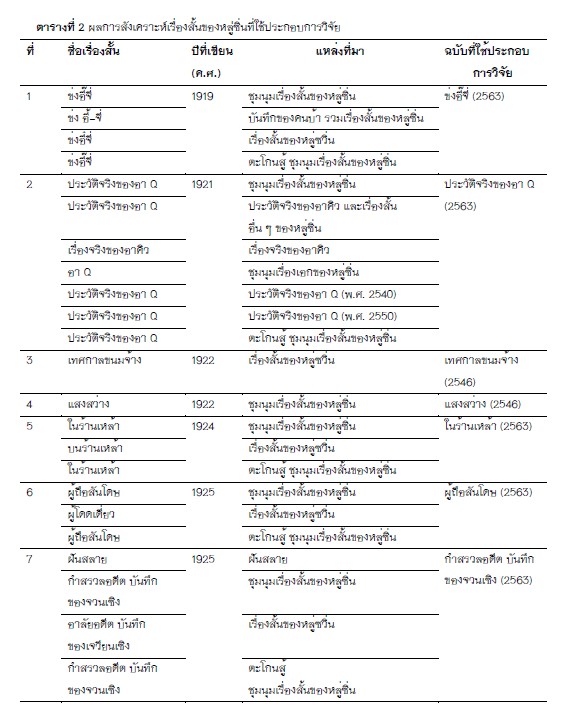
This research aimed to study the images of Chinese intellectuals in the early 20th century from seven short stories by Lu Hsun, using the concept of “Art for Life's Sake” and the concept concerning the relationship between literature and society as analytical frameworks. The research results were divided into two main issues: the images of Chinese intellectuals who had received feudal education found in two short stories, and the images of Chinese intellectuals who had received Western education found in five short stories. Characters representing Chinese intellectuals who had received feudal education included Kung I-chi in “Kung I-chi” and Chen Shi-cheng in “The white light.” Common characteristics of this group were proficiency only in memorizing texts and books and a lack of skills in dealing with life's storms. However, this group of intellectuals had a love for learning, the dignity of being scholars, and extraordinary patience and endurance. Meanwhile, Chinese intellectuals who had received Western education were divided into two subgroups: the group supporting the reactionary government, consisting of the “Imitation Foreign Devil” in “The true story of Ah Q,” Fang Xuan-chao in “The double fifth festival,” and Wei Lien-shu in “The Misanthrope.” Their common characteristics were being half-hearted, selfish, opportunistic, boastful, and bullying toward those weaker than themselves. As for the intellectuals who stood alongside the people, they consisted of Shih Chuan-sheng in “Regret for the Past” and Lu Wei-fu in “In the wineshop.” This group made efforts to solve problems and obstacles in their livelihood while trying to start new lives despite facing various failures.
Downloads
Article Details

This work is licensed under a Creative Commons Attribution-NonCommercial-NoDerivatives 4.0 International License.
The articles published are copyrighted by the Graduate School, Chiang Mai Rajabhat University.
The opinions expressed in each article of this academic journal are solely those of the individual authors and do not reflect the views of Chiang Mai Rajabhat University or its faculty members. The responsibility for the content of each article rests entirely with the respective authors. In the event of any errors, the authors alone are responsible for their own articles.
References
Boonkhachorn, T. (1999). Novels and Thai society 1932-1957. (2nd ed.). Bangkok: Faculty of Arts Textbooks Projects, Chulalongkorn University. [In Thai]
Boonwas, N. (2000). Lu Xun’s views of Chinese society through his literary works. (Master’s thesis, History, Thammasat University). [In Thai]
Columbia University. (n.d.). China - timeline of historical periods. Retrieved from https://afe.easia.columbia.edu/timelines/china_timeline.htm#annotated-outline
Eoseewong, N. (2012). Pen and Sail: Literature and history in early Bangkok. Nonthaburi: Same Sky Books. [In Thai]
Gu, M. D. (2021). Lu Xun and modern Chinese literature in the context of world literature. Journal of Modern Literature, 44(2), 76-92.
Kalkaew, C. (n.d.). Zhou Shuren. Bangkok: Centre Publications. [In Thai]
Kittinorarat, J. & Acherayawathana, O. (2024). Sampling in research: Principles, methods, and applications. Journal of Innovation in Administration and Educational Management, 2(1), 39-55. [In Thai]
Khamriang, P. (1980). Lu Hsun and the historical periods of China. In “Wild Grass” (pp. 109-201). Bangkok: Kaopai. [In Thai]
Hsun, L. (2003). The short stories of Lu Hsun. Bangkok: Chumsilp Thammada. [In Thai]
Hsun, L. (2020). Call to arms, a collection of Lu Hsun’s short stories. (2nd ed.). Bangkok: Thai Quality Books (2006). [In Thai]
Hucker, C. O. (n.d.). History of China. Retrieved from https://www.britannica.com/topic/history-of-China
Meilan, W. & Hang, T. T. (2024). The study of beliefs in the naming of ancient Chinese wines. Journal of Humanities and Social Sciences Uttaradit Rajabhat University, 11(1), 27-44. [In Thai]
Pinthong, T. (2021). Literature and Thai society. (6th ed). Bangkok: Ramkhamhaeng University. [In Thai]
Rene, W. & Warren, A. (1971). Theory of literature. (9th ed.). New York: Hawest Book, Brances & Warld, Inc.
Taweepwora (Taweep Woradilok). (2000). Lu Hsun: The master of modern Chinese literature. In Lu Hsun’s poetry anthology (pp. 8-98). Bangkok: Sukkhapabjai. [In Thai]
Theepakorn (Chit Phumisak). (2023). Art for life's sake, art for people’s sake. (9th ed.). Bangkok: Thai Quality Books (2006). [In Thai]
Triasanawadee, S. (2001). A comparative study of the translated versions of Lu Xun's A-Q zheng zhuan. (Master’s thesis, Chinese section, Chulalongkorn University). [In Thai]
Siangjong, P. (2014). Personality disorders of characters in Chinese literature during the new culture movement (1918-1924). Journal of the Faculty of Arts, Silpakorn University, 36(2), 179-203. [In Thai]
Yu, G. (2019). A brief introduction to Lu Xun and his short stories. US-China Foreign Language, 17(8), 386-392.
