
Thai Language and Culture in the Folk Game "Wao" (Kite) for Chinese Learners of Thai as a Foreign Language
Article Sidebar
Main Article Content
Abstract
This research aimed to analyze the linguistic and cultural values embedded in the traditional Thai folk game “kite” for Chinese learners of Thai as a Foreign Language. The study employed content analysis and utilized Moran’s (2001) 3Ps of Culture as the conceptual framework. The data were collected from seven documentary sources: (1) University Thai Reading Course (Part I), (2) Thailand Only: Unique Thai Stories, (3) Thai Wisdom Sports: A National Cultural Heritage, (4) Thai Encyclopedia for Youth, Learning Supplement Edition, Volume 37, (5) Encyclopedia of Thai Culture, Central Region, Volume 13, (6) Thai Proverbs, Sayings, and Idioms by the Royal Institute, and (7) Royal Institute Dictionary, B.E. 2554 (2011). In addition, fieldwork was conducted to observe and participate in kite flying in an authentic cultural context.
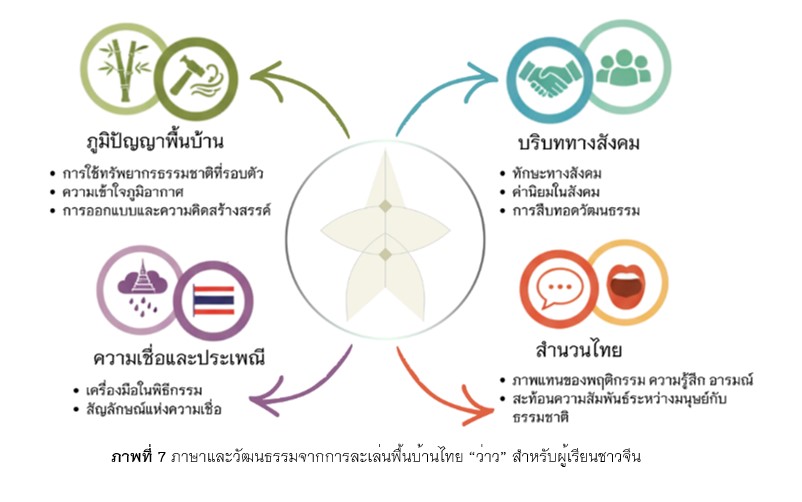
The research findings revealed that the kite reflected four key aspects of linguistic and cultural values: (1) local wisdom, (2) social context, (3) beliefs and traditions, and (4) Thai idiomatic expressions. The study also identified several limitations in learning this topic among Chinese learners of Thai, including insufficient depth of cultural content, incomplete lesson components, teacher-centered instructional approaches that limited learner engagement, and a lack of connection to real-life language use. Based on these findings, the study proposed guidelines for incorporating the kite folk game into Thai language instruction for Chinese learners in two main aspects: (1) learning models, emphasizing active learning and the integration of social skills development; and (2) learning media formats, recommending the development of creative and contemporary instructional materials that integrated linguistic and cultural knowledge in a holistic manner.
Downloads
Article Details

This work is licensed under a Creative Commons Attribution-NonCommercial-NoDerivatives 4.0 International License.
The articles published are copyrighted by the Graduate School, Chiang Mai Rajabhat University.
The opinions expressed in each article of this academic journal are solely those of the individual authors and do not reflect the views of Chiang Mai Rajabhat University or its faculty members. The responsibility for the content of each article rests entirely with the respective authors. In the event of any errors, the authors alone are responsible for their own articles.
References
Athikiet, K. (2017). Learning activities in Thai teaching: CTH 3109 (TL 316) (2nd ed.). Ramkhamhaeng University. [In Thai]
Department of Cultural Promotion. (2016). Thai wisdom sports: National intangible cultural heritage. Printing Affairs Office, War Veterans Organization of Thailand Under the Royal Patronage. [In Thai]
Department of Cultural Promotion. (2017). Knowledge and practices concerning nature and the universe: National intangible cultural heritage. Veterans Organization Printing Office. [In Thai]
Intakaew, S., Aditphatnan, N., & Maneekul, J. (2017). The use of group competition games to promote English grammar knowledge, English speaking ability, and social skills of Grade 7 students. Ganesha Journal, 10(1), 101–112. https://so01.tci-thaijo.org/index.php/pikanasan/article/view/97683 [In Thai]
Komaratat, C. (2011). Central Thai traditional sports: Study and analysis of origin, rules, and values (2nd ed.). Sataporn Books. [In Thai]
Krippendorff, K. (2019). Content analysis: An introduction to its methodology (4th ed.). Sage Publications.
Laohapensang, J. (2014). A study of methodology for integrate cultural capital with design education curriculum at higher education level. Journal of Industrial Education, 13(3), 91–98. https://ph01.tci-thaijo.org/index.php/JIE/article/view/126758 [In Thai]
Moran, P. R. (2001). Teaching culture: Perspectives in practice. Heinle & Heinle.
Miller, R. (2007). The holistic curriculum (2nd ed.). Toronto, Canada: University of Toronto Press.
Malayaporn, S. (2022). Electronic supplementary reader: “Thai dishes registered as national intangible cultural heritage” for Vietnamese students [Master’s thesis, Srinakharinwirot University]. http://ir-ithesis.swu.ac.th/dspace/handle/123456789/2188 [In Thai]
Phattarachai, S. (1999). “Kites: Play.” In Thai cultural encyclopedia: Central region (Vol. 13, pp. 6082–6087). Thailand Cultural Encyclopedia Foundation, Siam Commercial Bank. [In Thai]
Phothiyen, K. (2021). Active learning: Learning to satisfy education in the 21st century. Journal of Education, Silpakorn University, 19(1), 216–230. https://so02.tci-thaijo.org/index.php/suedujournal/article/view/245317 [In Thai]
Sukchit, P. (2005). Kites. In The Thai Junior Encyclopedia by Royal Command: Learning enhancement edition (Vol. 37, pp. 115–151). The Thai Junior Encyclopedia Project. [In Thai]
Sombat, K., & Mahavarakorn, S. (2022). Mae Chaem woven textile: Intangible cultural heritage and knowledge management toward Thai as a foreign language in active learning concept. Community and Social Development Journal, 23(1), 37–53. https://doi.org/10.14456/rcmrj.2022.251807 [In Thai]
Su, W. (2023). Supplementary reader on Thai chili pastes registered as national intangible cultural heritage for Chinese students [Master’s thesis, Srinakharinwirot University]. http://ir-ithesis.swu.ac.th/dspace/handle/123456789/2719 [In Thai]
The Royal Institute. (2013). Royal Institute dictionary B.E. 2554 (2nd ed.). The Royal Institute. [In Thai]
The Royal Institute. (2015). Thai proverbs, sayings, and idioms: Royal Institute edition (16th ed.). The Royal Institute. [In Thai]
Wetin, C. & Phakin, L. (2015). Thailand only: These things exist only in Thailand. Amarin. [In Thai]
Yang, C. (2024). Exploring pathways of “cultural exchange and mutual learning” in university Thai-language teaching. Journal of Jiamusi Vocational Institute, 40(6), 61–63. http://dehzz.com/qk-2-829-5-26845 [In Chinese]
You, H. (2009). University Thai reading course (Part I). Chongqing University. [In Chinese]
