
The Study of Ritual Procedures and Beliefs Related to Marriage Among Thais of Hakka-Chinese Descent in Hat Yai District, Songkhla Province
Article Sidebar
Main Article Content
Abstract
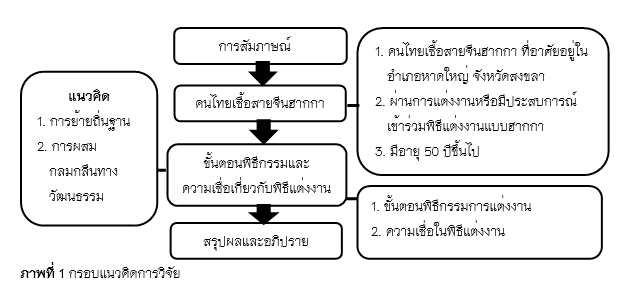
Wedding of Thai people of Hakka-Chinese descent is an overseas Chinese tradition that reflects their culture and beliefs. The objective of this research was to study the changes in ritual practices and beliefs of Thai people of Hakka-Chinese descent, who are part of the overseas Chinese community living in Hat Yai District, Songkhla Province. This study employed the concepts of migration and cultural assimilation and was conducted using purposive sampling. The informants were Hakka-Chinese residents of Hat Yai aged over 50 who had experience attending Hakka-style wedding ceremony. Semi-structured in-depth interviews and content analysis revealed that there were 15 procedures in the wedding ritual: 1. arranging a matchmaker, 2. checking astrological compatibility, 3. assessing the living conditions of the groom’s family, 4. arranging the wedding proposal ceremony, 5. organizing the wedding procession to the bride’s house, 6. proceeding to the bride’s house, 7. giving the dowry, 8. exchanging engagement rings, 9. escorting the bride from her house, 10. arriving at the groom’s house, 11. worshipping the ancestors, 12. eating glutinous rice balls and boiled eggs, 13. holding the tea offering ceremony, 14. holding the wedding banquet, and 15. entering the bridal chamber. Additionally, the study also revealed three main aspects of beliefs related to marriage: 1. numerology, 2. foods and fruits, and 3. ritual items. Although Hakka-style weddings in Hat Yai still follow traditional Hakka customs, cultural differences exist. The passage of time and the local economy have led to cultural integration and a reduction in the number of wedding ritual steps for the couple’s convenience in arrangement, as well as suitable timing. This study reflects that migration and cultural integration have influenced the transmission and transformation of cultural traditions. However, Thai people of Hakka-Chinese descent continue to preserve their original identity while adapting to contemporary wedding customs.
Downloads
Article Details

This work is licensed under a Creative Commons Attribution-NonCommercial-NoDerivatives 4.0 International License.
The articles published are copyrighted by the Graduate School, Chiang Mai Rajabhat University.
The opinions expressed in each article of this academic journal are solely those of the individual authors and do not reflect the views of Chiang Mai Rajabhat University or its faculty members. The responsibility for the content of each article rests entirely with the respective authors. In the event of any errors, the authors alone are responsible for their own articles.
References
Amornwanitsak, S. (2024). Thai-Chinese relations: A study of cultural acceptance and assimilation. Chinese studies Journal Kasetsart University, 17(2), 14-15. https://so01.tci-thaijo.org/index.php/CSJ/article/view/276923 [In thai]
Burutphat, K. (1975). People of hills. Phrae Pittaya Publishing.
Chotikasemsi, S. (2012). Traditions, culture, beliefs, and the Khanmak procession in marriage proposals of Songkhla residents. Journal of Cultural Approach, 13(24), 3-15. https://so02.tci-thaijo.org/index.php/cultural_approach/article/view/3451 [in thai]
Chumchit, T., & Plengdisakul, B. (2017). Factors affecting changes in beliefs in The Yao Liang Phi Ritual of the P Hu Thai people in Kunwa Sub-district, Kuchinarai District, Kalasin Province. Journal of Fine and Applied Arts, Khon Kaen University, 9(2), 123-148. https://so02.tci-thaijo.org/index.php/fakku/article/view/113917 [In Thai]
Dongsombat, S., Meethaisong, T., And Bangperg, K. (2019). Adaptation to the change in the culture and belief of the community of Tamyae Village Khaen Sub-district, Wapi Pathum District, Maha Sarakham Province. KKU International Journal of Humanities and Social Sciences, 9(3), 146-161. https://so04.tci-thaijo.org/index.php/KKUIJ/article/view/209670/158163 [In thai]
Kasetsiri, C. (Ed.). (2005). Chinese society in Thailand: An analytical history (2nded.). The Foundation for The Promotion of Social Science and Humanities Textbooks. [In Thai]
Lee, E. S. (1966). A theory of migration. Demography, 3(1), 47-57. https://www.jstor.org/stable/206006
Ma, G. (2021). Development Network Construction of Hakka People in Southern Thailand. Rusamilae Journal, 42(2), 6-36. https://so05.tci-thaijo.org/index.php/rusamelae/article/view/254212/172351 [In thai]
Mahattanobol, W. (2005). Hakka Is “Hakka”: Is “Chinese-Khae”. (2nded.). Matichon Publishing. [In Thai]
Malasri, T. (2019). The comparison of love and marriage attitude from Thai and Chinese proverbs. KKU Research Journal of Humanities and Social Sciences (Graduate Studies), 7(2), 136-137. https://so04.tci-thaijo.org/index.php/gskkuhs/article/view/206778 [In Thai]
Na Kotapura, P.R. (2018). The symbolism of fish in Theravada Buddhism. Panidhana Journal, 11(1), 37-56. https://so05.tci-thaijo.org/index.php/panidhana/article/view/148167/109184 [In Thai]
Phichetphan, C., & Phichetphan, S. (2017). Kon Khae (Not Khae) Hakka Ngin. First Offset (1993) Co., Ltd. [In Thai]
Poshakrishna, P. (2025). Dowry and Thai society. Journal Of MCU Haripunchai Review, 9(2), 613-623. https://so04.tci-thaijo.org/index.php/JMHR/article/view/aaa-044/aaa-044 [In Thai]
Saleh, M., Saesen, W., Somlok, A., Phuangrod, K., And Kitiwinit, S. (2024). Components and structures of Thai food naming and cultural identity of Thai-Chinese Hakka people in Betong District, Yala Province. Journal of Language, Religion and Culture, 13(2), 102-138. https://so03.tci-thaijo.org/index.php/gshskku/article/view/279024 [In Thai]
Satsanguan, N. (1999). Principles of cultural anthropology. (4thed.). Rammakarn Printing Co., Ltd. [In Thai]
Siripaisarn, S. & Kanchanadit, A. (2009). Rituals and beliefs of Chinese Thai in Songkhla Basin from past to present. Journal of Humanities and Social Sciences Thaksin University, 4(1), 97-124. https://kb.psu.ac.th/server/api/core/bitstreams/3c95af1f-c57e-47cc-8c9a-61a30413f8cf/content [In Thai]
Siripaisarn, S., Kanchanadit, A., Narksaithong, P., And Thongdee, S. (2006). Social And Cultural Change of Chinese Population in Hat Yai City from The Past to The Present. Thaksin Journal, 9(2), 43-54. https://ph02.tci-thaijo.org/index.php/tsujournal/article/view/69005/56180 [In Thai]
Sukprasert, W. (2017). Legal Status of Sin-Sod (Bride Price) In Thai Law [Master Thesis, Thammasat University]. http://ethesisarchive.library.tu.ac.th/thesis/2017/TU_2017_5701031048_9174_9126.pdf [In Thai]
Supharchan, W., Boonprakarn, K., And Jiaramat, A. (2016). The Everyday Life Practice Via Cross-Ethnic. Marriage. Journal Of Liberal Arts Prince of Songkla University, 5(1), 78-87. https://so03.tci-thaijo.org/index.php/journal-la/article/view/64413 [in thai]
Thi Hang, T. (2023). Kukrit Studies: Beliefs About Colors. Connexion: Journal of Humanities and Social Sciences,12(1). https://so05.tci-thaijo.org/index.php/MFUconnexion/article/view/263050 [In Thai]
Wang, Q., & Onkam, I. (2021). Beliefs And Rituals of Chinese Taiwanese Shrines: A Case Study of Thammakatanyu Foundation Shrine (Xian Loo Tai Thiankong), Samutprakan Province. Journal Of Mcu Buddhist Review, 5(2), 73-75. https://so06.tci-thaijo.org/index.php/jmb/article/view/252684 [In Thai]
Wang, R. (2011). A Brief Analysis of Chinese and Japanese Matchmaking Culture: Focusing on The Role of Matchmakers. Wenxuejia, 12(3), 153-155. [In Chinese]
Yanyongkasemsuk, R. (2015). Capital Of Marriage. Burapha Journal of Political Economy, 3(2), 31-54. https://so01.tci-thaijo.org/index.php/pegbuu/article/view/199459/139220 [In Thai]
Yothinsirikul, S. (2018). Chinese auspiciosness and Feng Shui science among Chinese-Thai people in Yaowarat Community. Silpakorn University Journal, 38(5), 137-138. https://so05.tci-thaijo.org/index.php/sujthai/article/view/152935/111775 [In Thai]
Zeng, X. (1999). Taiwan Hakka cultural studies. Jinshi Printing Co., Ltd. [In Chinese}
