
การศึกษาขั้นตอนพิธีกรรมและความเชื่อเกี่ยวกับการแต่งงานของคนไทยเชื้อสายจีนฮากกา ในอำเภอหาดใหญ่ จังหวัดสงขลา
Article Sidebar
Main Article Content
บทคัดย่อ
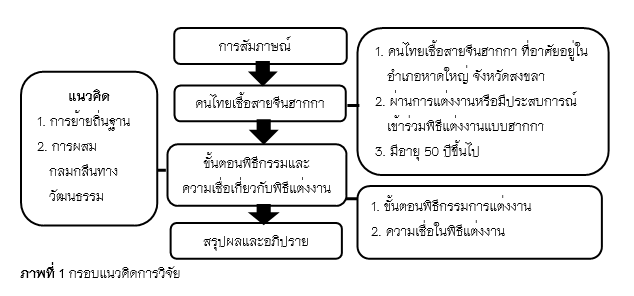
การแต่งงานของคนไทยเชื้อสายจีนฮากกาคือประเพณีที่สะท้อนให้เห็นถึงวัฒนธรรมและความเชื่อของสังคมชาวจีนโพ้นทะเล งานวิจัยนี้มีวัตถุประสงค์เพื่อศึกษาขั้นตอนพิธีกรรมและความเชื่อเกี่ยวกับการแต่งงานของคนไทยเชื้อสายจีนฮากกาซึ่งเป็นหนึ่งในกลุ่มชาวจีนโพ้นทะเลที่อาศัยอยู่ในอำเภอหาดใหญ่ จังหวัดสงขลา โดยใช้แนวคิดการย้ายถิ่นฐานและแนวคิดการผสมกลมกลืนทางวัฒนธรรมมาประกอบการศึกษา ใช้การสุ่มตัวอย่างแบบเจาะจงกับกลุ่มคนไทยเชื้อสายจีนฮากกาที่อาศัยอยู่ในอำเภอหาดใหญ่ จังหวัดสงขลา ที่เคยผ่านการแต่งงานหรือมีประสบการณ์การเข้าร่วมพิธีแต่งงานแบบฮากกาและมีอายุ 50 ปีขึ้นไป โดยใช้วิธีการสัมภาษณ์แบบกึ่งโครงสร้างในรูปแบบเจาะลึกรายบุคคล วิเคราะห์ข้อมูลด้วยการวิเคราะห์เนื้อหา พบว่า ขั้นตอนพิธีกรรมการแต่งงานมีทั้งหมด 15 ขั้นตอนย่อย ได้แก่ 1) การจัดหาแม่สื่อ 2) การตรวจดูดวงความสมพงศ์ของดวงชะตา 3) การตรวจพื้นฐานความเป็นอยู่ของบ้านฝ่ายชาย 4) การสู่ขอ 5) การจัดขบวนรับตัวเจ้าสาว 6) การเดินทางของเจ้าบ่าวมายังบ้านเจ้าสาว 7) การมอบสินสอด 8) การสวมแหวนหมั้นให้กันและกัน 9) การเดินทางออกจากบ้านของเจ้าสาว 10) การเดินทางมาถึงบ้านเจ้าบ่าว 11) การไหว้บรรพบุรุษ 12) การกินบัวลอยและไข่ต้ม 13) การยกน้ำชา 14) การจัดงานเลี้ยงมงคลสมรส และ 15) การเข้าห้องหอ ส่วนความเชื่อในการแต่งงานมีทั้งหมด 3 ด้าน ได้แก่ 1) ด้านตัวเลข 2) ด้านอาหารและผลไม้ และ 3) ด้านสิ่งของ การแต่งงานในรูปแบบของชาวจีนฮากกาในอำเภอหาดใหญ่ยังคงอ้างอิงจากรูปแบบฮากกาดั้งเดิม แต่เนื่องด้วยความแตกต่างทางวัฒนธรรมการแต่งงานตามพื้นถิ่นของอำเภอหาดใหญ่ การเปลี่ยนผันของเวลาและเศรษฐกิจในพื้นที่อำเภอหาดใหญ่ทำให้มีการผสมผสานทางวัฒนธรรมและมีการปรับลดขั้นตอนลงเพื่อความสะดวกรวดเร็วของการจัดงานแต่งงานของเจ้าบ่าวและเจ้าสาว อีกทั้งยังเป็นไปตามความเหมาะสมของช่วงเวลา การศึกษาครั้งนี้สะท้อนให้เห็นว่า การอพยพย้ายถิ่นฐานและการผสมผสานทางวัฒนธรรมนั้นมีผลต่อการสืบทอดเปลี่ยนแปลงทางประเพณีและวัฒนธรรม อย่างไรก็ตาม ชาวจีนฮากกาก็ยังคงรักษาเอกลักษณ์ดั้งเดิมเอาไว้ พร้อมทั้งมีการปรับตัวให้เหมาะสมกับรูปแบบการแต่งงานในสมัยปัจจุบัน
Downloads
Article Details

อนุญาตภายใต้เงื่อนไข Creative Commons Attribution-NonCommercial-NoDerivatives 4.0 International License.
บทความที่ได้รับการตีพิมพ์เป็นลิขสิทธิ์ของบัณฑิตวิทยาลัย มหาวิทยาลัยราชภัฎเชียงใหม่
ข้อความที่ปรากฏในบทความแต่ละเรื่องในวารสารวิชาการเล่มนี้เป็นความคิดเห็นส่วนตัวของผู้เขียนแต่ละท่านไม่เกี่ยวข้องกับมหาวิทยาลัยราชภัฎเชียงใหม่ และคณาจารย์ท่านอื่นๆ ในมหาวิทยาลัยฯ แต่อย่างใด ความรับผิดชอบองค์ประกอบทั้งหมดของบทความแต่ละเรื่องเป็นของผู้เขียนแต่ละท่าน หากมีความผิดพลาดใด ๆ ผู้เขียนแต่ละท่านจะรับผิดชอบบทความของตนเองแต่ผู้เดียว
เอกสารอ้างอิง
Amornwanitsak, S. (2024). Thai-Chinese relations: A study of cultural acceptance and assimilation. Chinese studies Journal Kasetsart University, 17(2), 14-15. https://so01.tci-thaijo.org/index.php/CSJ/article/view/276923 [In thai]
Burutphat, K. (1975). People of hills. Phrae Pittaya Publishing.
Chotikasemsi, S. (2012). Traditions, culture, beliefs, and the Khanmak procession in marriage proposals of Songkhla residents. Journal of Cultural Approach, 13(24), 3-15. https://so02.tci-thaijo.org/index.php/cultural_approach/article/view/3451 [in thai]
Chumchit, T., & Plengdisakul, B. (2017). Factors affecting changes in beliefs in The Yao Liang Phi Ritual of the P Hu Thai people in Kunwa Sub-district, Kuchinarai District, Kalasin Province. Journal of Fine and Applied Arts, Khon Kaen University, 9(2), 123-148. https://so02.tci-thaijo.org/index.php/fakku/article/view/113917 [In Thai]
Dongsombat, S., Meethaisong, T., And Bangperg, K. (2019). Adaptation to the change in the culture and belief of the community of Tamyae Village Khaen Sub-district, Wapi Pathum District, Maha Sarakham Province. KKU International Journal of Humanities and Social Sciences, 9(3), 146-161. https://so04.tci-thaijo.org/index.php/KKUIJ/article/view/209670/158163 [In thai]
Kasetsiri, C. (Ed.). (2005). Chinese society in Thailand: An analytical history (2nded.). The Foundation for The Promotion of Social Science and Humanities Textbooks. [In Thai]
Lee, E. S. (1966). A theory of migration. Demography, 3(1), 47-57. https://www.jstor.org/stable/206006
Ma, G. (2021). Development Network Construction of Hakka People in Southern Thailand. Rusamilae Journal, 42(2), 6-36. https://so05.tci-thaijo.org/index.php/rusamelae/article/view/254212/172351 [In thai]
Mahattanobol, W. (2005). Hakka Is “Hakka”: Is “Chinese-Khae”. (2nded.). Matichon Publishing. [In Thai]
Malasri, T. (2019). The comparison of love and marriage attitude from Thai and Chinese proverbs. KKU Research Journal of Humanities and Social Sciences (Graduate Studies), 7(2), 136-137. https://so04.tci-thaijo.org/index.php/gskkuhs/article/view/206778 [In Thai]
Na Kotapura, P.R. (2018). The symbolism of fish in Theravada Buddhism. Panidhana Journal, 11(1), 37-56. https://so05.tci-thaijo.org/index.php/panidhana/article/view/148167/109184 [In Thai]
Phichetphan, C., & Phichetphan, S. (2017). Kon Khae (Not Khae) Hakka Ngin. First Offset (1993) Co., Ltd. [In Thai]
Poshakrishna, P. (2025). Dowry and Thai society. Journal Of MCU Haripunchai Review, 9(2), 613-623. https://so04.tci-thaijo.org/index.php/JMHR/article/view/aaa-044/aaa-044 [In Thai]
Saleh, M., Saesen, W., Somlok, A., Phuangrod, K., And Kitiwinit, S. (2024). Components and structures of Thai food naming and cultural identity of Thai-Chinese Hakka people in Betong District, Yala Province. Journal of Language, Religion and Culture, 13(2), 102-138. https://so03.tci-thaijo.org/index.php/gshskku/article/view/279024 [In Thai]
Satsanguan, N. (1999). Principles of cultural anthropology. (4thed.). Rammakarn Printing Co., Ltd. [In Thai]
Siripaisarn, S. & Kanchanadit, A. (2009). Rituals and beliefs of Chinese Thai in Songkhla Basin from past to present. Journal of Humanities and Social Sciences Thaksin University, 4(1), 97-124. https://kb.psu.ac.th/server/api/core/bitstreams/3c95af1f-c57e-47cc-8c9a-61a30413f8cf/content [In Thai]
Siripaisarn, S., Kanchanadit, A., Narksaithong, P., And Thongdee, S. (2006). Social And Cultural Change of Chinese Population in Hat Yai City from The Past to The Present. Thaksin Journal, 9(2), 43-54. https://ph02.tci-thaijo.org/index.php/tsujournal/article/view/69005/56180 [In Thai]
Sukprasert, W. (2017). Legal Status of Sin-Sod (Bride Price) In Thai Law [Master Thesis, Thammasat University]. http://ethesisarchive.library.tu.ac.th/thesis/2017/TU_2017_5701031048_9174_9126.pdf [In Thai]
Supharchan, W., Boonprakarn, K., And Jiaramat, A. (2016). The Everyday Life Practice Via Cross-Ethnic. Marriage. Journal Of Liberal Arts Prince of Songkla University, 5(1), 78-87. https://so03.tci-thaijo.org/index.php/journal-la/article/view/64413 [in thai]
Thi Hang, T. (2023). Kukrit Studies: Beliefs About Colors. Connexion: Journal of Humanities and Social Sciences,12(1). https://so05.tci-thaijo.org/index.php/MFUconnexion/article/view/263050 [In Thai]
Wang, Q., & Onkam, I. (2021). Beliefs And Rituals of Chinese Taiwanese Shrines: A Case Study of Thammakatanyu Foundation Shrine (Xian Loo Tai Thiankong), Samutprakan Province. Journal Of Mcu Buddhist Review, 5(2), 73-75. https://so06.tci-thaijo.org/index.php/jmb/article/view/252684 [In Thai]
Wang, R. (2011). A Brief Analysis of Chinese and Japanese Matchmaking Culture: Focusing on The Role of Matchmakers. Wenxuejia, 12(3), 153-155. [In Chinese]
Yanyongkasemsuk, R. (2015). Capital Of Marriage. Burapha Journal of Political Economy, 3(2), 31-54. https://so01.tci-thaijo.org/index.php/pegbuu/article/view/199459/139220 [In Thai]
Yothinsirikul, S. (2018). Chinese auspiciosness and Feng Shui science among Chinese-Thai people in Yaowarat Community. Silpakorn University Journal, 38(5), 137-138. https://so05.tci-thaijo.org/index.php/sujthai/article/view/152935/111775 [In Thai]
Zeng, X. (1999). Taiwan Hakka cultural studies. Jinshi Printing Co., Ltd. [In Chinese}
