
Intercultural Communication Strategies and Academic Adaptation Competence of Chinese and Thai Undergraduate Students Using English in a Thai University Online Instruction Context
Article Sidebar
Main Article Content
Abstract
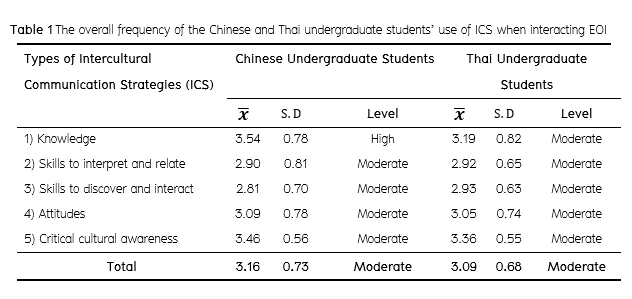
This research is a mixed method research, the purpose of this dissertation aimed to scrutinize intercultural communication strategies (ICS) and academic adaptation competence (AAC) of Chinese and Thai undergraduate students using English as an online instruction (EIO) when encountering their intercultural communication problems in a Thai university online instruction context. The instruments were both online semi-structured questionnaires and online in-depth interviews were conducted with 40 fourth-year Thai and 40 fourth-year Chinese undergraduate students majoring in English Studies at the Faculty of Humanities, Chiang Rai Rajabhat in 2021 academic year, selected by the purposive sampling technique. The quantitative data were systematically analyzed using frequency, percentage, mean, and standard deviation (S.D.), and the qualitative data with its content analysis were also summarized and categorized in themes. Results of the study revealed that the Chinese undergraduate students’ intercultural communication strategies (ICS) related to their knowledge were seldom used in a moderate level; otherwise, intercultural communication strategies (ICS) related to the Thai undergraduate students’ critical cultural awareness were seldom used in a moderate level. In terms of the Chinese and Thai undergraduate students’ academic adaptation competence before, during, and after studying in the Thai public higher educational institution, it showed that both of them could adapt themselves academically and socially before, during, and after studying in a public Thai higher educational institution. Also, this study will be an insightful resource for any further studies and training programs to help both Chinese and Thai interlocutors understand their self-academic adaptation process and discover an appropriate means to handle the mismatch between cultures occurred in the Thai-speaking academic environment.
Downloads
Article Details

This work is licensed under a Creative Commons Attribution-NonCommercial-NoDerivatives 4.0 International License.
The articles published are copyrighted by the Graduate School, Chiang Mai Rajabhat University.
The opinions expressed in each article of this academic journal are solely those of the individual authors and do not reflect the views of Chiang Mai Rajabhat University or its faculty members. The responsibility for the content of each article rests entirely with the respective authors. In the event of any errors, the authors alone are responsible for their own articles.
References
Canale, M., & Swain, M. (1980). Theoretical bases of communicative approaches to second language teaching and testing. Applied Linguistics, 1(1), 1-47.
Cheng, Y., Song, L., & Huang, L. (2018). The belt & road initiative in the global arena, Chinese and European perspectives. Singapore: Palgrave Macmillan.
Chiang Rai Rajabhat University (CRRU.) (2019). Self-assessment report: SAR. Chiang Rai: Chiang Rai Rajabhat University.
Chomsky, N. (1965). Aspects of the theory of syntax. Cambridge, MA: MIT Press Chulalongkorn.
Croucher, S. M., Sommier, M., & Rahmani, D. (2015). Intercultural communication: Where we’ve been, where we’re going, issues we face. Communication Research and Practice, 1(1), 71-87.
Dashtestani, R. (2014). English as a foreign language—teachers’ perspectives on implementing online instruction in the Iranian EFL context. Research in Learning Technology, 22, 1-15. ttps://doi.org/10.3402/rlt.v22.20142
Euamornvanich, P. (2016). Intercultural communication problems and adjustment between foreign instructors and Thai students at Rajabhat Universities in Bangkok. Dhonburi Rajabhat University Journal, 10(2), 78-92.
Euamornvanich, P. (2017). Communication under the dimension of cultural diversity based on the concept of Geert Hofstede communication through multi-cultural dimensions of Geert Hans de Wit & Philip G. Altbach, (2021). Internationalization in higher education: global trends and recommendations for its future. Policy Reviews in Higher Education, 5(20), 1-19.
Heath, R., Kari, S., & Sihan, Z. (2022). Global English medium instruction: Perspectives at the crossroads of Global Englishes and EMI. Asian Englishes, 24(2), 160-172. DOI: 10.1080/13488678.2022.2056794
Inkaew, M. (2016). An analysis of intercultural communicative competence: Hotel front office personnel in Bangkok. PASAA, 51(1), 185-214.
Kim, Y, Y., & Park, E, C. (2017). Theory reflections: cross-cultural adaption theory. International Journal of Intercultural Relations, (13), 25-29.
Ladaval, S. (2018). Acculturation problems of Thai master’s degree students in the United Kingdom. Journal of Alternative Perspectives in the Social Sciences, 9(3), 332-340.
Niemets, K., Sehida, K., Niemets, L., Krainyukov, O., Telebienieva, I., & Kobylin, P. (2018). Some issues of the formation and implementation of the development strategies of Ukraine’s regions taking into account European experience. In Proceedings of the 32nd International Business Information Management Association Conference (IBIMA). 15-16 November 2018, Seville, Spain. Retrieved from https://ibima.org/accepted-paper/formation-and-implementation-of-the-development-strategies-of-ukraines-regions-in-the-aspect-of-eurointegration/
Nomnian, S. (2014). Thai entrepreneurs’ needs of English language learning materials for the raft service business in Kanchanaburi province. Humanities Journal, 21(2), 243- 275.
Nomnian, S. & Jhaiyanuntana, J. (2018). Chinese overseas students’ perspectives on benefits and limitations of English language learning and teaching between China and Thailand. Arab World English Journal, 9(59), 204-235.
Office of the Higher Education Commission (OHEC). (2018). Manual for the internal quality assurance for higher education institutions. Bangkok: Prigwhan Graphic Co., Ltd.
Ota, H. (2016). Internationalization of higher education: Trends and challenges: Featured articles: Internationalization of higher education: A response to globalization. Journal of International Education, 22, 1-9.
Phithakphongphan, T. (2020). The role of intercultural awareness in intercultural communication: A case study of English student trainees at a Thai airport. (Doctoral thesis, York St John University).
Rastegar, M., & Gohari, S. M. (2016). Communication strategies, attitude, and oral output of EFL learners: A study of relations. Open Journal of Modern Linguistics, 6(5), 401-419.
Stoian, C. E., Farcas, M. A., Dragomir, G. M, & Gherhes, V. (2022). Transition from online to face-to-face education after COVID-19: The benefits of online education from students’ perspective. Sustainability, 14, 12812. https://doi.org/10.3390/ su141912812
Songsirisak, P. (2018). Cross-cultural adaptation of Chinese students: Problems and solutions. Journal of Education Research, Srinakharinwirot University, 13(2), 222-234.
Songsathaphorn, P., Chen, C., and Ruangkanjanases, A. (2014). A study of factors influencing Chinese students’ satisfaction toward Thai universities. Journal of Economics, Business and Management,
(2), 105-111.
Suwanasom, T. (2019). A study on intercultural strategies in English as a lingua franca communication of Naresuan University graduate students. Journal of Liberal Arts Prince of Songkhla University, 11(1), 307-333.
Wang, L. (2018). Exploring models of improving Chinese students’ intercultural communication competence (ICC) based on their experiences in English-speaking countries. (Master’s thesis, University of Victoria).
Wutthisarnwattana, T. (2021). Intercultural communication strategies and self-adaptation of Chinese students in a Thai public university: A case study of Chiang Rai Rajabhat University. Kasalongkham Research Journal, 15(2), 51-72.
