
Metadiscourse in Business English Writing of Thai EFL Undergraduate Students
Article Sidebar
Main Article Content
Abstract
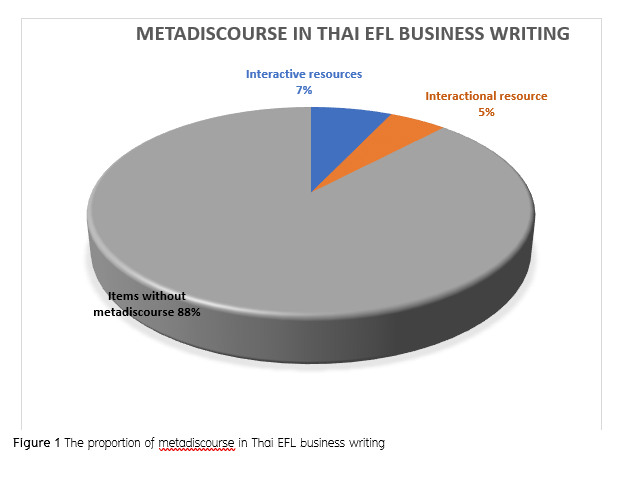
This study is a discourse analysis that attempts to investigate the use of metadiscourse in the English business writings of Thai EFL undergraduates. Data is the written text of 21 business plans of 35 Thai EFL students from business English program. The writing contains 2,248 items from sentences, phrases, topics, and graphs and a total of 18,975 words were gathered from the entire statement. They were analyzed by applying Hyland’s metadiscourse model which divided functions into interactive resources and interactional resources. Frequency and percentage were also used to explore the occurrence of metadiscourse and applied as a tool in interpreting data. The results reveal that interactive resources were used more frequently than interactional resources. For interactive resources, it was found that transitions were applied most often, followed by code glosses, frame markers, endophoric markers, and evidentials. For interactional resources, it was found that engagement markers were applied most often, followed by self-mentions, hedges, boosters, and attitude markers. However, when considering the use of metadiscourse with a total of 18,975 words, it was found that metadiscourse was applied on a small scale in which interactive resources were applied 7 percent and interactional resources were applied only 5 percent. Consequently, the results of the study indeed reflect that metadiscourse needs to be more concerned in Thai EFL classrooms.
Downloads
Article Details

This work is licensed under a Creative Commons Attribution-NonCommercial-NoDerivatives 4.0 International License.
The articles published are copyrighted by the Graduate School, Chiang Mai Rajabhat University.
The opinions expressed in each article of this academic journal are solely those of the individual authors and do not reflect the views of Chiang Mai Rajabhat University or its faculty members. The responsibility for the content of each article rests entirely with the respective authors. In the event of any errors, the authors alone are responsible for their own articles.
References
Alyousef, H.F. (2015). An investigation of metadiscourse features in international postgraduate business students’texts: The use of interactive and interactional markers in tertiary multimodel finance texts. SAGE Open, 5(4), 1-10.
Crismore, A. (1983). Metadiscourse: What it is and how it is used in school and non-school social science texts. Urbana-Champaign: University of Illinois.
Crismore, A., & Farnswoth, R. (1990). Metadiscourse in popular and professional science discourse. In W. Nash (ed.), The writing scholar: Studies in academic discourse. (pp. 118-136). Newbury Park (CA): SAGE.
Crismore, A., Markkanen, R., & Steffensen, M. (1993). Metadiscourse in persuasive writing: A study of texts written by American and Finnish University students. Written Communication, 10(1), 39-71.
Chaisiri, T. (2010). Implementing a genre pedagogy to the teaching of writing in a university context in Thailand. Language Education in Asia, 1(1), 181-199.
Cheng, X., & Steffenson, M. (1996). Metadiscourse: A technique for improving student writing. Research in the Teaching of English, 30(20), 149-181.
Fujioka, M. (2001). Asian students’ English writing experience. In PAC3 at JALT 2001 Conference Proceedings International Conference Centre Kitakyushu Japan (pp. 185 -194). 22-25 November, 2001. Tokyo: The Japan Association for Language Teaching. Retrieved from https://jalt-publications.org /archive/proceedings/2001/185.pdf
Hong, H., & Cao, F. (2014). Interactional metadiscourse in young EFL learner writing. International Journal of Corpus Linguistics, 19(2), 201-224.
Hyland, K. (1998). Persuasion and context: The pragmatics of academic metadiscourse. Journal of Pragmatics, 30, 437-455.
Hyland, K. (1999). Talking to students: Metadiscourse in introductory textbooks. English for Specific Purposes, 18(1), 3-26.
Hyland, K. (2004). Disciplinary interactions: Metadiscourse in L2 post graduate writing. Journal of Second Language Writing, 13, 133-151.
Hyland, K. (2005). Metadiscourse. London: Continunum.
Hyland, K. (2017). Metadiscourse: What is it and where is it going?. Journal of Pragmatics, 113, 16-29.
Hyland, K., & Tse, P. (2004). Metadiscourse in academic writing: A reappraisal. Applied Linguistics, 25(2), 156-177.
Intaraprawat, P., & Steffensen, M. (1995). The use of metadiscourse in good and poor ESL essays. Journal of Second Language Writing, 6(2), 183-206.
Khruawan, M., Khaourai, P., Sangthakeong, A., & Chanpermpoonpaul, S. (2021). English business email writing problems of 4th year logistics and supply chain management students of the Faculty of Business Adminstration at Huachiew Chalermprakiet University. Liberal Arts Review, 16(1), 59-69.
Pongsukvajchakul, P. (2021). Language learning strategies used in English writing by Thai undergraduate students. International Journal of Education, 9(2), 54-59.
Simin, S., & Tavangar, M. (2009). Metadiscourse knowledge and use in Iranian EFL writing. Asian EFL Journal, 11(1), 230-255.
Taghizadeh, M., & Tajabadi, F. (2013). Metadiscourse in essay writing: An EFL case. International Research Journal of Applied and Basic Science, 4(7), 1658-1662.
Tajeddin, Z., & Alemi, M. (2012). L2 learners’ use of metadiscourse markers in online discussion forums. Issue in Language Teaching, 1(1), 93-122.
Thompson, G. (2001). Interaction in academic writing: Learning to argue with the reader. Applied Linguistics, 22(1), 58-78.
Vande Kopple, W. (1985). Some explanatory discourse on metadiscourse. Collage Composition and Communication, 36, 82-93.
Williams, J. (1981). Style: Ten lessons in clarify and grace. Boston: Scott Foresman.
Wongwichai, K., & Tachom, K. (2020). Students’ English business writing skills development through intercultural emails. Journal of SaengKhomKham Buddhist Studies, 6(2), 193-208.
