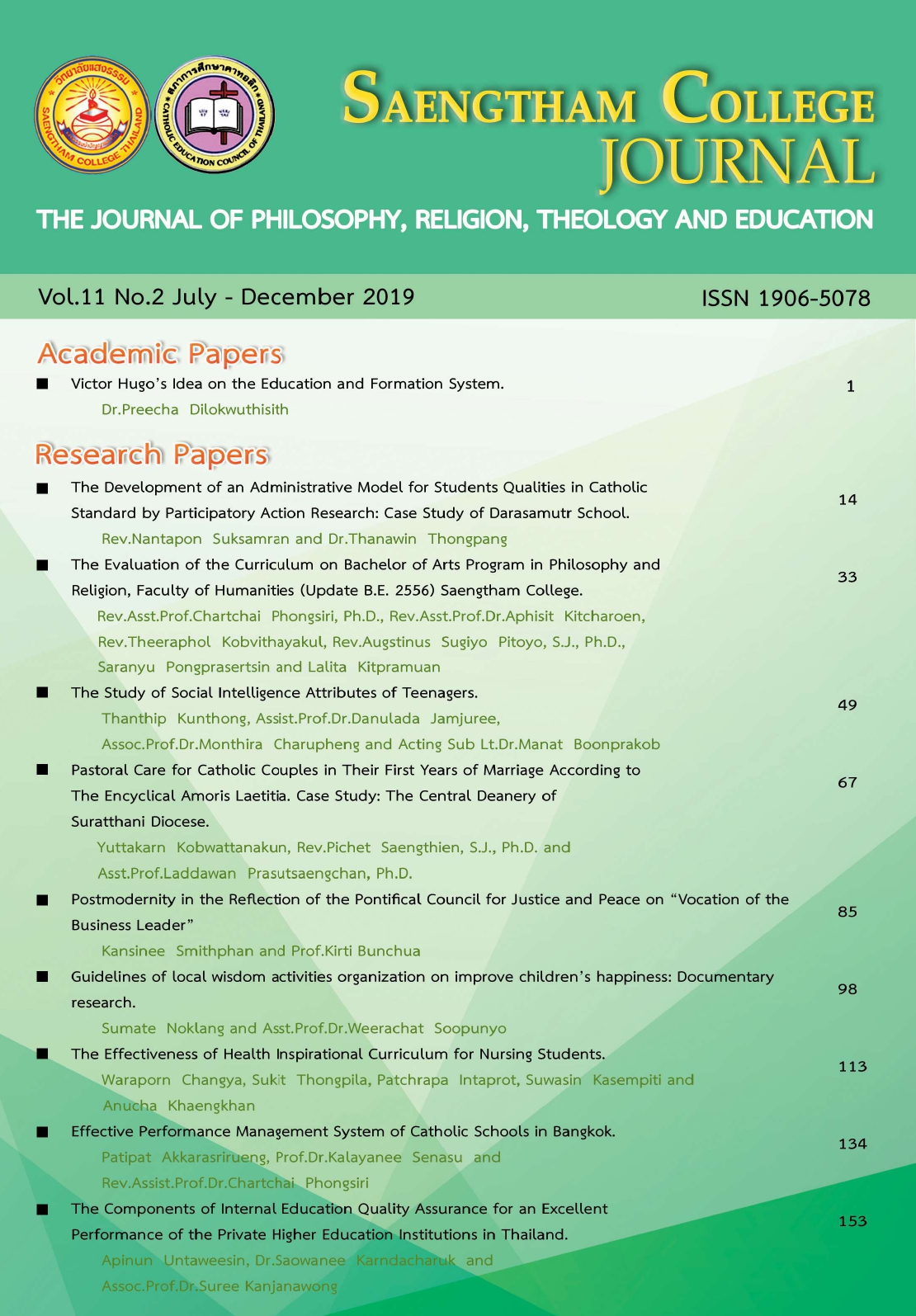
Postmodernity in the Reflection of the Pontifical Council for Justice and Peace on “Vocation of the Business Leader”
Article Sidebar
Main Article Content
Abstract
The purpose of this research was to study the document of the Pontifical Council for Justice and Peace, how the work entitled "The Vocation of the Business Leader" is exposed by modernism. However, by conducting a qualitative research on the philosophical basis, which includes dialectical, discursive, and interpretative dimensions, it was found out that the reflection could be interpreted according to modern philosophy, which advocates taking advantage in business, developing society strictly according to the norms of the Catholic Church, attaching to the idea that all things are hierarchical and man is God’s most precious creation. Humans are the center of the world and hold utmost importance in promoting meaning and understanding of resource ownership. Nonetheless, the researcher believes that a postmodern philosophical interpretation would give better meaning to the Church's approach, focusing on the adoption of the quality technology and the quality business including the quality of life of business leaders. This vocation, therefore, counterbalances to the solution of the problem that humanity is saved from the pitfalls of scientific and technological development by offering good choices for the improvement of the quality of life for humanity and the world. As Christians ground their faith on reason, Catholic businessmen can use their minds to critically judge, analyze, and evaluate the various aspects of religion, so that they can anchor their life and work strongly in the Christian virtues of faith, trust and love.
Article Details

This work is licensed under a Creative Commons Attribution-NonCommercial-NoDerivatives 4.0 International License.
- The academic and research articles, as well as the content and opinions expressed therein, published in Saengtham College Journal are solely the responsibility of the respective author(s).
- Articles published in Saengtham College Journal are the property of Saengtham College. Reproduction, modification, or dissemination of all or part of the content in any form without written permission from Saengtham College is prohibited.
- Articles published in Saengtham College Journal are protected under the Copyright Act.
References
กีรติ บุญเจือ. (2551). คู่มือจริยศาสตร์ตามหลักวิชาการสากล. กรุงเทพฯ: เชน ปริ้นติ้ง.
_________. (2547). ตรรกวิทยาและตรรกวิทยาสัญญาลักษณ์เบื้องต้น. กรุงเทพฯ: จุฬาลงกรณ์มหาวิทยาลัย.
_________. (2538). ศาสนศาสตร์เบื้องต้น ชุดศาสนศึกษา. (พิมพ์ครั้งที่ 3). กรุงเทพฯ: ไทยวัฒนพานิช.
_________. (2530). หลักปฏิบัติของชาวคริสต์คาทอลิก (คริสตศาสนาภาคหลัง) ชุดศาสนศึกษา. กรุงเทพฯ: ไทยวัฒนพานิช.
โป๊ป รีพอร์ต, ผู้รวบรวม. (2557). ความจริง ความรัก ความเมตตา. กรุงเทพฯ: เจ สไมล์ ดีไซน์.
Pontifical Council for Justice and Peace. (2557). ข้อคิดคำนึงเรื่อง “กระแสเรียกผู้นำธุรกิจ” (แปลจาก A Reflection: The Vocation of the Business Leader โดย กีรติ บุญเจือ). กรุงเทพฯ: ชมรมนักธุรกิจคาทอลิก.
Bauman, Z. (1993). Postmodern Ethics. Cambridge: Blackwell.
Hayes, J. L. (1996). In God We Trust: But Which One?. Madison, WI: Freedom from Religion Foundation.
Plunkett, W.R., & Attner, R. F. (1997). Meeting and Exceeding Customer Expeatations, Management. Cincinnati Ohio: South Weston College Publishing.
Ricoeur, P. (1981). The Task of Hermeneutics. InHermeneutics and the Human Sciences: Essays on Language,Action and Interpretation, (Ed. and Trans. John B. Thompson). Cambridge: Cambridge University Press.
Tannenbaum, R., & Schmidt, W. H. (1958). How to Choose a Leardership Pattem. Harvard Business Review 36.
