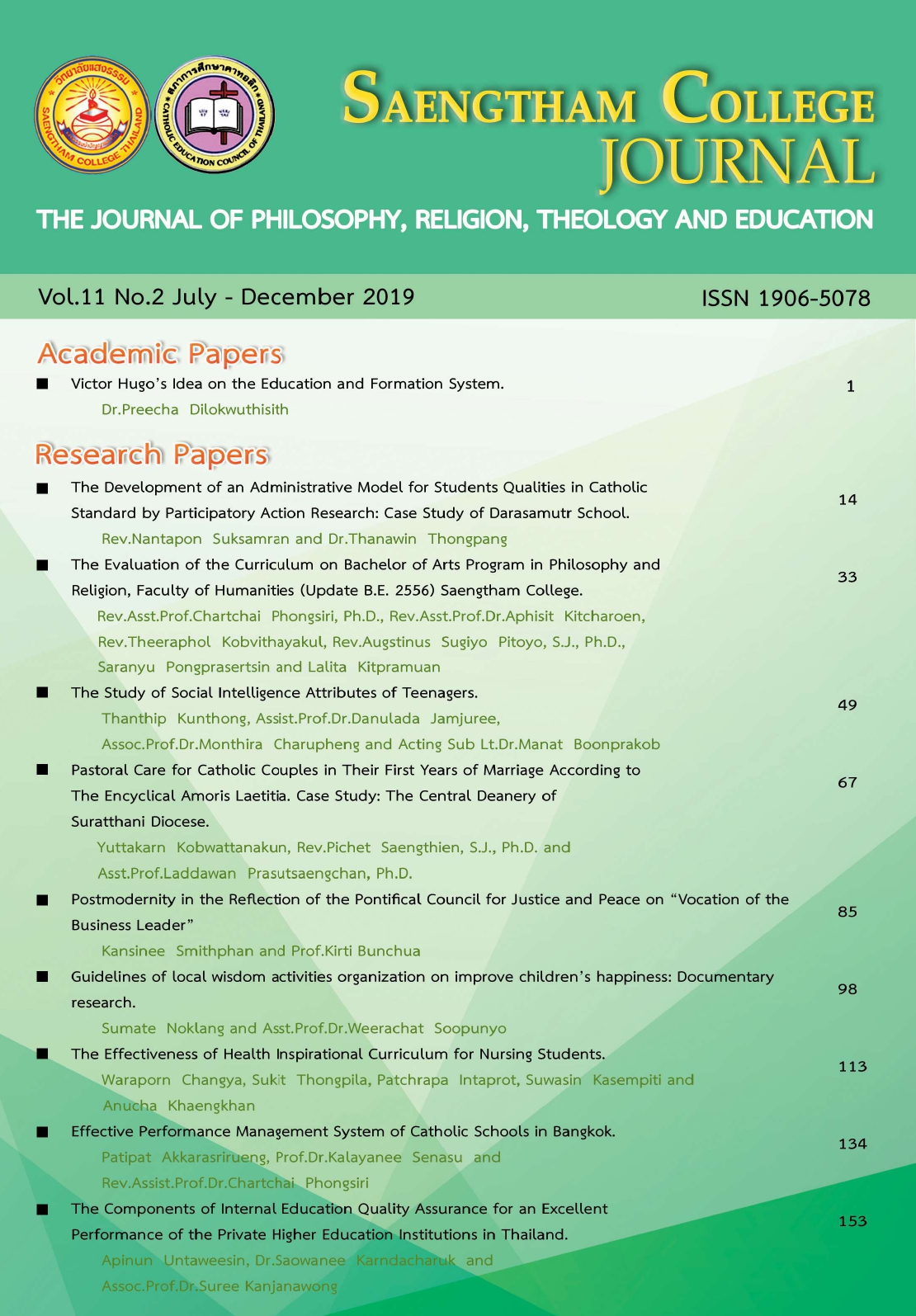
Guidelines of local wisdom activities organization on improve children’s happiness: Documentary research
Article Sidebar
Main Article Content
Abstract
The purpose of this qualitative was to analyze knowledge related to the concept of improve children’s happiness and, to integrate and synthesize the theoretical framework of guidelines for organizing local wisdom activities to improve children’s happiness. Using of research methodology in documentary analysis by classification of knowledge from 50 copies of documents and research related to the improve children’s happiness. Research were found that: - 1) Knowledge related to improve children’s happiness has 4 factor are children's happiness development, andragogy for improve children’s happiness, leisure activities for improve children’s happiness, and local wisdom learning for improve children’s happiness; -2) the theoretical framework of guidelines for organizing local wisdom activities to improve children’s happiness has 6 factor is Local wisdom learning activities for self-understanding, Local wisdom learning activities for self-development, Local wisdom learning for create success guidelines, Local wisdom learning activities for positive solutions and Local wisdom learning activities for positive self-motivation.
Article Details

This work is licensed under a Creative Commons Attribution-NonCommercial-NoDerivatives 4.0 International License.
- The academic and research articles, as well as the content and opinions expressed therein, published in Saengtham College Journal are solely the responsibility of the respective author(s).
- Articles published in Saengtham College Journal are the property of Saengtham College. Reproduction, modification, or dissemination of all or part of the content in any form without written permission from Saengtham College is prohibited.
- Articles published in Saengtham College Journal are protected under the Copyright Act.
References
ชิดชงค์ ส. นันทนาเนตร. (2560). ทฤษฎีการเรียนรู้สำหรับผู้ใหญ่. นครปฐม: คณะศึกษาศาสตร์ มหาวิทยาลัยศิลปากร.
ประสิทธิ์ ประคองศรี. (2554). มหัศจรรย์ภูมิปัญญาท้องถิ่นในการจัดการภัยพิบัติธรรมชาติของชุมชนในภาคตะวันออกเฉียงเหนือ. การประชุมวิชาการ เรื่อง “การจัดการภัยพิบัติธรรมชาติในภาคตะวันออกเฉียงเหนือเพื่อการพึ่งพาตนเองของท้องถิ่นอย่างยั่งยืน” วันที่ 15-16 ธันวาคม 2554, ณ ห้องหลักเมือง โรงแรมเจริญธานี อำเภอเมือง จังหวัดขอนแก่น.
ปรางค์สุทิพย์ ทรงวุฒิศีล. (2557). จิตวิทยาเด็กและวัยรุ่น. กรุงเทพฯ: รามคำแหง.
มะลิวัลย์ หนกหลัง, สารีพันธุ์ ศุภวรรณ และ ชนกนารถ บุญวัฒนะกุล. (2558). ผลของกิจกรรมนันทนาการ เรื่อง ผลิตภัณฑ์จากต้นจากที่มีต่อผลสัมฤทธิ์ทางการเรียนสำหรับวัยรุ่นตอนต้น ชุมชนเกาะหยงสตาร์ อำเภอปะเหลียน จังหวัดตรัง. วารสารวิจัยและพัฒนาหลักสูตร. 5(2), 60-71.
นิรันดร์ จุลทรัพย์. (2558). การแนะแนวเพื่อพัฒนาผู้เรียน. สงขลา: นำศิลป์โฆษณา.
ลักขณา สริวัฒน์. (2557). จิตวิทยาสำหรับครู. กรุงเทพฯ: โอ.เอส พริ้นติ้ง เฮ้าส์.
สำนักงานเลขาธิการสภาการศึกษา กระทรวงศึกษาธิการ. (2551). คู่มือการสรรหาและคัดเลือกครูภูมิปัญญาไทย. กรุงเทพฯ: 21 เซ็นจูรี่ จำกัด.
สุดา ทองเซ่ง, ดรุณี จำปาทอง และ ดิเรก สุขสุนัย. (2558). ผลของการเรียนรู้โดยใช้แหล่งเรียนรู้ในชุมชนบ้านร่มโพธิ์ทอง เรื่องภูมิปัญญาท้องถิ่น ที่มีต่อผลสัมฤทธิ์ทางการเรียนและทักษะการคิดของนักเรียนชั้นประถมศึกษาปีที่ 5 โรงเรียนบ้านร่มโพธิ์ทอง จังหวัดฉะเชิงเทรา. วารสารศึกษาศาสตร์ มสธ. 8(2), 217-228.
สุนทร สุนันท์ชัย และ สนอง โลหิตวิเศษ. (2554). ปรัชญาการศึกษานอกระบบและการศึกษาตามอัธยาศัยของไทย ในปรัชญาและหลักการการศึกษานอกระบบและการศึกษาตามอัธยาศัย, ชนกนารถ บุญวัฒนะกุล บรรณาธิการ. นนทบุรี: มหาวิทยาลัยสุโขทัยธรรมาธิราช.
สุวิมล ตั้งสัจจพจน์. (2553). นันทนาการและการใช้เวลาว่าง. กรุงเทพฯ: เอดิสันเพรสโพรดักส์ จำกัด.
Eppler, M.J. (2008). A Process-Based Classification of Knowledge Maps and Application Examples. Knowledge and Process Management. 15(1): p.59–71.
Gavin J.H. & Mason R.O. (2004). The Virtuous Organization: The Value of Happiness in the Workplace. Organization Dynamics. 33(1): p.379-392.
Penn, H. (2008). Understanding Early Childhood: Issues and Controversies. New York: McGraw Hill/Open University Press.
Rossman, J. R. and Schlatter, B. E. (2015). Recreation Programming: Designing Leisure Experience. Illinois: Sagemon Publishing.
Shamanur, K.C. (2018). Recreation for modern generation. International Journal of Physical Education, Sports and Health. 5(1): p.161-163.
Singhal, D. (2017). Understanding Student- Centered Learning and Philosophies of Teaching Practices. International Journal of Scientific Research and Management. 5(2): p.5123-5129.
Witt, P.A. and Caldwell, L.L. (2005). Recreation and Youth Development. Pennsylvania: Venture Pub., Inc.
