
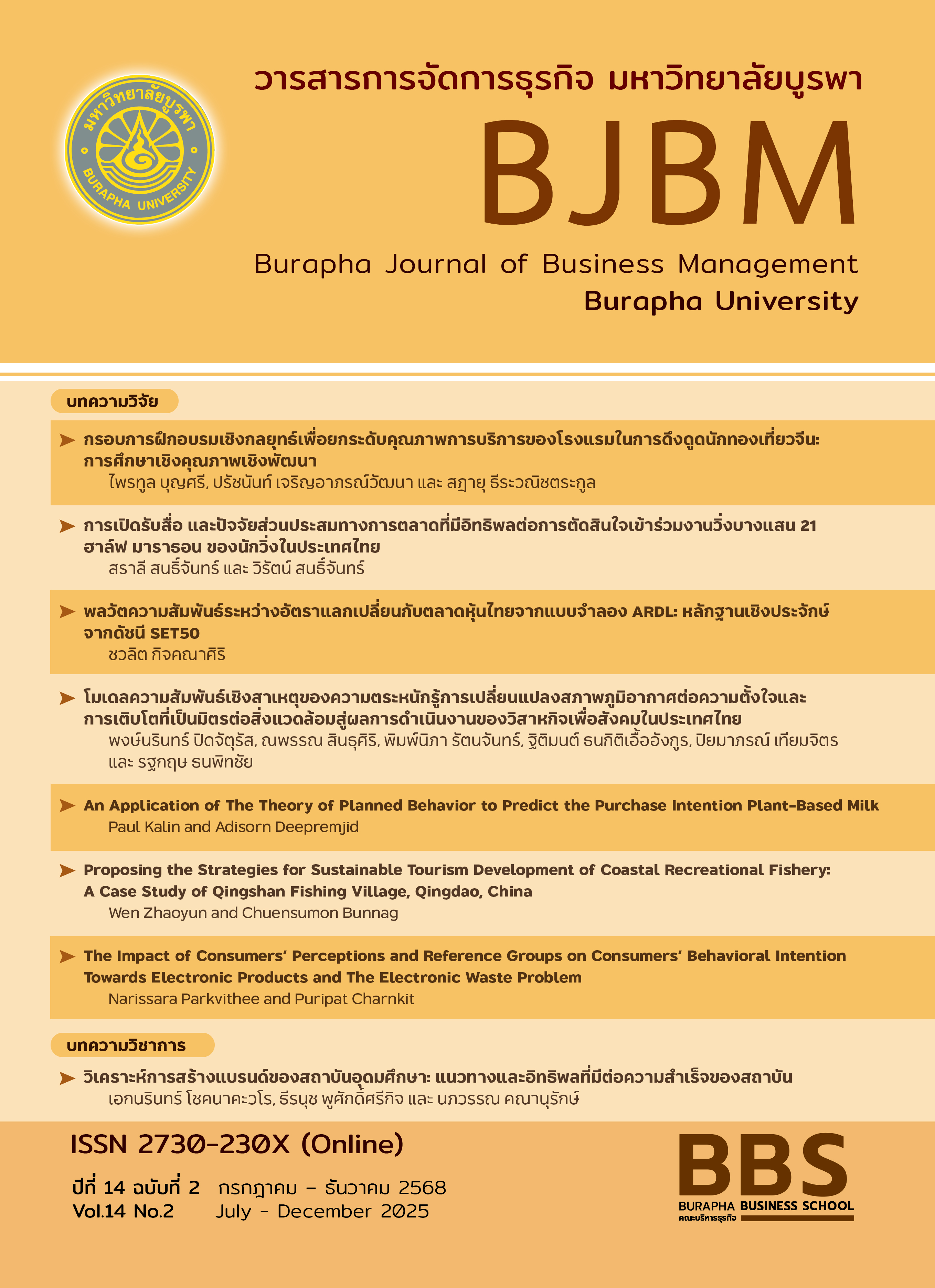
The Impact of Consumers’ Perceptions and Reference Groups on Consumers’ Behavioral Intention Towards Electronic Products and The Electronic Waste Problem
Article Sidebar
Main Article Content
บทคัดย่อ
This study aims to investigate the development of a causal relationship model incorporating the three latent variables, which are consumers’ perceptions of e-goods and the e-waste problem, reference group influence, and consumers’ behavioral intention. The research employed a quantitative approach to gather data in Thailand for enterprises that are associated with personal computers and mobile phones market segment of electronic product industry. An online survey approach using a self-administered questionnaire as a research tool was implemented. Researchers conducted a path analysis with latent variables by employing the structural equation modeling (SEM) to analyze the data through AMOS version 24. The findings suggest that the development of a causal relationship model indicated quite good congruence with empirical data. In addition, consumers’ perceptions and reference group appear to be potential determinants and play a role in influencing consumers’ behavioral intention in the aspects of product utilization and word-of-mouth.
Article Details

อนุญาตภายใต้เงื่อนไข Creative Commons Attribution-NonCommercial-NoDerivatives 4.0 International License.
บทความที่จะตีพิมพ์เพื่อเผยแพร่ในวารสารการจัดการธุรกิจ มหาวิทยาลัยบูรพา จะต้องเป็นบทความที่ไม่เคยได้รับการตีพิมพ์เผยแพร่หรืออยู่ระหว่างการพิจารณาเพื่อตีพิมพ์เผยแพร่ในวารสารอื่น ๆ ทั้งนี้ หากพบว่ามีการละเมิดลิขสิทธิ์ ด้วยข้อคิดเห็นที่ปรากฏและแสดงในเนื้อหาบทความต่าง ๆ ให้ถือว่าเป็นความเห็นและความรับผิดชอบโดยตรงของผู้เขียนบทความนั้น ๆ มิใช่ความเห็นและความรับผิดชอบใด ๆ ของคณะบริหารธุรกิจ มหาวิทยาลัยบูรพา สำหรับในกรณีผู้ประสงค์จะนำข้อความในวารสารการจัดการธุรกิจ มหาวิทยาลัยบูรพา ไปเผยแพร่ต้องได้รับอนุญาตจากกองบรรณาธิการวารสารการจัดการธุรกิจ มหาวิทยาลัยบูรพา ตามกฎหมายว่าด้วยลิขสิทธิ์
เอกสารอ้างอิง
Ahmed, Z. U., Johnson, J. P., Yang, X., Fatt, C. K., Teng, H. S., & Boon, L. C. (2004). Does Country of Origin Matter for Low-Involvement Products? International Marketing Review, 21(1), 102-120. https://doi.org/10.1108/02651330410522925.
Ajzen, I. (1985). From Intentions to Actions: A Theory of Planned Behavior. In Action Control, From Cognition to Behavior: Chap. 2 (pp. 11-39). Berlin, Springer-Verlag. https://doi.org/ 10.1007/978-3-642-69746-3_2.
Ajzen, I. (1991). The Theory of Planned Behavior. Organizational Behavior and Human Decision Processes, 50(2), 179-211. https://doi.org/10.1016/0749-5978(91)90020-T.
Ajzen, I. (2002). Perceived Behavioral Control, Self-Efficacy, Locus of Control, and the Theory of Planned Behavior. Journal of Applied Social Psychology, 32(4), 665-683. https://doi.org/ 10.1111/j.1559-1816.2002.tb00236.x.
Bangkokbiznews. (2021). Thailand Internet User Behavior 2021. Retrieved December 18, 2021, from https://www.bangkokbiznews.com/tech/978041.
Beresford Research. (2022). Age Ranges by Generation. Retrieved October 11, 2022, from https://www.beresfordresearch.com/age-range-by-generation.
Bryman, A., & Bell, E. (2015). Business Research Methods (4th ed.). Oxford University Press.
Chaweesuk, S., & Wongjaturapatra, S. (2012). Theories of Information Technology Use Acceptance. KMITL Information Technology Journal, 1(1), 1-21.
Chen, C., & Chen, F. (2010). Experience Quality, Perceived Value, Satisfaction and Behavioral Intentions for Heritage Tourists. Tourism Management, 31, 29-35. https://doi.org/ 10.1016/j.tourman.2009.02.008.
Chiou, J. (1998). The Effects of Attitude, Subjective Norms, and Perceived Behavioral Control on Consumers’ Purchase Intentions: The Moderating Effects of Product Knowledge and Attention to Social Comparison Information. Retrieved March 9, 2025, from https://scispace.com/pdf/the-effects-of-attitude-subjective-norm-and-perceived45je hjyjad.pdf.
Chokenukul, P., Sukhabot, S., & Rinthaisong, I. (2019). A Causal Relationship Model of Purchasing Behavior of Consumers in Thailand Regarding Processed Fish Products. Kasetsart Journal of Social Sciences, 40(2), 366-372. https://doi.org/10.1016/ j.kjss.2017.10.006.
Confente, I. (2015). Twenty-Five Years of Word-of-Mouth Studies: A Critical Review of Tourism Research. The International Journal of Tourism Research, 17(6), 613-624. https://doi.org/10.1002/ jtr.2029.
Dodds, W. B., Monroe, K. B., & Grewal, D. (1991). Effects of Price, Brand, and Store Information on Buyers’ Product Evaluations. Journal of Marketing Research, 28(3), 307-319. https://doi.org/ 10.2307/3172866.
Eco-Business. (2025). Fuji Xerox launches eco campaign. Retrieved January 29, 2025, from https://www.eco-business.com/press-releases/fuji-xerox-launches-eco-campaign.
Environmental and Pollution Control Office 13. (2018). Electronic Trash in Thailand. Retrieved July 24, 2018, from https://epo13.pcd.go.th/th/news/detail/20817.
Field, A. (2013). Discovering Statistics Using IBM SPSS Statistics (4th ed.). SAGE Publications.
Future-Fit Business. (2025). The Body Shop’s Bio-Bridges Mission. Retrieved January 10, 2025, from https://futurefitbusiness.org/case-studies/the-body-shops-bio-bridges-mission.
George, D., & Mallery, P. (2003). SPSS for Windows Step by Step: A Simple Guide and Reference, 11.0 Update (4th ed.). Allyn and Bacon.
Green News. (2018). Thailand: City of Global Bin. Retrieved July 18, 2018, from https://greennews.agency/?p=17662.
Hair, J. F., Black, W. C., Babin, B. J., Anderson, R. E. (2014). Multivariate Data Analysis (7th ed.). Pearson.
Hair, J. F., Black, W. C., Babin, B. J., Anderson, R. E. (2010). Multivariate Data Analysis: A Global Perspective (7th ed.). Pearson.
Hair, J. F., Black, W. C., Babin, B. J., Anderson, R. E., Tatham, R. L. (2006). Multivariate Data Analysis (6th ed.). Pearson.
Hair J. F., Black, W. C., Babin, B. J., & Anderson, R. E. (2019). Multivariate Data Analysis (8th ed.). Cengage.
Hui, M. K., & Zhou, L. (2003). Country-of-Manufacture Effects for Known Brands. European Journal of Marketing, 37(1/2), 133-153. https://doi.org/10.1108/03090560310458664.
Kotler, P. (2000). Marketing management (The Millennium ed.). Prentice Hall.
Kotler, P., & Lee, N. R. (2005). Corporate Social Responsibility: Doing the Most Good for Your Company and Your Cause. John Wiley and Son, Inc.
National Statistical Office Thailand. (2019). Important Statistics and Indicators. Retrieved August 1, 2025, from https://www.nso.go.th/nsoweb/nso/statistics_and_indicators?impt_branch =300.
Palachai, N. (2015). The Influence of Electronic Word-of-Mouth Marketing (eWOM) and 3i Model of Brand Development on the Decision to Buy Motorcycles of People in Bangkok. Independent Study, Master of Business Administration Program, Graduate School, Bangkok University.
Petrick, J. F., & Backman, S. J. (2002). An Examination of The Construct of Perceived Value for The Prediction of Golf Travelers’ Intentions to Revisit. Journal of Travel Research, 41(1), 38-45. https://doi.org/10.1177/004728750204100106
Samitthikrai, C. (2011). Consumer Behavior. Chulalongkorn University Press.
Sareerat, S., Sirikutta, S., Attirawong, W., Sanchanon, P., & Hirankitti, P. (2006). Marketing Research. Dhammasan Co., Ltd.
Sareerat, S., Sereerat. S., Patavanich, O., Laksitanon, P., & Limthai, S. (2000). Principles of Marketing. Thirafilm and Sightex Co., Ltd.
Schumacker, R. E., & Lomax, R. E. (2016). A Beginner’s Guide to Structural Equation Modeling (4th ed.). Routledge.
Shil, P. (2012). Evolution and Future of Environmental Marketing. Asia Pacific Journal of Marketing & Management Review, 1(3), 74-81.
Shrestha, N. (2020). Detecting Multicollinearity in Regression Analysis. American Journal of Applied Mathematics and Statistics, 8(2), 39-42. https://doi.org/10.12691/AJAMS-8-2-1
Statista Research Department. (2025). Consumer electronics industry in Thailand-statistics and facts. Retrieved August 8, 2025, from https://www.statista.com/topics/8457/ consumer-electronics-industry-in- thailand/#topicOverview.
Step-initiative. (2025). List of StEP Members. Retrieved June 17, 2025, from https:// www.step-initiative.org/list-of-step-members.html.
Suki, N. M., & Suki, N. M. (2011). Exploring the Relationship Between Perceived Usefulness, Perceived Ease of Use, Perceived Enjoyment, Attitude and Subscribers’ Intention Towards Using 3G Mobile Services. Journal of Information Technology Management, 22(1), 1-7.
Suksawang, P. (2020). Structural Equation Modeling (3th ed.). A.P. Blue Print.
Tarn, J. L. (2008). The Effects of Service Quality, Perceived Value and Customer Satisfaction on Behavioral Intentions. Journal of Hospitality and Leisure Marketing, 6(4), 31-43.
https://doi.org/10.1300/J150v06n04_04.
Tapsai, C. (2015). The Online Test Bank Management System in Integration Model. Procedia-Social and Behavioral Science, 197, 2544-2547. https://doi.org/10.1016/j.sbspro. 2015.07.619.
TDRI. (2016). Big 5 National Environment Problems Challenge Development. Retrieved August 15, 2016, from https://tdri.or.th/2016/08/2016-08-14.
The Standard. (2018). Thailand Becoming Global Electronic Waste Dumping. Retrieved June 6, 2018, from https://thestandard.co/thailand-becoming-global-electronic-waste-dumping.
Thompson, R. L., Higgins, C. A., & Howell, J. M. (1991). Personal Computing: Toward A Conceptual Model of Utilization. MIS Quarterly, 15(1), 125-143.
Verlegh, P. W., & Candel, M. J. (1999). The Consumption of Convenience Foods: Reference Groups and Eating Situations. Food Quality and Preference, 10(6), 457-464. https://doi.org/ 10.1016/S0950-3293(99)00042-7.
Vlachos, P. A., Tsamakos, A., Vrechopoulos, A. P., & Avramidis, P. K. (2009). Corporate Social Responsibility: Attributions, Loyalty, and The Mediating Role of Trust. Journal of The Academy of Marketing Science, 37(2), 170-180. https://doi.org/10.1007/ s11747-008-0117-x.
Vongmahasetha, T. (2016). Corporate Social Responsibility (CSR) and Trust Influencing Consumer’s Loyalty for Products in Energy Industry. Research and Development Journal Suan Sunandha Rajabhat University, 8(1), 137-147.
Warotwattananont, P. (2015). The Determinant that Influence to Word of Mouth in the Digital Age. Journal of Communication and Management NIDA, 1(1), 86-100.
Zikmund, W. G., & Babin, B. J. (2015). Essential of Marketing Research (6th ed.). Cengage.
Zimbardo, P. G., Ebbesen, E. B., & Maslach, C. (1977). Influencing Attitudes and Changing Behavior: An Introduction to Method, Theory, and Applications of Social Control and Personal Power (2nd ed.). Random House.
