
Investor Reaction to Communicating Key Audit Matters in Auditor’s Reports
Article Sidebar
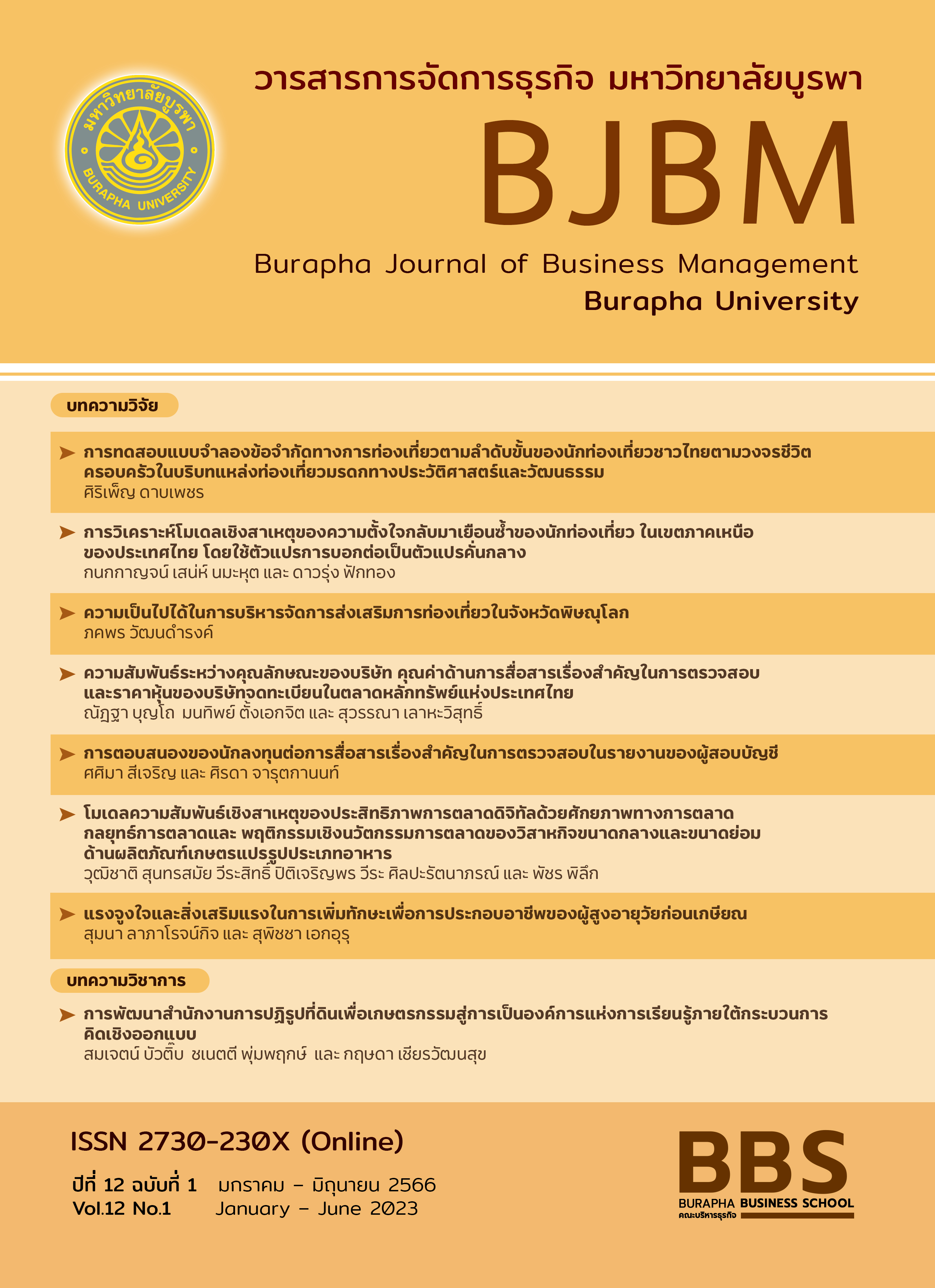
Main Article Content
Abstract
The objective of this research is to study the communication of and the investors’ reaction to key audit matters in auditor' s reports including both the number and presentation format of key audit matters. The samples used in the research are listed companies on the Stock Exchange of Thailand and the Market for Alternative Investment during the period of year 2016 - 2019. The research employs multiple regression analysis for hypothesis testing. The results show that most of key audit matters in the auditor’s reports of the samples are presented in descriptive format. An average of key audit matters in the auditor’s reports is 1.86. Most of the issue that is identified in the key audit matters is revenue recognition and asset impairment. The result does not find investor reaction to the number and presentation format of key audit matters. However, when the research takes type of stock exchange variable into the consideration, the result finds the investors negatively react to the number and presentation format of key audit matters in the auditor’s reports of the samples in the Market for Alternative Investment.
Article Details

This work is licensed under a Creative Commons Attribution-NonCommercial-NoDerivatives 4.0 International License.
The article to be published in the Burapha Journal of Business Management must not have been previously published in any journal and must not be under consideration by other journals. If copyright infringement is found, or the comments in the articles are contrary to ethics, it is deemed to be the opinion and direct responsibility of the article’s authors, not the opinion or responsibility of the Burapha Business School, Burapha University. Wanting to publicize any content in the Burapha Journal of Business Management, permission must be obtained from the editorial team of the Burapha Journal of Business Management according to the copyright laws.
References
ชาญชัย ตั้งเรือนรัตน์. (2552). การสื่อสารของรายงานของผู้สอบบัญชี: กรณีร่างรายงานของผู้สอบบัญชีแบบใหม่. วารสารวิชาชีพบัญชี, 13(8), 31-53.
ชาญชัย ตั้งเรือนรัตน์. (2560). การใช้รายงานของผู้สอบบัญชีแบบใหม่: ประสบการณ์ปีแรก. วารสารวิชาชีพบัญชี, 13(38), 5-21.
ศศิภา สอิ้งทอง. (2560). ประโยชน์ที่ได้รับจากการรายงานเรื่องสำคัญในการตรวจสอบในรายงานผู้สอบบัญชีของบริษัทที่จดทะเบียนในตลาดหลักทรัพย์แห่งประเทศไทย. งานค้นคว้าอิสระปริญญามหาบัณฑิต, สาขาการบัญชี, คณะพาณิชยศาสตร์และการบัญชี, มหาวิทยาลัยธรรมศาสตร์.
ศิลปพร ศรีจั่นเพชร. (2560). "เรื่องสำคัญในการตรวจสอบ" ในหน้ารายงานผู้สอบบัญชีกับการตอบสนองของตลาดหลักทรัพย์แห่งประเทศไทย. วารสารวิชาชีพบัญชี, 38(6), 22-37.
สภาวิชาชีพบัญชี ในพระบรมราชูปถัมภ์. (2559). มาตรฐานการสอบบัญชีฉบับที่ 701: การสื่อสารเรื่องสำคัญในการตรวจสอบในรายงานของผู้สอบบัญชีรับอนุญาต. กรุงเทพมหานคร: สภาวิชาชีพบัญชี ในพระบรมราชูปถัมภ์.
Altawalbeh, M. A. F., & Alhajaya, M. E. S. (2019). The investors reaction to the disclosure of key audit matters: Empirical evidence from Jordan. International Business Research, 12(3), 50-57.
Bae, K. H., & Jeong, S. W. (2007). The value-relevance of earnings and book value, ownership structure, and business group affiliation: Evidence from Korean Business Groups. Journal of Business Finance & Accounting, 34(5), 740-766.
Bamber, L. S., Barron, O. E., & Stevens, D. E. (2010). Trading volume around earnings announcements and other financial reports: Theory, research design, empirical evidence, and directions for future research. Contemporary Accounting Research, 28(2), 431–471.
Bédard, J., Gonthier-Besacier, N., & Schatt, A. (2018). Consequences of Expanded Audit Reports: Evidence from the Justifications of Assessments in France. A Journal of Practice & Theory, 38(3), 23-45.
Brimble, M., & Hodgson, A. (2007). On the intertemporal value relevance of conventional financial accounting in Australia. Accounting and Finance, 47(4), 599–622.
Boonyanet, W., & Promsen, W. (2019). Key Audit Matters: Just Little Informative Value to Investors in Emerging Markets? Chulalongkorn Business Review, 41(159), 153-183.
Christensen, B. E., Glover, S. M., & Wolfe, C. J. (2014). Do critical audit matter paragraphs in the audit report change nonprofessional investors' decision to invest? Auditing: A Journal of Practice & Theory, 33(4), 71-93.
Cordoş, G. S., & Fülöp, M. T. (2015). Understanding audit reporting changes: introduction of Key Audit Matters. Accounting and Management Information Systems, 14(1), 128-152.
Fakhfakh, M. (2015). The readability of international illustration of auditor's report: An advanced reflection on the compromise between normative principles and linguistic requirements. Journal of Economics, Finance and Administrative Science, 20(38), 21-29.
Gutierrez, E., Minutti-Meza, M., Tatum, K. W., & Vulcheva, M. (2018). Consequences of adopting an expanded auditor’s report in the United Kingdom. Review of Accounting Studies, 23(4), 1543-1587.
Hirst, D. E., & Hopkins, P. E. (1998). Comprehensive Income Reporting and Analysts’ Valuation Judgments. Journal of Accounting Research, 36, 47-75.
Kim, O., & Verrecchia, R. E. (1991).Trading volume and price reactions to public announcements. Journal of Accounting Research, 29(2), 302-321.
Lennox, C. S., Schmidt, J. J., & Thompson, A. M. (2022). Why are expanded audit reports not informative to investors? Evidence from the United Kingdom. Review of Accounting Studies, 2022, 1-36.
Pathirawasam, C. (2013). The Value Relevance of Earnings and Book Value: The Importance of Ownership Concentration and Firm Size. Journal of Competitiveness, 5(2), 98–107.
Rapley, E. T., Robertson, J. C., & Smith, J. L. (2018). The effects of disclosing critical audit matters and auditor tenure on investors’ judgments. Journal of Accounting and Public Policy, 40(1), 73 - 81.
Shrestha, N. (2020). Detecting Multicollinearity in Regression Analysis. American Journal of Applied Mathematics and Statistics, 8, 39–42.
Sirois, L. P., Bédard, J., & Bera, P. (2018). The informational value of key audit matters in the auditor's report: evidence from an eye-tracking study. Accounting Horizons, 32(12), 132-159.
