
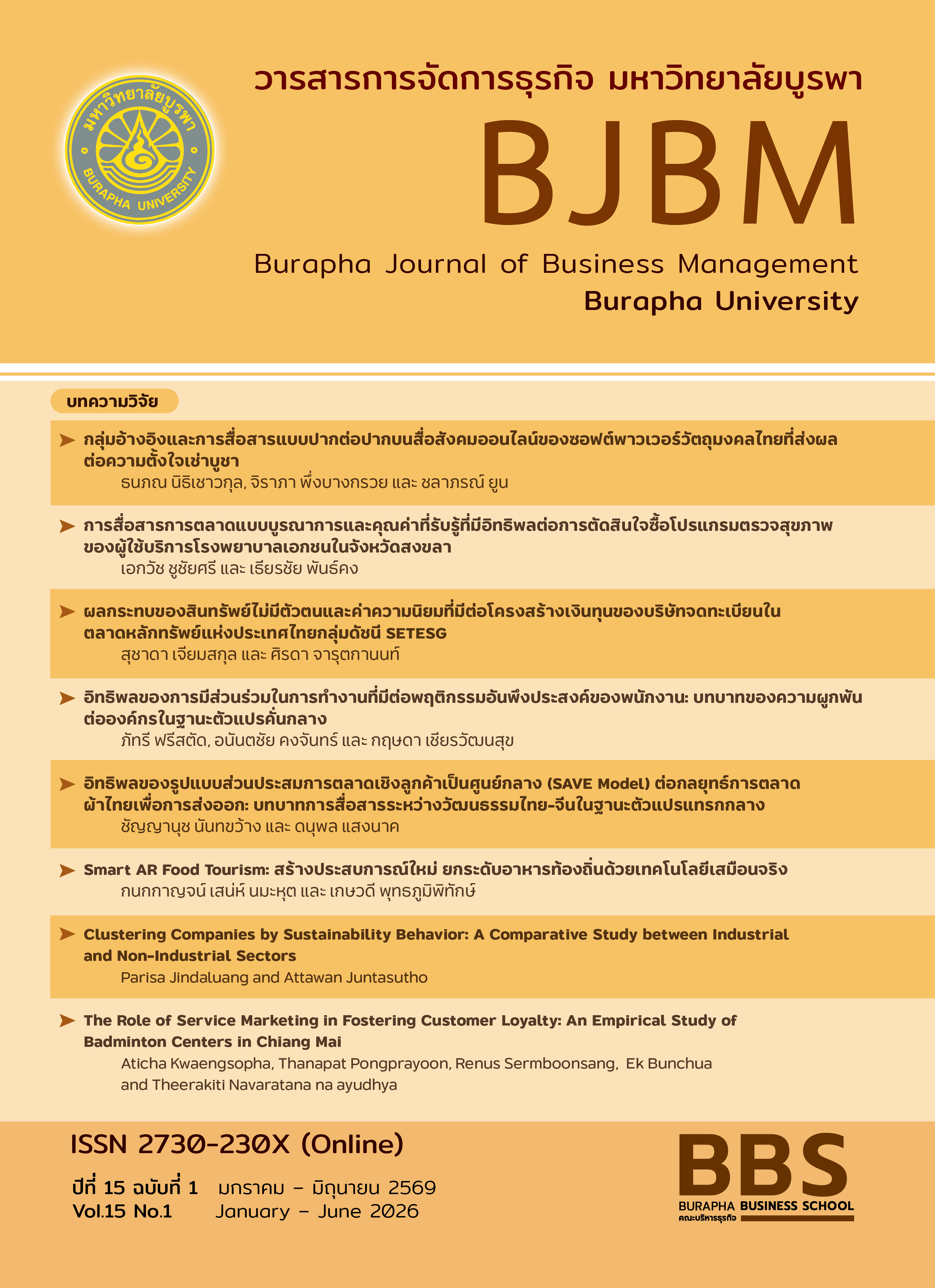
The Effect of Intangible Assets and Goodwill on Capital Structure of The Companies Listed on The Stock Exchange of Thailand in SETESG Index
Article Sidebar
Main Article Content
Abstract
The objective of this research is to study capital structure and the effect of intangible assets and goodwill on capital structure of listed companies on the Stock Exchange of Thailand in SETESG index. The study examines data from a sample group during year 2019 to 2023, totaling 457 samples. According to multiple regression analysis, the researchers find that total intangible assets and intangible assets excluding goodwill have a statistically significant positive association with the company's capital structure. However, the researchers do not find an association between the company's goodwill and capital structure.
This research supports Pecking Theory and Signaling Theory by demonstrating that intangible assets of companies listed in the SETESG index can be used as collateral assets, like tangible assets. Companies with a high proportion of intangible assets often select debt financing instead of shareholder funding, possibly due to lower costs and advantage from tax savings. Furthermore, companies with a high proportion of intangible assets use debt financing to signal the low risk of their intangible assets.
Article Details

This work is licensed under a Creative Commons Attribution-NonCommercial-NoDerivatives 4.0 International License.
The article to be published in the Burapha Journal of Business Management must not have been previously published in any journal and must not be under consideration by other journals. If copyright infringement is found, or the comments in the articles are contrary to ethics, it is deemed to be the opinion and direct responsibility of the article’s authors, not the opinion or responsibility of the Burapha Business School, Burapha University. Wanting to publicize any content in the Burapha Journal of Business Management, permission must be obtained from the editorial team of the Burapha Journal of Business Management according to the copyright laws.
References
Bangkokbiznews. (2023). Business mergers and acquisitions surge in 4 years, 137 cases, value exceeding 4 trillion baht. Retrieved August 4, 2024, from https://www.bangkokbiznews.com/ business/ economic/1093479.
Beatty, A., Weber, J., & Yu, J. J. (2008). Conservatism and debt. Journal of Accounting and Economics, 45(2–3), 154-174. https://doi.org/10.1016/j.jacceco.2008.04.005.
d'Arcy, A., & Tarca, A. (2018). Reviewing IFRS Goodwill Accounting Research: Implementation Effects and Cross-Country Differences," The International Journal of Accounting, Elsevier, 53(3), 203-226. https://doi.org/10.1016/j.intacc.2018.07.004.
Dudney, D; Haris, C., Li, Z., & Morillon, T. (2024). The impact of intangible assets on capital structure in Asia. Journal of Accounting and Finance, 24(2), 203-221. https://doi.org/ 10.33423/jaf.v24i2.7054.
Farooq, O. (2015). Effect of ownership concentration on capital structure: evidence from the MENA region. International Journal of Islamic and Middle Eastern Finance and Management, 8(1), 99-113. https://doi.org/10.1108/IMEFM-10-2013-0115.
Federation of Accounting Professions. (2023a). Thai Accounting Standard No.36 (Bounded
Federation of Accounting Professions. (2023b). Thai Accounting Standard No.38 (Bounded volume 2023) Intangible Assets. Federation of Accounting Professions.
Federation of Accounting Professions. (2023c). Thai Financial Reporting Standard No.3 (Bounded volume 2023) Business Combination. Federation of Accounting Professions.
Federation of Accounting Professions. (2023d). Thai Financial Reporting Standard No.10 (Bounded volume 2023) Consolidated Financial Statements. Federation of Accounting Professions.
Frankel, R., Seethamraju, C., & Zach, T. (2008). GAAP goodwill and debt contracting efficiency: Evidence from net worth covenants. Review of Accounting Studies, 13(1), 87–118. https://doi.org/10.1007/s11142-007-9045-0.
Garanina, T., & Pavlova, Y. (2011). Intangible assets and value creation of a company: Russian and UK evidence. Proceedings of the 3rd. European Conference on Intellectual Capital, 165-175.
Gil-Alana, L. A., Iniguez-Sanchez, R., & Lopez-Espinosa, G. (2011). Endogenous problems in cross-sectional valuation models based on accounting information. Rev Quant Finan Acc, 37(2), 245–265. https://doi.org/10.1007/s11156-010-0203-2.
Hang, M., Geyer-Klingeberg, J., Rathgeber, A. W., & Stöckl, S. (2018). Measurement matters- a meta study of the determinants of corporate capital structure. Quarterly Review of Economics and Finance, 68, 211-225. https://doi.org/10.1016/j.qref.2017.11.011.
Jangruxsakul, S., Witheeprai, W., Wirat, K., Chayapan, K., Thonghattha, T., & Petchchedchoo, P. (2021). Factors Affecting Capital Structure of Listed Companies in SET 100. Suthiparithat Journal, 35(1), 175-193
Jensen, M.C., & Meckling, W. H. (1976). Theory of the firm: managerial behavior, agency costs and ownership structure. Journal of Finance Economics, 3(4), 305-360.
Jonassen, C., & Cornéer, P. (2021). A quantitative study of how capital structure is affected by intangible assets - the case of Sweden. Thesis of master’s degree, Gothenburg University.
Kannika, W., & Banchuenvijit, W. (2019). Factors Which Affect the Capital Structures of Lised Companies in SET CLMV. Interdisciplinary Social Sciences and Communication Journal, 2(3), 207-221.
Kraus, A., & Litzenberger, R. H. (1973). A state-preference model of optimal financial leverage. The Journal of Finance, 28(4), 911-922. https://doi.org/10.2307/2978343.
Lee, M. Y. (2016). On the Durbin-Watson statistic based on a Z-test in large samples. International Journal of Computational Economics and Econometrics, 6(1),114-121. https://doi.org/10.1504/IJCEE.2016.073370.
Lev, B., Radhakrishnan, S., & Zhang, W. (2009). Organization capital. Abacus, 45(3), 275–298. https://doi.org/10.1111/j.1467-6281.2009.00289.
Lim, S. V., Macias, A. J., & Moeller, T. (2020). Intangible assets and capital structure. Journal of Banking & Finance, 118(c), 1-24. https://doi.org/10.1016/j.jbankfin.2020.105873.
Mohanlingam S., Nguyen, L.T.P, & Mom, R. (2021). The effects of intangible assets on financial performance and financial policies of listed technology firms in Thailand. Apheit International Journal, 10(1), 1-17.
Myers, S. C. (1984). The capital structure puzzle. Journal of Finance, 39(3), 575-592.
Noohuang, J., & Pongsupatt, A. (2021). Factors Affecting Capital Structure of Listed Companies in The Stock Exchange of Thailand 100 INDEX (SET 100). Journal of Buddhist and Education and Research, 7(3), 16-29.
Ocak, M., & Fındık, D. (2019). The impact of intangible assets and sub-components of intangible assets on sustain able growth and firm value: Evidence from Turkish listed firms. Sustainability, 11(19), 1-23. https://doi.org/10.3390/su11195359.
Peng, Y. T., Zeng, J. Y., & Chang, J. S. (2021). Exploring the relevance of intangible assets and capital structure. International Journal of Trade, Economics and Finance, 12(6), 144-148. https://doi.org/10.18178/ijtef.2021.12.5.709.
Qureshi, M. J., & Siddiqui, D. A. (2020). The Effect of Intangible Assets on Financial Performance, Financial Policies, and Market Value of Technology Firms: A Global Comparative Analysis. Asian Journal of Finance and Accounting, 12(1), 26-57. https://doi.org/10.5296/ajfa.v 12i1.16655.
Ratchapaetayakom, S., & Bangchokdee, S. (2020). Firm Characteristics Related to Capital Structure of CG Rating Companies in The Stock Exchange of Thailand. Srinakharinwirot Business Journal, 11(2), 112-129.
Ross, S.A. (1977). The determination of financial structure: the incentive-signaling approach. The Bell Journal of Economics, 8(1), 23-40. https://doi.org/10.2307/3003485.
Semsomboon, M. (2018). The Relationship between Goodwill from Business Combinations and Financial Ratios of the Group of Companies in Service Industry Listed on the Stock Exchange of Thailand. Kasem Bundit Journal, 18(3), 82-96.
Shrestha, N. (2020). Detecting Multicollinearity in Regression Analysis. American Journal of Applied Mathematics and Statistics, 8, 39–42. https://doi.org/10.12691/ajams-8-2-1.
Stewart, T. A. (1995). Trying to grasp the intangible. Fortune, 137(2), 157–161.
Thailand Development Research Institute. (2016). Can intellectual property be used as collateral for loans? Retrieved August 4, 2024, from https://tdri.or.th/2016/10/2016-09-01.
Thakur, O.A., Tunde, M.B., Noordin, B. A., Alam, M. K., & Prabowo, M. A. (2024). The relationship between goodwill and capital structure and the moderating effect of financial market development. Journal of Economics, Finance and Administrative Science. 29(57), 121-145. https://doi.org/10.1108/JEFAS-04-2022-0107.
Thessrimuang, S., & Kaewprapa, K. (2018). The Relationship between Intangible Assets and Abnormal Returns of Listed Companies in the Stock Exchange of Thailand. Journal of Accountancy and Management, 10(2), 179-188.
Van Ark, B., A., Hao, J., Corrado, C., & Hulten, C. (2009). Measuring intangible capital and its contribution to economic growth in Europe. European Investment Bank (EIB), 14(1), 62-93.
Waenkaeo, K., & Waroonkun, S. (2023). The Value Relevance of Intangible Asset on Stock Price of Listed Companies on The Stock Exchange of Thailand in Technology Industry. Journal of Humanities and Social Sciences Thonburi University, 17(3), 103-115.
Wongwean, A., & Mokkhavesa, B. (2021). Intangible Assets and Asset Management Efficiency That Affect Profitability of Listed Companies on the SET 100. Journal of Social Science for Local Rajabhat Mahasarakham University, 5(4), 235-244.
World Intellectual Property Organization. (2024). New WIPO Data Show Intangible Asset Investment Growing Fast, Spreading Globally. Retrieved August 4, 2024, from https://www.wipo.int/pressroom/en/articles/2024/article_0008.html.
Xu, X., Swatdikun, T., & Chen, X. (2024). The impact of intangible assets on capital structure: an empirical data of Thai listed companies. Science, Technology, and Social Sciences Procedia, 2024(5), 1-13.
