
Smart AR Food Tourism: Creating New Experiences, Elevating Local Cuisine through Augmented Reality
Article Sidebar
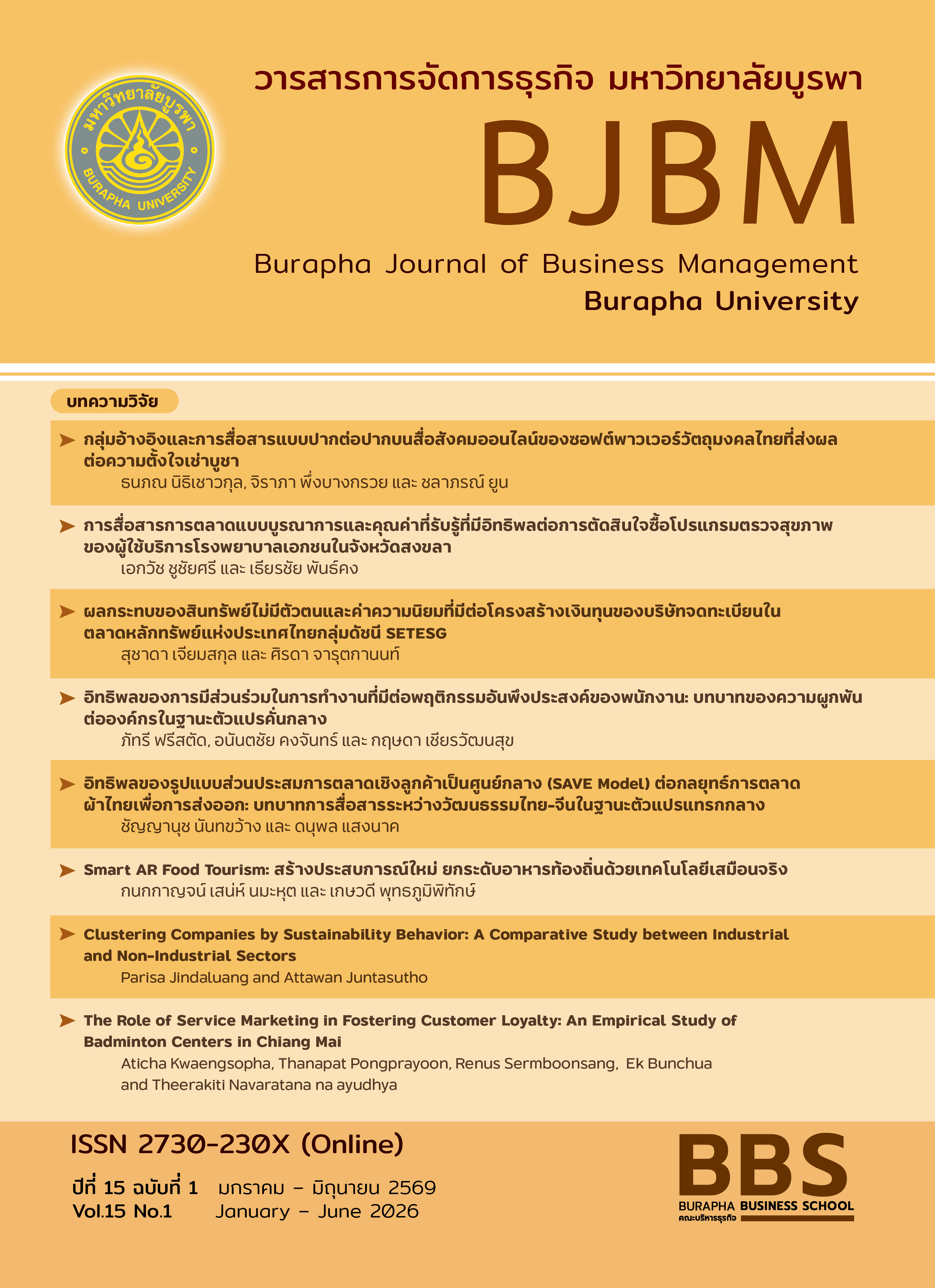
Main Article Content
Abstract
This study aims to develop the Smart AR Food Tourism platform by applying technology to promote gastronomy tourism in Phitsanulok, Thailand. The research involved creating 3D models of local food, along with historical and cultural narratives. A research and development approach was employed, including the design, development, and testing of a prototype AR application for smartphones, and Unity software. The sample consisted of 60 tourists visiting Phitsanulok, aged between 20 and 60, with prior experience using smartphones. Research instruments included a system performance evaluation for additional feedback. Quantitative data were analyzed using descriptive statistics.
The findings revealed that the Smart AR Food Tourism platform successfully displayed interactive 3D models of local dishes, allowing users to rotate, and scan QR codes to access multimedia content. Overall user satisfaction was rated at the “high” level ( = 4.47). Participants rated the system highly in terms of Usability ( = 4.60) and Content & Information ( = 4.55), highlighting the platform’s role in enhancing cultural understanding and motivating tourism experiences. Moreover, the overall system performance was rated at the “high” level ( = 4.43). Participants rated the Interactive Experience received the highest ( = 4.57) and System Functionality ( = 4.48). The study demonstrates that AR is a powerful innovation capable of transforming food consumption from a “taste-based experience” to an “immersive cultural experience.” The platform not only adds economic and cultural value to local communities but also serves as a prototype that can be expanded to other regions of Thailand in the future.
Article Details

This work is licensed under a Creative Commons Attribution-NonCommercial-NoDerivatives 4.0 International License.
The article to be published in the Burapha Journal of Business Management must not have been previously published in any journal and must not be under consideration by other journals. If copyright infringement is found, or the comments in the articles are contrary to ethics, it is deemed to be the opinion and direct responsibility of the article’s authors, not the opinion or responsibility of the Burapha Business School, Burapha University. Wanting to publicize any content in the Burapha Journal of Business Management, permission must be obtained from the editorial team of the Burapha Journal of Business Management according to the copyright laws.
References
Azuma, R. T. (1997). A survey of augmented reality. Presence: Teleoperators and Virtual Environments, 6(4), 355-385. https://doi.org/10.1162/pres.1997.6.4.355.
Billinghurst, M., Clark, A., & Lee, G. (2015). A survey of augmented reality. Foundations and Trends in Human–Computer Interaction, 8(2-3), 73-92. https://doi.org/10.1561/ 1100000049.
Björk, P., & Kauppinen-Räisänen, H. (2016). Local food: A source for destination attraction. International Journal of Contemporary Hospitality Management, 28(1), 177-194. https://doi.org/ 10.1108/IJCHM-05-2014-0214.
Chung, N., Han, H., & Joun, Y. (2015). Tourists’ intention to visit a destination: The role of augmented reality (AR) applications for heritage tourism. Computers in Human Behavior, 50, 588-599. https://doi.org/10.1016/j.chb.2015.02.068.
Davis, F. D. (1989). Perceived usefulness, perceived ease of use, and user acceptance of information technology. MIS Quarterly, 13(3), 319–340. https://doi.org/10.2307/249008.
Dieck, M. C. T., & Jung, T. H. (2018). A theoretical model of mobile augmented reality acceptance in urban heritage tourism. Current Issues in Tourism, 21(2), 154-174. https:// doi.org/10.1080/ 13683500.2015.1070801.
Gretzel, U., Sigala, M., Xiang, Z., & Koo, C. (2015). Smart tourism: Foundations and developments. Electronic Markets, 25, 179-188. https://doi.org/10.1007/s12525-015-0196-8.
Hall, C. M., & Mitchell, R. (2005). Gastronomic tourism: Comparing food and wine tourism experiences. Niche Tourism, 73-88. https://doi.org/10.1016/B978-0-7506-6133-1.50014-7
Hjalager, A. M., & Richards, G. (2002). Tourism and gastronomy. Routledge.
Lee, H., Jung, T. H., tom Dieck, M. C., & Chung, N. (2020). Experiencing immersive virtual reality in museums. Information & management, 57(5), 103229. https://doi.org/10.1016/ j.im.2019. 103229.
Okumus, B. (2021). Food tourism research: A perspective article. Tourism Review, 76(1), 38-42. https://doi.org/10.1108/TR-11-2019-0450.
Okumus, B., Dedeoğlu, BB, & Shi F. (2021). Gender and generation as antecedents of food neophobia and food neophilia. Tourism Management Perspectives, 37(2), 100773. https://doi.org/10.1016/ j.tmp.2020.100773.
Pine, B. J., & Gilmore, J. H. (1999). The experience economy: Work is theatre & every business a stage. Harvard Business Press.
Selener, D. (1998). Participatory action research and social change. Cornell Participatory Action Research Network.
Srisa-ard, B. (2013). Introduction to Research (9th ed.). Suwiriyasarn.
tom Dieck, M. C., & Jung, T. H. (2018). A theoretical model of mobile augmented reality acceptance in urban heritage tourism. Current Issues in Tourism, 21(2), 154-174. https://doi.org/10.1080/13683500.2015.1070801
Tourism Authority of Thailand. (2023). Amazing Thailand Culinary City: Sustainable gastronomy tourism initiative. TAT.
UNWTO. (2021). Guidelines for the development of gastronomy tourism. United Nations World Tourism.
UNWTO. (2022). Gastronomy tourism: Guidelines for development. United Nations World Tourism.
Venkatesh, V., & Davis, F. D. (2000). A theoretical extension of the Technology Acceptance Model: Four longitudinal field studies.
Management Science, 46(2), 186-204. https://doi.org/ 10.1287/mnsc.46.2.186.11926.
Yovcheva, Z., Buhalis, D., & Gatzidis, C. (2013). Engineering augmented tourism experiences. Tourism Management, 37, 147-161. https://doi.org/10.1007/978-3-642-36309-2_3.
