
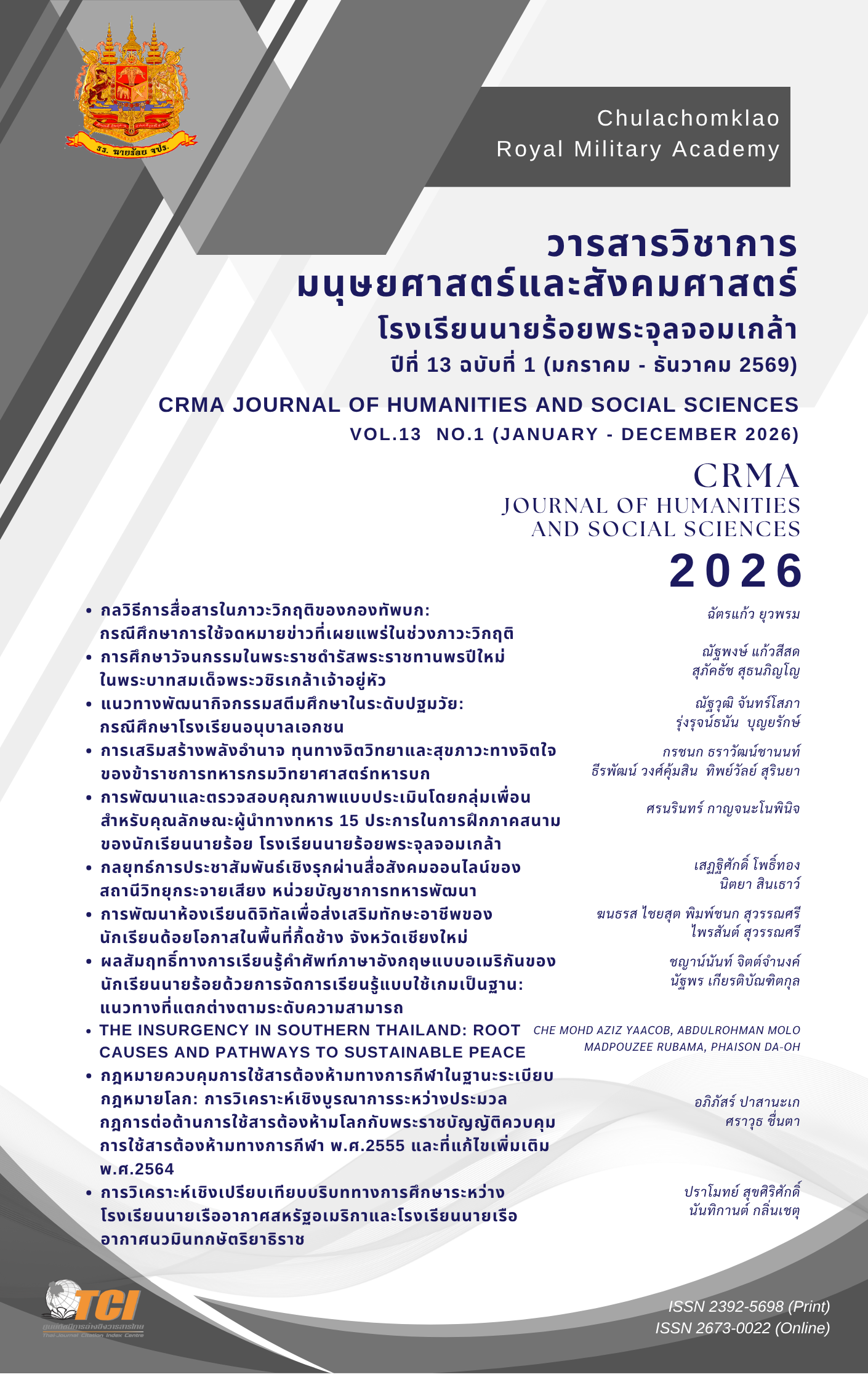
การเสริมสร้างพลังอำนาจ ทุนทางจิตวิทยาและสุขภาวะทางจิตใจของข้าราชการทหารกรมวิทยาศาสตร์ทหารบก
คำสำคัญ:
การเสริมสร้างพลังอำนาจ, ทุนทางจิตวิทยา , สุขภาวะทางจิตใจ , ข้าราชการทหารบทคัดย่อ
การศึกษาวิจัยครั้งนี้มีวัตถุประสงค์เพื่อ 1) ศึกษาระดับการเสริมสร้างพลังอำนาจ ระดับทุนทางจิตวิทยาและระดับสุขภาวะทางจิตใจของข้าราชการทหาร 2) เปรียบเทียบสุขภาวะทางจิตใจของข้าราชการทหารตามปัจจัยส่วนบุคคล 3) ศึกษาความสัมพันธ์ของการเสริมสร้างพลังอำนาจกับสุขภาวะทางจิตใจของข้าราชการทหาร และ 4) ศึกษาความสัมพันธ์ของทุนทางจิตวิทยากับสุขภาวะทางจิตใจของข้าราชการทหาร กลุ่มตัวอย่างที่ใช้ในการวิจัยครั้งนี้ คือ ข้าราชการทหารที่ปฏิบัติหน้าที่ประจำกรม วิทยาศาสตร์ทหารบก จำนวน 169 คน ได้จากวิธีการสุ่มตัวอย่างแบบแบ่งชั้นภูมิ เก็บรวบรวมข้อมูลโดยใช้แบบสอบถามที่มีค่า IOC อยู่ระหว่าง .67 – 1.00 และมีค่าความเชื่อมั่นทั้งฉบับเท่ากับ .956 และทำการวิเคราะห์ข้อมูลโดยใช้โปรแกรมสำเร็จรูปทางสถิติ สถิติที่ใช้ในการวิเคราะห์ข้อมูล ได้แก่ ร้อยละ ค่าเฉลี่ย ส่วนเบี่ยงเบนมาตรฐาน การทดสอบค่า t-test การทดสอบค่า F-test เปรียบเทียบค่าเฉลี่ยรายคู่โดย LSD และค่าสัมประสิทธิ์สหสัมพันธ์เพียร์สัน ผลการวิจัยพบว่า 1) การเสริมสร้างพลังอำนาจ ทุนทางจิตวิทยา และสุขภาวะทางจิตใจของข้าราชการทหารอยู่ในระดับสูง 2) ข้าราชการทหารที่มีเพศ อายุ ระดับการศึกษา สถานภาพสมรส อายุราชการ ระดับชั้นยศ รายได้ และหน่วยปฏิบัติงาน แตกต่างกัน มีสุขภาวะทางจิตใจไม่แตกต่างกัน 3) การเสริมสร้างพลังอำนาจมีความสัมพันธ์ทางบวกกับสุขภาวะทางจิตใจของข้าราชการทหารอย่างมีนัยสำคัญทางสถิติที่ระดับ .01 และ 4) ทุนทางจิตวิทยามีความสัมพันธ์ทางบวกกับสุขภาวะทางจิตใจของข้าราชการทหารอย่างมีนัยสำคัญทางสถิติที่ระดับ .01
เอกสารอ้างอิง
กรมวิทยาศาสตร์ทหารบก. (2559). แผนปฏิบัติราชการ 4 ปี กรมวิทยาศาสตร์ทหารบก พ.ศ. 2559-2562.
กองทัพบก. (2567). สมุดปกขาว กองทัพบก พ.ศ. 2567. กระทรวงกลาโหม.
ทองแดง อาฒยะพันธ์. (2564). การพัฒนามาตรการลดการสูญเสียกำลังพลกองทัพบกจากอัตวินิบาตกรรม [เอกสารวิจัยส่วนบุคคล, วิทยาลัยการทัพบก]. https://www.awc.ac.th/storage/research/604.pdf
ภัทราภรณ์ ผ่องแผ้ว และ ชนิดา จิตตรุทธะ. (2565). ความสัมพันธ์ระหว่างทุนทางจิตวิทยาเชิงบวกและพฤติกรรมสร้างสรรค์ นวัตกรรมของข้าราชการศูนย์รักษาความปลอดภัย กองบัญชาการกองทัพไทย. วารสารสมาคมนักวิจัย, 28(1), 54–71. https://so04.tci-thaijo.org/index.php/jar/article/view/260759
มัทนพร จิตรภักดี. (2564). ทุนทางจิตวิทยา ภาวะผู้นำแบบผู้รับใช้ ความสมดุลระหว่างชีวิตและการทำงาน และความยึดมั่น ผูกพันในงานของเจ้าหน้าที่ตำรวจตำแหน่งรองสารวัตรในพื้นที่สามจังหวัดชายแดนภาคใต้ [วิทยานิพนธ์มหาบัณฑิต, มหาวิทยาลัยเกษตรศาสตร์]. https://he01.tci-thaijo.org/index.php/policenurse/article/view/245614/169323
รัฐธรรมนูญแห่งราชอาณาจักรไทย พุทธศักราช 2560. ราชกิจจานุเบกษา. เล่มที่ 134 ตอนที่ 40 ก. หน้า 1-90.
Best, J. W. (1977). Research in education (3rd ed.). Prentice-Hall.
Breeding, R. R. (2008). Empowerment as a function of contextual self-understanding. Rehabilitation Counselling Bulletin, 51(2), 96–106. https://doi.org/10.1177/0034355207311346
Conger, J. A., & Kanungo, R. N. (1988). The empowerment process: Integrating theory and practice. Academy of Management Review, 13(3), 471–482. https://doi.org/10.5465/amr.1988.4306983
Diener, E. (2000). Subjective well-being: The science of happiness and proposal for a national index. American Psychologist, 55(1), 34–43. https://doi.org/10.1037/0003-066X.55.1.34
Huppert, F. A. (2009). Psychological well-being: Evidence regarding its causes and consequences. Applied Psychology: Health and Well-Being, 1(2), 137–164. https://doi.org/10.1111/j.1758-0854.2009.01008.x
Kanter, R. M. (1977). Men and women of the corporation. Basic Books.
King, R. B., & Caleon, I. S. (2021). School psychological capital: Instrument development, validation, and prediction. Child Indicators Research, 14(1), 341–367. https://doi.org/10.1007/s12187-020-09757-1
Luthans, F., Vogelgesang, G. R., & Lester, P. B. (2006). Developing the psychological capital of resiliency. Human Resource Development Review, 5(1), 25–44. https://doi.org/10.1177/1534484305285335
Luthans, F., Youssef, C. M., & Avolio, B. J. (2007). Psychological capital: Developing the human competitive edge. Oxford University Press. https://doi.org/10.1093/acprof:oso/9780195187526.001.0001
Ryff, C. D. (1989). Happiness is everything, or is it? Explorations on the meaning of psychological well-being. Journal of Personality and Social Psychology, 57(6), 1069–1081. https://doi.org/10.1037/0022-3514.57.6.1069
Yamane, T. (1967). Statistics: An introductory analysis (2nd ed.). Harper & Row.
ดาวน์โหลด
เผยแพร่แล้ว
รูปแบบการอ้างอิง
ฉบับ
ประเภทบทความ
หมวดหมู่
สัญญาอนุญาต
ลิขสิทธิ์ (c) 2026 วารสารวิชาการมนุษยศาสตร์และสังคมศาสตร์ โรงเรียนนายร้อยพระจุลจอมเกล้า

อนุญาตภายใต้เงื่อนไข Creative Commons Attribution-NonCommercial-NoDerivatives 4.0 International License.
เนื้อหาและข้อมูลที่ตีพิมพ์ในวารสารนี้ถือเป็นข้อคิดเห็นและความรับผิดชอบของผู้เขียนบทความโดยตรงกองบรรณาธิการวารสารไม่จำเป็นต้องเห็นด้วยหรือร่วมรับผิดชอบในทุกกรณี
บทความและข้อมูลที่ได้รับการตีพิมพ์ในวารสารนี้ถือเป็นลิขสิทธิ์ของวารสารผู้ใดต้องการตีพิมพ์ซ้ำต้องได้รับอนุญาตจากบรรณาธิการวารสารก่อนเท่านั้น และบทความที่ได้รับการตอบรับเพื่อตีพิมพ์ในวารสารนี้จะต้องไม่ปรากฎในสิ่งพิมพ์อื่นใดมาก่อนที่จะปรากฎในวารสารนี้ กองบรรณาธิการจะส่งวารสารที่มีบทความของผู้เขียนตีพิมพ์ให้แก่ผู้เขียนจำนวน 1 ฉบับ